Wells Fargo Autograph vs Sapphire Reserve for Dining: Same 3x, $795 Apart
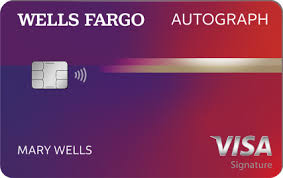
The Wells Fargo Autograph has no annual fee. The Chase Sapphire Reserve charges $795. Both earn 3x points at restaurants, and both pay 1 cent per point when you redeem for cash, so each returns 3% on dining.
That makes the answer short. Don't get the Reserve for dining. If you value both banks' points the same, no amount of restaurant spending recovers the fee. If you already carry the Reserve for travel, it wins two kinds of restaurant purchase, Exclusive Tables restaurants and delivery apps, and ties the Autograph on the rest.
See which card wins on your dining spend →

The side-by-side
| Wells Fargo Autograph | Chase Sapphire Reserve | |
|---|---|---|
| Annual fee | $0 | $795 |
| Dining earn | 3x | 3x |
| Cash value per point | 1 cent | 1 cent |
| Delivery apps | May not earn 3x | 3x if coded as a restaurant |
| Dining credits | None | $300 Exclusive Tables, $15/mo DoorDash |
| Transfer partners | 10 | 14 |
| Foreign transaction fee | None | None |
Neither card publishes a cap on its dining rate.
Same 3x, same 1-cent floor
Before its 2025 refresh, Chase Travel redeemed Reserve points at 1.5 cents, which made 3x on dining worth 4.5%. New points no longer get that rate. Chase Travel now pays 1 cent per point, and Points Boost offers pay "up to 2x" on select hotels and flights that Chase rotates periodically.
Some older points keep the old rate. Chase's wording: "Points earned prior to October 26, 2025, by Sapphire Reserve cardmembers who applied prior to June 23, 2025, can be redeemed at 1.5x on Chase Travel until October 26, 2027." Points you earn at dinner this month don't qualify.
The Autograph's points can also be worth more than a penny. The no-fee card can transfer to Wells Fargo's airline and hotel partners, just like the Autograph Journey. Wells Fargo's card page says you can "transfer your rewards points directly to select travel loyalty programs, in any amount." Transfers are final.
Where "dining" differs
Both banks pay 3x based on how the merchant codes its business, and the two definitions differ at the edges.
Wells Fargo pays 3x at merchants whose Visa code is "eating places and restaurants, drinking places, fast food restaurants, and/or caterers." Its terms then list purchases that "may not earn bonus Points," including bakeries, grocery stores with restaurants on site, and third-party delivery services.
Chase counts "takeout and eligible delivery services" toward 3x dining. Bakeries and caterers earn 3x only if they code as restaurants. Food bought at stadiums, casinos, theme parks or grocery stores may not count.
If you order through delivery apps often, this decides the card for those orders: use the Chase card. Coding varies by platform and by restaurant, so check the category on your statement after a small order. The best dining cards guide covers how the major delivery apps tend to code.
What the Reserve adds at restaurants
The Reserve carries up to $300 a year in statement credits at Sapphire Reserve Exclusive Tables restaurants. It splits into $150 for January through June and $150 for July through December, and an unused half does not roll over. Any meal at a listed restaurant paid with the Reserve qualifies, with or without an OpenTable booking.
Delivery and takeout don't count toward the credit. Neither do payments through digital wallets or third-party payment accounts, or a charge on a mobile card reader at the table. The list runs to roughly 400 restaurants, mostly in large metros, and Chase adds and drops restaurants without notice. The Exclusive Tables guide covers how to use each half without losing it.
Chase also changed the DoorDash benefit on October 1, 2026. Reserve cardholders with DashPass get a $15 monthly promo on any DoorDash order, plus two $10 monthly promos for groceries and other non-restaurant orders. Only the $15 promo can go toward restaurant food, which caps its dining value at $180 a year.
Our credit capture index values the Exclusive Tables credit at 40% of face, or about $120 a year for a typical cardholder. If you already eat at listed restaurants twice a year, your number is closer to $300.
Can dining alone pay for the $795 fee?
Suppose dining is the only reason you would get the Reserve. Its advantage over the Autograph is:
Here is your annual dining spend, and are what one Chase and one Wells Fargo point are worth to you in cents, and is the dining-credit value you would actually collect. When both points are worth the same, the first term is zero and your spending drops out.
| Point values (Chase / Wells) | Credits counted | Reserve vs Autograph at $10,000 dining | Break-even dining spend |
|---|---|---|---|
| Equal | $120 (40% index) | −$675 | Never |
| Equal | $300 (full Exclusive Tables) | −$495 | Never |
| Equal | $480 (plus $15/mo DoorDash) | −$315 | Never |
| 1.5¢ / 1¢ | $120 | −$525 | $45,000/yr |
| 1.5¢ / 1¢ | $300 | −$345 | $33,000/yr |
At equal point values the Reserve stays behind at every spending level, even with every dining credit counted at full value. Restaurant spending closes the gap only if a Chase point is worth more to you than a Wells Fargo point. Value Chase points at 1.5 cents and cash out Wells Fargo points at 1 cent, and you would need $33,000 a year at restaurants ($2,750 a month) with the full $300 credit.
That scenario is lopsided. It gives Chase points a transfer value and Wells Fargo points a cash value, but the Autograph transfers too. CardSavvy's default values both currencies at 1.5 cents, which puts you back in the equal-value rows.
For scale, $10,000 a year at restaurants earns 30,000 points on either card: $300 in cash, or $450 at 1.5 cents. The table leaves out welcome bonuses and assumes you pay in full each month, since interest at a typical card APR would erase any of these gaps.
Run the Reserve's full numbers, including its travel credits →
If you already have both cards
Once you hold the Reserve for its travel benefits, the fee is already paid. Each restaurant charge becomes a smaller question: which card returns more on this purchase?
Quick Decision Guide
- At an Exclusive Tables restaurant with credit left this half: use the Reserve. The statement credit is worth more than any points difference.
- Ordering through a delivery app: use the Reserve. The Autograph may pay 1x, and the $15 monthly DoorDash promo comes with the Reserve.
- Anywhere else, if you redeem for cash: either card. Both return 3%.
- Anywhere else, if you transfer: the card whose partners you book. A larger balance in one program you use is easier to spend well than two small ones.
- Topping off an award at a shared airline partner: Wells Fargo transfers in any amount, while Chase transfers in 1,000-point blocks. A small Autograph balance can fill the gap exactly.
The cheaper Chase option: Freedom Unlimited

The Reserve isn't the only way to earn 3x Chase points on dining. The no-fee Chase Freedom Unlimited earns 3% on dining, "including takeout and eligible delivery services." On its own its points redeem at 1 cent.
To transfer Freedom Unlimited points, you combine them into a Sapphire or Ink card account, and the transfer ratio follows that card. Through the Reserve, World of Hyatt is 1:1. Through the $95 Sapphire Preferred it has been 4:3 since October 1, 2026, so 1,000 Chase points become 750 Hyatt points.
For a Chase-loyal diner, the realistic options are the Freedom Unlimited alone, the Freedom Unlimited paired with a Sapphire Preferred, or the Reserve held for reasons beyond dining. The Autograph sits outside that system. In a Chase wallet, its case rests on its other 3x categories (gas and EV charging, transit, streaming, phone plans) and on partners Chase doesn't offer. The trifecta breakdown shows how these cards pair.
Where each currency goes
| Wells Fargo | Chase | |
|---|---|---|
| Shared airlines (1:1 at both) | Aer Lingus, Flying Blue, British Airways, Iberia, JetBlue, Virgin Atlantic | Same six |
| Wyndham | 1:2 | 1:1 |
| Other airlines | Avianca LifeMiles, Cathay Pacific | Aeroplan, Singapore, Southwest, United |
| Other hotels | Choice (1:2) | Hyatt, IHG, Marriott |
Six airline partners overlap at the same ratio, so for a Flying Blue or Avios booking the two currencies are interchangeable and can land in the same airline account. Chase's exclusive partners matter most to US-based travelers who fly United or Southwest or stay at Hyatt. Wells Fargo's exclusives are Avianca LifeMiles (Star Alliance) and Cathay Pacific (Oneworld), plus a better Wyndham ratio.
Wells Fargo also narrowed its program in 2026. Since September 25, you can no longer give points to another Wells Fargo cardholder, and points on your own Wells Fargo cards no longer combine automatically, though you can still combine them by hand. For what Chase points are worth by redemption type, see how much Chase points are worth and the Chase transfer partner guide.
Compare both cards against your own spending →
Bottom line
If you are choosing a dining card, get the Autograph. It matches the Reserve's 3x and 1-cent cash value with no fee. Dining credits can't close a $795 gap when both currencies are worth the same to you.
If you already hold the Reserve for travel, use it where it wins: Exclusive Tables restaurants while credit remains, and delivery apps. For other meals, either card returns 3% in cash, so pick the currency you redeem.
If dining is your main reason for keeping the Reserve, compare it with the $95 Sapphire Preferred, which also earns 3x. Our Reserve vs Preferred dining comparison runs that math. If your Autograph arrived as a converted Bilt card, the Autograph transition guide covers setup.
Card terms verified October 31, 2026 against Wells Fargo and Chase product pages, the Autograph terms effective December 30, 2025, and Chase's June 2025 and June 2026 announcements. Benefits change; confirm current terms before applying.
Cards Mentioned in This Article
Click any card above to see if it's worth adding to your wallet — personalized verdict in 30 seconds.
Related on Learn
Hand-picked based on topic and reader interest
Chase Sapphire Reserve Grandfathered Points: What Keeps 1.5x Until October 2027
Older Sapphire Reserve points still redeem at 1.5 cents in Chase Travel until October 26, 2027. Who qualifies, why a transfer can use them up, what they add over cash, and whether they justify another $795 renewal.
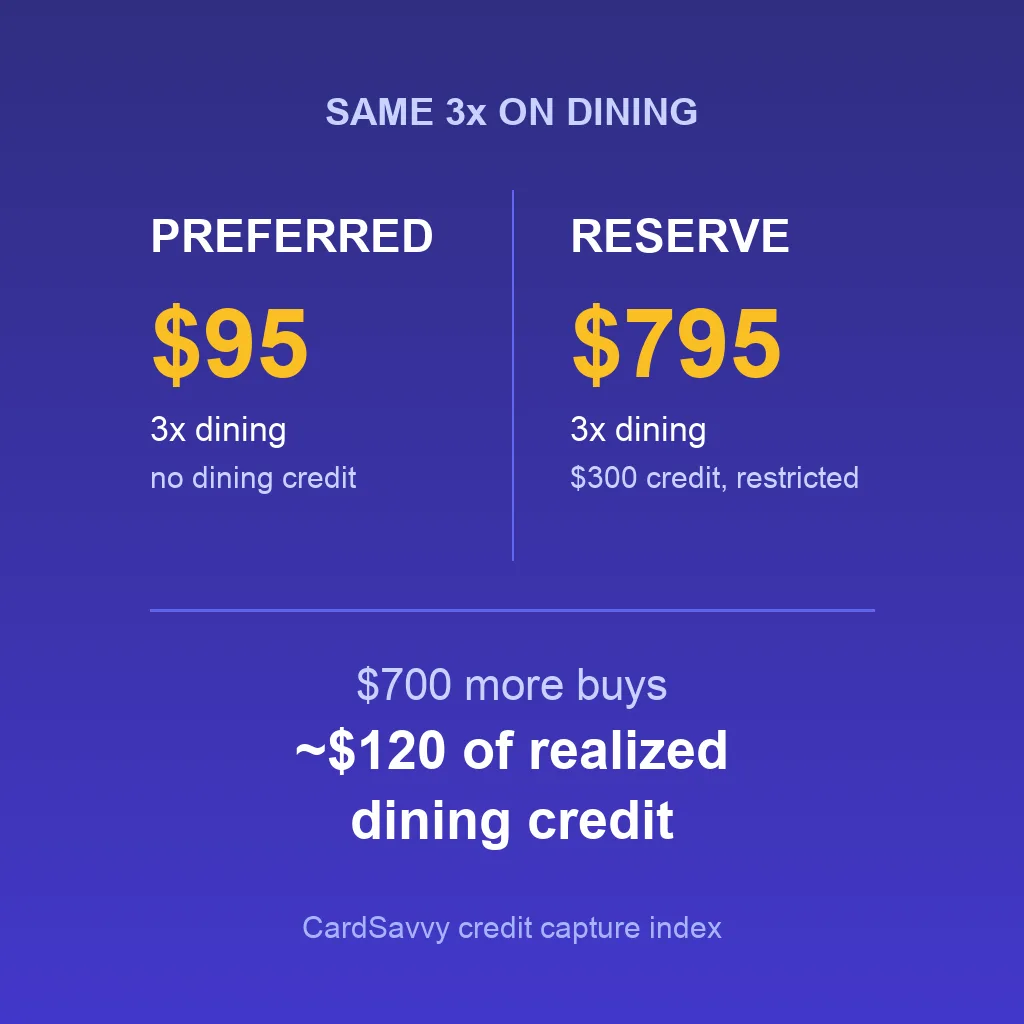
Sapphire Reserve vs Preferred for Dining: Is $700 More Worth It?
The $795 Sapphire Reserve and the $95 Sapphire Preferred earn the same 3x on dining. The Reserve's entire dining premium is one restricted credit, and our capture index values it near $120. Here is when that still makes sense.

Chase Says the Sapphire Reserve Is Worth $5,500+. Here Is the Real Math.
Chase claims $5,500+ in first-year value for the Sapphire Reserve. We break down every credit line by line to show what most cardholders actually get.
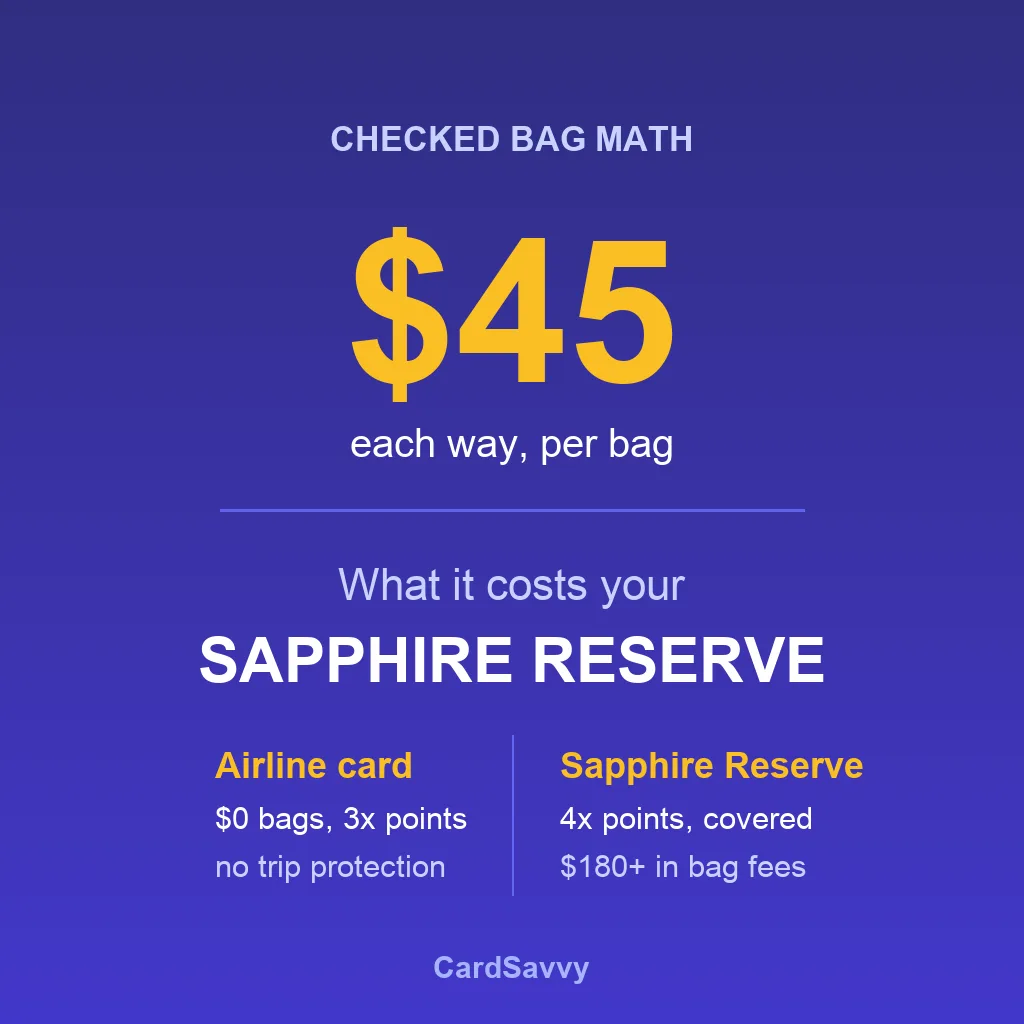
Airline Card vs Sapphire Reserve: What Checking Bags Costs You in 2026
Checked bags now cost $45 each way, and the waiver requires buying the ticket with the airline card. That decision quietly moves your airfare off the Sapphire Reserve, taking the 4x category and the trip protections with it. Here is what that is worth.
Get smarter with your cards
Math-first card strategy posts, sent when we publish — not on a schedule. No spam. Unsubscribe anytime.
We respect your inbox.
Ready to optimize your wallet?
Get personalized card recommendations and spending strategies in under 2 minutes.
Free to use. No signup required.
Get My Strategy →Just need an answer for one purchase? Best Card →