Airline Card vs Sapphire Reserve: What Checking Bags Costs You in 2026
Checked bags cost about $45 each way on most major carriers now, and the waiver that makes them free almost always requires buying the ticket with that airline's own credit card. For a family, that rule quietly settles a question most premium-card analysis never asks: your airfare stops going on the Chase Sapphire Reserve.
That matters more than the lost points. It also moves your trip insurance.
Run your own Reserve numbers →
The bag fee decision is not close
Alaska charges $45 for a first checked bag and $55 for a second, each way on North American itineraries, for flights booked on or after April 10, 2026. The $95 Atmos Rewards Ascent waives the first bag for the cardholder and up to six guests on the same reservation. Alaska's terms are explicit about the condition: "Airfare must be purchased with your card to qualify for this benefit."
| Bags checked | One round trip | Two trips a year |
|---|---|---|
| 1 bag | $90 | $180 |
| 2 bags | $180 | $360 |
| 3 bags | $270 | $540 |
| 4 bags | $360 | $720 |
One checked bag on one round trip nearly covers the card's annual fee. A family checking three bags clears it almost three times over on a single vacation.
Against that, buying the same ticket on the Sapphire Reserve earns 4x Ultimate Rewards instead of 3x Atmos points. On a $1,200 fare that difference is roughly 1,200 points. There is no points valuation that turns 1,200 points into $180, let alone $360.
So buy the ticket with the airline card. The rest of this post is about what that costs you, because the answer is not zero.
Three limits are worth knowing before you count on the waiver. A cardholder has to be traveling on the reservation, so buying tickets for family you are not joining does not work. The flight has to be marketed and operated by Alaska, Hawaiian, Horizon, or SkyWest, so a connection onto a oneworld partner pays that airline's standard fee. And the benefit cannot be stacked with a free-bag allowance you already have from status.
For the per-carrier version of this table, including which cards cover how many people on the reservation, see which bag-fee card actually pays for itself. The bag fee calculator runs it for your own itinerary.

What moves off the Reserve along with the fare
Two things leave, and only one of them is points.
The 4x category. The Reserve earns 4x on flights booked directly with the airline. On the trips where you check bags, that category now earns nothing, because you are not using the card. If checked-bag trips are most of your family flying, a large share of the 4x airfare category you were counting on when you justified the annual fee does not exist.
The travel protections. This is the part that surprises people. The Sapphire Reserve Guide to Benefits, in the version Chase currently publishes (effective 10/01/24), sets the eligibility bar this way for trip delay, baggage delay, and lost luggage:
"The Covered Traveler is covered when You charge all or a portion of the cost of the Common Carrier fare to Your Covered Card and/or use redeemable Rewards."
Read that carefully, because it cuts both ways. You do not need the whole fare on the Reserve. A portion counts, and paying with Chase points counts. But if the entire ticket goes on the Atmos card, no portion was charged to the Reserve, and the protections do not attach to that trip.
The practical loss is specific: trip delay coverage of $500 per traveler after a delay over 6 hours, baggage delay of $100 a day for up to 5 days after 6 hours, and lost luggage up to $3,000 per traveler. Those are exactly the protections a family checking four bags would most want, and they are the ones the bag-fee waiver pushes you to give up.
Whether you can split payment between the two cards, satisfying the airline's purchase requirement while putting a portion on the Reserve, depends on the airline's tender rules and on how it reads its own benefit terms. Confirm it with the airline before relying on it. Do not assume it works.
One benefit works differently and is worth knowing: primary rental car coverage requires you to "use a Covered Card Account and/or redeemable Rewards, to initiate and complete the entire Rental Vehicle transaction." Partial payment is not enough there.
The $300 travel credit is not a baggage benefit
A common response is that the Reserve's $300 travel credit reimburses bag fees anyway, so the waiver does not matter.
Chase does not document this. Its rewards category FAQ lists airlines as an included travel merchant and specifically excludes "in-flight goods and services," and it says nothing about checked-bag fees in either direction. In practice a bag fee paid to the airline usually posts under the airline's merchant code and triggers the credit. That is a reasonable expectation, not a published benefit.
Even when it works, it does not help. The $300 is a finite bucket, and most Reserve holders exhaust it every year on airfare, hotels, parking, and transit without trying. Compare the two paths:
- Pay $45 for the bag and let the credit reimburse it. You have $255 of credit left.
- Use the airline card, pay $0, and spend that $45 of credit on something else. You have $300 of credit left.
The second path leaves you $45 better off. A credit you were going to spend anyway cannot also be counted as covering a cost you could have avoided entirely.
What is left to justify the fee
The Reserve costs $795, with a $300 travel credit that any traveler will use. That leaves about $495 a year to be covered by everything else.
Test it by asking what you would pay cash for. Our credit capture index haircuts each Reserve credit by how much of it a typical cardholder captures: the travel credit at 90%, the Lyft credit at 65%, The Edit hotel credit at 30%, StubHub at 25%, Peloton at 20%. A $500 hotel credit that sends you to a narrow list of properties with a two-night minimum is worth whatever it displaces from spending you would have done anyway.
Two 2026 details matter for this arithmetic. The Edit credit is now $500 per calendar year with a $250 maximum per transaction, not two fixed semiannual windows. And the $250 Chase Travel hotel credit expires December 31, 2026, so it should not factor into a decision about whether to hold this card permanently.
The redemption side also got harder. The flat 1.5 cents per point through Chase Travel is gone for newly earned points, replaced by a 1 cent baseline with Points Boost offers reaching up to 2 cents on selected hotels and flights. Chase describes those offers as promotional and subject to change. Points earned before October 26, 2025 on accounts opened before June 23, 2025 keep the old fixed rate into late October 2027. The simple version of the Reserve, where the portal was a guaranteed 1.5 cent floor, no longer exists.
Alaska does not close the gap either. Atmos Rewards is not one of Chase's 14 transfer partners, so the two currencies never combine.
The clearest recent point in the Reserve's favor: on August 15, 2026, Chase Sapphire Lounges left the Priority Pass network, which means fewer non-cardholders competing for the same seats. Reserve cardholders keep unlimited access with two guests, and the access window on connecting itineraries widened from 3 hours to 5. If you genuinely use lounges, they just got better.
See what the Reserve is worth on your spending →
What you actually give up by downgrading
Most people overestimate this, because the insurance gap between the Reserve and the $95 Sapphire Preferred is narrower than it looks.
| Protection | Reserve | Preferred |
|---|---|---|
| Trip cancellation / interruption | $10,000 per traveler | Same |
| Baggage delay | $100/day, 5 days | Same |
| Lost luggage | $3,000 per traveler | Same |
| Trip delay | After 6 hours | After 12 hours |
| Rental car | Primary, $75,000 | Primary, $60,000 |
| Emergency medical | $2,500 | Not included |
Both cards carry primary rental coverage, and the cancellation, baggage delay, and lost luggage caps are identical. The Reserve's real premium is the 6-hour delay threshold, the higher rental cap, and emergency medical and evacuation coverage.
The more expensive part of downgrading is elsewhere. Chase refreshed the Preferred on June 15, 2026, and its World of Hyatt transfer rate drops to 4:3 for existing cardholders on October 1, 2026. The Reserve keeps 1:1. If Hyatt transfers are how you redeem, that is a real cost and it lands in about six weeks.
The verdict
Most families who check bags should pair the airline card with the Sapphire Preferred, not the Reserve. You keep the Ultimate Rewards ecosystem, nearly all of the trip insurance, and primary rental coverage for $95 instead of $795, and the airline card handles the flights where bags are the dominant cost. This is the default recommendation.
Keep the Reserve if you use the lounges and the credits. Not if Chase's marketing says they are worth thousands, but if you can name the lounges you visit, the hotel bookings you would have made anyway, and the non-airline 4x spending you put on the card, and it clears roughly $495. For frequent travelers who fly carriers where they check no bags, this still works.
Consider the $395 Atmos Summit only if Alaska becomes your default airline. It carries the same first-bag waiver as the Ascent plus lounge passes and companion benefits. The $95 Ascent captures the entire bag-fee argument, so the Summit has to justify its extra $300 on Alaska-specific perks alone.
The thing to stop doing is counting 4x airfare in your Reserve math. On the trips where your family checks bags, you will rationally buy the ticket somewhere else. Value the card on what it does the rest of the year.
Compare both setups in the optimizer →
Card terms verified August 20, 2026 against Chase's published pages and Guide to Benefits, and Alaska's published baggage fees. Benefits change; confirm current terms before applying.
Cards Mentioned in This Article
Click any card above to see if it's worth adding to your wallet — personalized verdict in 30 seconds.
Related on Learn
Hand-picked based on topic and reader interest
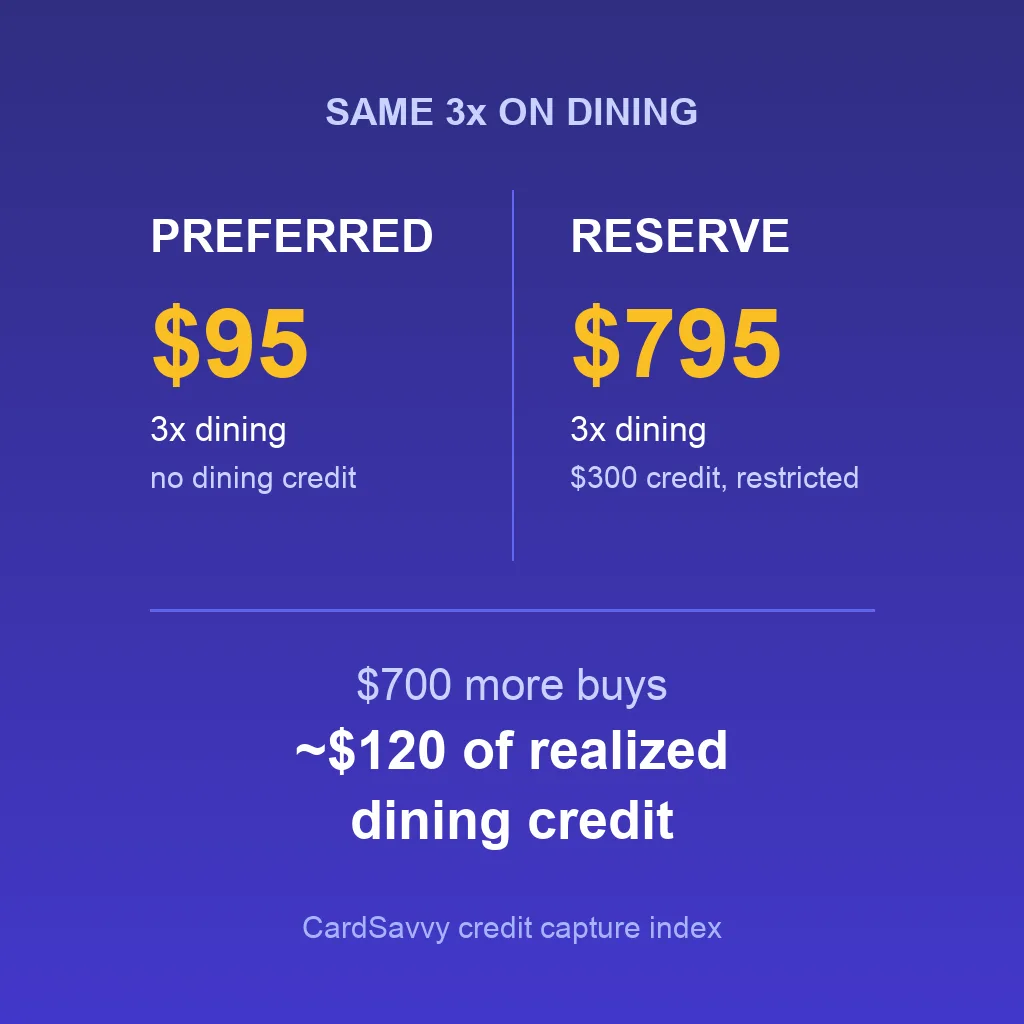
Sapphire Reserve vs Preferred for Dining: Is $700 More Worth It?
The $795 Sapphire Reserve and the $95 Sapphire Preferred earn the same 3x on dining. The Reserve's entire dining premium is one restricted credit, and our capture index values it near $120. Here is when that still makes sense.

Chase Says the Sapphire Reserve Is Worth $5,500+. Here Is the Real Math.
Chase claims $5,500+ in first-year value for the Sapphire Reserve. We break down every credit line by line to show what most cardholders actually get.

Airline Bag Fees Are a Credit-Card Funnel: The Real Strategy Behind the 2026 Hikes
The April 2026 airline bag-fee hikes were blamed on fuel costs. The structure of the fees — hitting non-cardholders while sparing co-brand cardholders and elites — is part of a larger loyalty-card economics shift. Here is the evidence, the mechanism, and what CardSavvy users should do.

Delta Gold Is a Card to Hold, Not a Card to Spend On
The $150 Delta Gold earns its fee through the checked-bag waiver and TakeOff 15, not through 2x SkyMiles. That distinction decides who should carry it and what belongs on it.
Get smarter with your cards
Math-first card strategy posts, sent when we publish — not on a schedule. No spam. Unsubscribe anytime.
We respect your inbox.
See the math for yourself
Is the $795 annual fee worth it?
Free calculator. No signup required.
Try the CSR Calculator →