Chase Says the Sapphire Reserve Is Worth $5,500+. Here Is the Real Math.
You have probably seen this ad on your Instagram feed.

"$5,500+ in value your first year." It is a bold number. And technically, Chase is not making it up. But the gap between what a card can be worth and what it will be worth for you is where most people lose money.
At CardSavvy, we believe in math over marketing. So let's do the math.

See what the CSR is actually worth for your spending →
How Chase Gets to $5,500+
Here is every line item Chase is likely counting in that headline number:
| Benefit | Face Value |
|---|---|
| Travel credit | $300 |
| The Edit hotel credit | $500 |
| Dining credit (Exclusive Tables) | $300 |
| StubHub credits | $300 |
| DoorDash credits | $300 |
| Lyft credits | $120 |
| Peloton credits | $120 |
| Apple TV+ and Apple Music | $288 |
| DashPass subscription | $120 |
| Sign-up bonus (60K points at 1.5cpp) | $900 |
| Priority Pass lounge access | ~$250+ |
| Points earned on assumed spending | ~$900+ |
| Total | ~$5,500+ |
The last row is the one most people miss. Chase is not just adding up credits. They are also assuming you put meaningful spend on the card and earn bonus points on it. For example, $500/month in dining at 3x and $300/month in travel at 4x-8x generates roughly 40,000-50,000 points per year, worth $600-$750+ at the portal redemption rate. Layer in everyday spending at 1x and the total points value climbs past $900.
That is how the headline clears $5,500: credits at face value, sign-up bonus at the portal rate, lounge access at an estimated dollar figure, and assumed points earnings on top. None of these individual numbers are fabricated. But stacking them all at 100% utilization and presenting the sum as a single headline is where marketing math diverges from personal math.
The question is whether you will hit that ceiling.
Understanding how to value credit card points honestly is the first step toward answering that question.
The Three Problems with Face-Value Math
Problem 1: Credits Are Not Cash
A credit only has value if you would have spent the money anyway. If you do not buy event tickets, the $300 StubHub credit is worth $0 to you. If you do not own a Peloton, the $120 Peloton credit is worth $0. If you do not order delivery, the $300 DoorDash credit might go mostly unused.
This is the "coupon book" problem. Card issuers stack credits knowing that a meaningful percentage of cardholders will forget to use them, use them partially, or spend money they otherwise would not have spent just to "capture" the credit.
The question is not "does the credit exist?" The question is: "Does it pay for itself without changing my existing habits?"
Problem 2: Restricted Credits Can Cost You More Than They Save
Some credits come with strings that quietly eat into their value.
The Edit hotel credit ($500). This sounds generous until you dig in. The credit only works at specific "Edit" properties booked through the Chase Travel portal. A NerdWallet study found that Chase Travel Edit properties are 7.8% more expensive on average than booking the same room directly. On a $1,000 booking, you might pay $78 extra to capture a $250 credit, netting $172 instead of $250. The credit also requires a 2-night minimum stay and prepaid "Pay Now" booking.
The dining credit ($300). This credit is limited to roughly 400 Exclusive Tables restaurants on OpenTable, spread across about 50 metros and heavily concentrated in the largest of them. If you live in a major metro, you will probably find options. If you are in a smaller city or suburb, you may struggle to use it at all. The credit resets semiannually ($150 per half), adding another layer of timing pressure.
Problem 3: The Sign-Up Bonus Is a One-Time Event
The 60,000-point sign-up bonus is real and valuable. At 1.5 cents per point through the Chase Travel portal, that is $900. But it only happens once.
In year two, the $5,500 headline drops by $900 immediately. The ongoing math is what matters for deciding whether to keep the card, and that ongoing math needs to stand on its own without the sign-up bonus propping it up.
The 1.5 cents per point figure also needs a caveat as of 2026. That rate was the Chase Travel redemption floor under the old program, and it survives only for points earned before October 26, 2025 on accounts opened before June 23, 2025, through late October 2027. Points earned since then redeem at a 1 cent baseline, with Points Boost offers reaching up to 2 cents on selected hotels and flights. Chase describes those offers as promotional and subject to change, so treat any figure above 1 cent as an opportunity rather than a floor. Transfer partners can yield more or less depending on how and when you book.
What the CSR Is Realistically Worth
Let's walk through a worked example. Imagine a typical urban professional who travels 2-3 times per year and dines out regularly. Here is what their credit stack might actually look like after applying realistic haircuts:
| Benefit | Face Value | Utilization | Your Value |
|---|---|---|---|
| Travel credit | $300 | 90% (broad, automatic) | $270 |
| Edit hotel credit | $500 | 50% (portal markup, 2-night min) | $250 |
| Dining credit | $300 | 60% (metro-dependent, semiannual) | $180 |
| StubHub | $300 | 30% (niche use case) | $90 |
| DoorDash | $300 | 50% (monthly, easy to forget) | $150 |
| Lyft | $120 | 40% (monthly, urban only) | $48 |
| Peloton | $120 | 0% (do not own one) | $0 |
| Apple subs | $288 | 80% (Apple ecosystem user) | $230 |
| DashPass | $120 | 50% (order delivery sometimes) | $60 |
| SUB (year 1 only) | $900 | 100% (real points) | $900 |
| Total | $3,248 | $2,178 |
Subtract the $795 annual fee and the net first-year value is roughly $1,383. That is about 25% of Chase's $5,500 headline.
In year two, without the sign-up bonus: $1,278 minus $795 equals $483 net. Still positive, but a far cry from the Instagram ad.
And this is for someone who uses most of the credits. Someone who skips StubHub, Peloton, DoorDash, and DashPass entirely is looking at an even thinner margin.
Run your own numbers with the CSR Calculator →
When the CSR Actually Makes Sense
The Sapphire Reserve is not a bad card. For the right person, it is genuinely excellent. The card makes sense if you check most of these boxes:
You live in a major metro. Exclusive Tables restaurants, Lyft availability, and DoorDash selection are all significantly better in cities like New York, San Francisco, Chicago, and Los Angeles.
You already use the services. If DoorDash, Lyft, and Apple Music are already line items in your budget, those credits convert at near-full value with minimal behavior change.
You book hotels through Chase Travel and price-compare. The Edit credit can be genuinely valuable if you verify that portal prices are competitive before booking. Do not assume they will be.
You value transfer partners. The Chase Ultimate Rewards ecosystem includes World of Hyatt (one of the best hotel transfer values in the game), United, Southwest, and several international airlines. If you will use points for premium cabin flights or aspirational hotel stays, the CSR's points earn premium cabin flights at rates that portal-only cards cannot match.
If this sounds like you, the CSR can deliver $1,000+ in annual net value after fees. That is a strong return. It is just not $5,500.
For a detailed head-to-head comparison with a simpler alternative, see our Venture X vs. Sapphire Reserve breakdown.
When You Should Skip It
The CSR is not the right card for everyone, and there is no shame in that. You should probably look elsewhere if:
You are in a smaller city or suburb. The dining credit, Lyft credits, and DoorDash credits all lose value outside major metros. If Exclusive Tables has zero restaurants near you, that is $300 in dead weight.
You do not use the subscription services. Peloton, DashPass, Apple TV+, and StubHub are lifestyle products. If you would not pay for them independently, a credit does not make them free. It makes them a discount on something you did not want.
You travel once a year or less. The Edit credit, travel credit, and lounge access all scale with travel frequency. A once-a-year traveler will leave hundreds in credits on the table.
Your family checks bags. At $45 per bag each way, the free-bag waiver on a co-brand airline card beats the CSR's 4x airfare earning, and claiming it means buying the ticket on that card instead. That also moves your trip protections. See what checking bags costs your Sapphire Reserve.
You want simplicity. The CSR requires active management: tracking semiannual resets, enrolling in offers, booking through specific portals, and monitoring dining credit eligibility. If you want a card you can set and forget, the Capital One Venture X delivers a near-zero effective fee with far less complexity.
Not sure? Compare every card in your wallet →
The Bottom Line
Chase's $5,500+ number is not a lie. It is a ceiling. It represents the maximum possible value if you use every credit at full face value, redeem every point at the portal rate, and assign dollar values to subscriptions regardless of whether you would pay for them independently.
Most people will not hit that ceiling. A realistic first-year value for an active, urban cardholder is closer to $1,400 to $2,500 after fees, depending on which credits align with their existing spending.
The real question is never "can this card be worth $5,500?" It is "will this card be worth $5,500 for me?"
That is exactly why we built CardSavvy. Our CSR Calculator lets you plug in your actual spending, adjust the credit utilization sliders, and see your net value in seconds based on the credits you would actually use.
And if you want to go further, the CardSavvy Optimizer will compare the CSR against every card in your wallet (and every card you could add) to show you exactly where you are leaving money on the table.
Frequently Asked Questions
Cards Mentioned in This Article
Click any card above to see if it's worth adding to your wallet — personalized verdict in 30 seconds.
Related on Learn
Hand-picked based on topic and reader interest
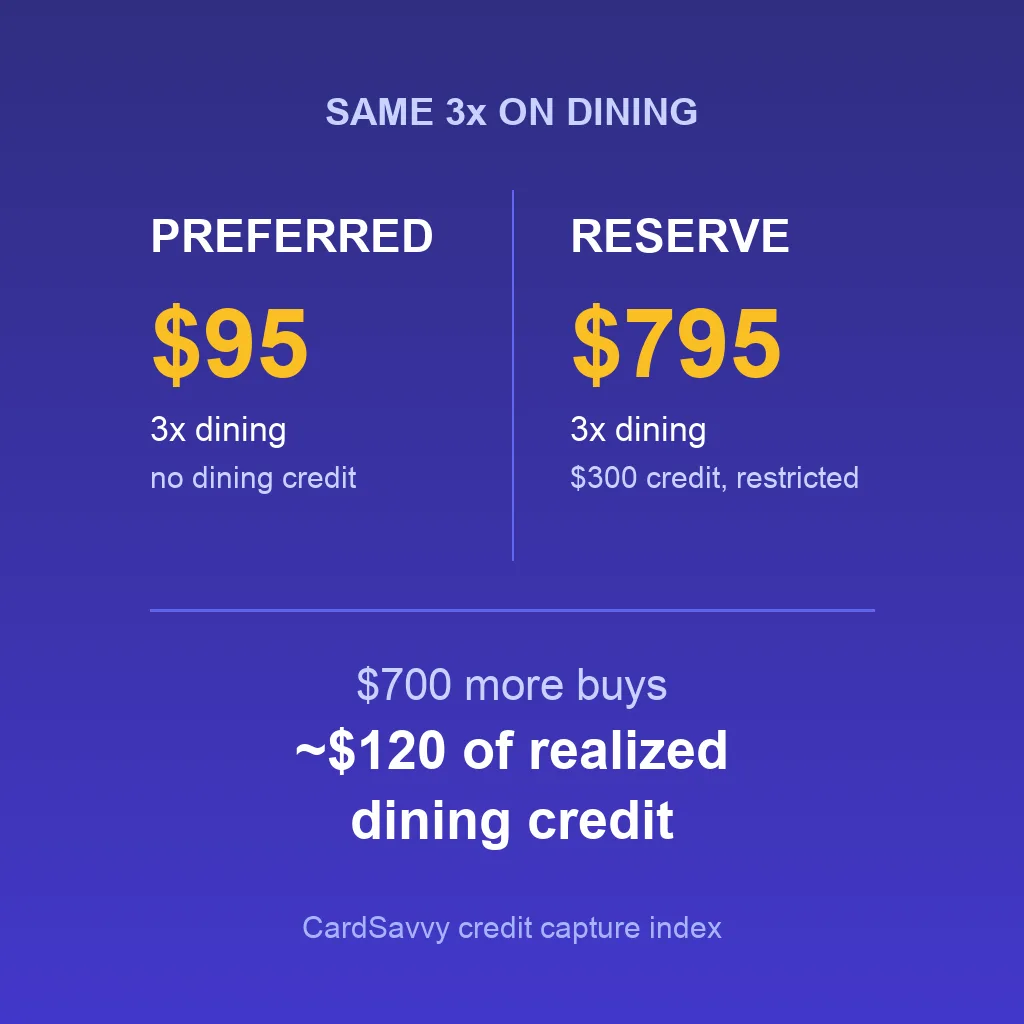
Sapphire Reserve vs Preferred for Dining: Is $700 More Worth It?
The $795 Sapphire Reserve and the $95 Sapphire Preferred earn the same 3x on dining. The Reserve's entire dining premium is one restricted credit, and our capture index values it near $120. Here is when that still makes sense.
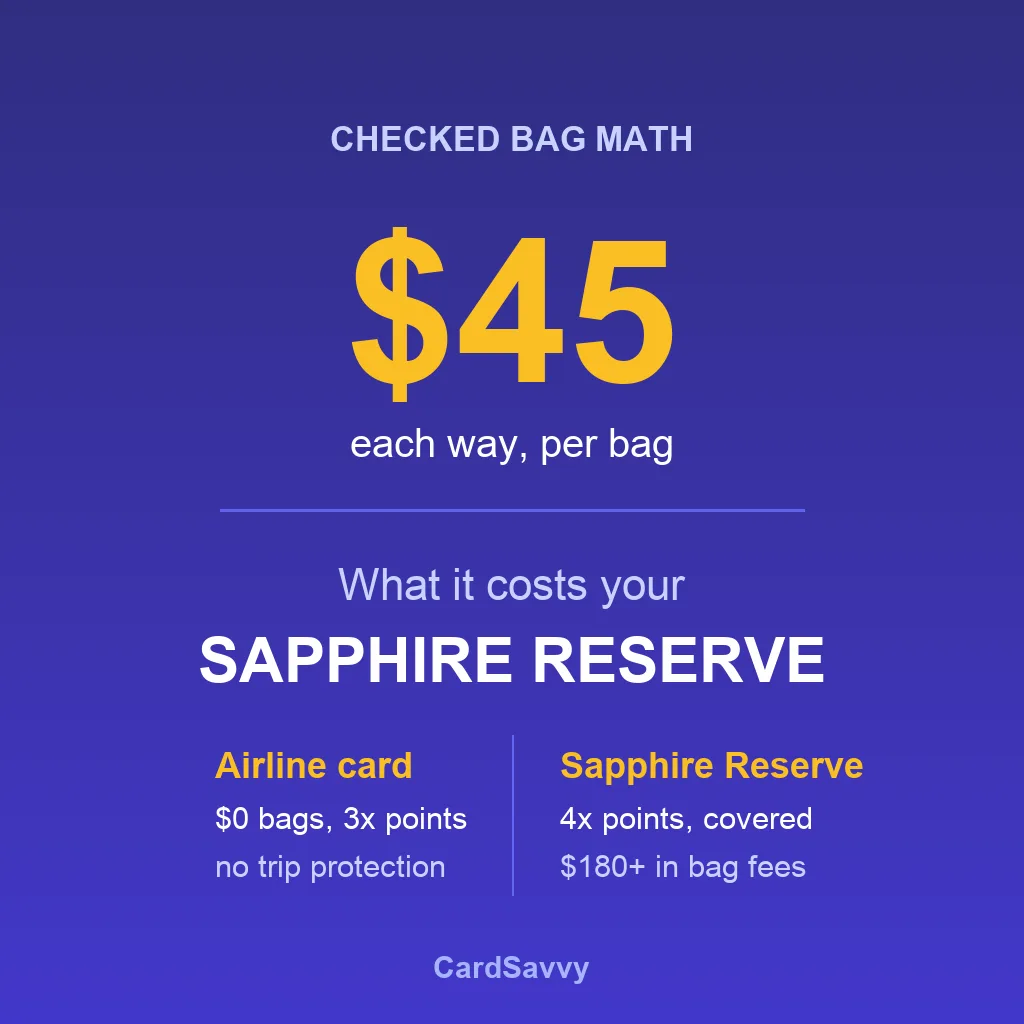
Airline Card vs Sapphire Reserve: What Checking Bags Costs You in 2026
Checked bags now cost $45 each way, and the waiver requires buying the ticket with the airline card. That decision quietly moves your airfare off the Sapphire Reserve, taking the 4x category and the trip protections with it. Here is what that is worth.

Are Premium Card Credits Real Value or Forced Spending? A “Coupon-Book” Scorecard (2026)
We score the biggest premium cards of 2026—Amex Platinum, CSR, Venture X, and Gold—using a strict "Real Value" rubric to see if they are worth the fee.

Chase Sapphire Reserve StubHub Credit: $300 Guide (2026)
The Chase Sapphire Reserve's $300 StubHub credit is real, but resale markups and fees can quietly eat the value. Here's how to use it and what to actually count.
Get smarter with your cards
Math-first card strategy posts, sent when we publish — not on a schedule. No spam. Unsubscribe anytime.
We respect your inbox.
Ready to optimize your wallet?
Get personalized card recommendations and spending strategies in under 2 minutes.
Free to use. No signup required.
Get My Strategy →Just need an answer for one purchase? Best Card →