Sapphire Reserve vs Preferred for Dining: Is $700 More Worth It?
The Chase Sapphire Reserve costs $795 a year. The Chase Sapphire Preferred costs $95. Both earn 3x points on dining worldwide, including takeout and eligible delivery services.
That is the whole comparison on earn rate. There is no dining multiplier hiding behind the extra $700.
Run the Reserve's numbers on your spending →
Dining is the one rate the refresh left alone
Chase overhauled the Reserve in 2025. The annual fee went from $550 to $795. Travel earning was restructured: 4x on flights and hotels booked directly, 8x through Chase Travel, and other travel categories such as cruises and vacation rentals dropped to 1x. The flat 1.5 cents per point portal redemption was replaced by Points Boost.
Dining stayed at 3x. It is the same rate the $95 card has paid for years, and the June 2026 Preferred refresh did not change it either.
So when someone asks whether the Reserve is a good dining card, the accurate answer is that it earns exactly what the cheap one earns. Everything the Reserve adds for restaurants is a single credit.
The Reserve's dining premium is one credit
The Reserve carries up to $300 a year in statement credits at Sapphire Reserve Exclusive Tables restaurants, a collection curated by The Infatuation and hosted on OpenTable. Chase's pricing terms set the structure precisely:
"A statement credit will be automatically applied to your account for dining purchases at select restaurants up to a maximum accumulation of $150 in statement credits from January 1 through June 30 and up to $150 from July 1 through December 31, for a total maximum accumulation of $300 in statement credits each calendar year."
Two things follow. The credit accumulates within each six-month window rather than carrying forward, so an unused first half is gone in July. And it applies only at participating restaurants, not at any restaurant where you earn 3x.
You can spread each $150 across several visits rather than needing one large check, which is the most cardholder-friendly part of the design.
What the credit is actually worth
Our credit capture index applies a haircut to every premium-card credit based on how much of it a typical cardholder captures. The Reserve's travel credit is rated at 90%, because it applies automatically to any travel purchase. The dining credit is rated at 40%, or about $120 realized against $300 of face value.
The gap between those two numbers is the entire argument. The travel credit is automatic and broad. The dining credit requires you to be near the right restaurants, twice a year, within fixed windows.
The network makes that concrete. Chase markets Exclusive Tables as "over 275 top dining spots," though the live list has grown to roughly 400 across about 50 metros. Distribution is severely top-heavy: New York carries around 50 restaurants and San Francisco around 28, while some participating cities have exactly one. In a one-restaurant market, a $300 credit means eating at the same place six times a year.
It also moves. A July 2026 update added roughly 90 restaurants and removed about 60 without notifying cardholders. Las Vegas went from nine eligible restaurants to one. Value a credit whose redemption set can shrink that far in a single update at a discount.
Chase relaxed this structure elsewhere. The Edit hotel credit became a calendar-year $500 on January 1, 2026, instead of two fixed semiannual windows. Dining did not get the same treatment and remains split into halves.
The arithmetic
Set the fee difference against the dining premium:
| Sapphire Preferred | Sapphire Reserve | |
|---|---|---|
| Annual fee | $95 | $795 |
| Dining earn | 3x | 3x |
| Dining credit | none | $300 face |
| Credit at 40% capture | none | ~$120 |
The Reserve costs $700 more and returns roughly $120 of realized dining value. On restaurants alone, that is a losing trade by a wide margin, and no amount of restaurant spending changes it, because the multipliers are identical. Spending $20,000 a year at restaurants earns 60,000 points on either card.
This is why the Reserve has to be judged on travel. Its $300 travel credit applies automatically to any travel purchase, which is why our index rates it at 90%. Add lounge access, trip protections, and 4x on flights and hotels booked directly, and there is a real case for the card. That case simply has nothing to do with dining.
Compare both cards against your actual spending →
When the dining credit does earn its keep
The 40% haircut is an average, and averages hide the people at both ends.
If you live in a dense metro and already eat at the kind of restaurants in this collection, your capture rate is closer to 100%. Seattle is a reasonable example: Tomo in White Center participates, as does The Pink Door downtown. We have used the credit there and it worked as described. For someone with roughly eight participating restaurants in town and a habit of eating at them, $300 is close to $300.
The test is whether you would have booked these restaurants anyway. A credit that changes where you eat is worth its face value. A credit that changes how much you eat out is worth considerably less, because you spent money you would not otherwise have spent.
If you are in a smaller market, the honest number is lower than 40%, and possibly zero.
The verdict
If dining is your main reason for holding the Sapphire Reserve, downgrade to the Preferred. You lose no dining earning whatsoever, and you save $700 a year. The Preferred also picked up a $100 Chase Travel hotel credit, 3x on gas and EV charging, and 3x on vacation homes in its June 2026 refresh.
One cost of downgrading is worth knowing: the Preferred's World of Hyatt transfer rate drops to 4:3 for existing cardholders on October 1, 2026, while the Reserve keeps 1:1. If Hyatt transfers are central to how you redeem, price that in.
Keep the Reserve if the travel side stands on its own. Take the $795 fee, subtract the $300 travel credit you will use automatically, and ask whether lounges, trip protections, and 4x on direct travel bookings are worth the remaining $495. Then treat the dining credit as a discount on that answer rather than a reason for it.
For a full comparison of dining cards including Amex Gold's 4x and the no-fee options, see our best dining credit cards guide. For the mechanics of using the credit without losing it, see the Exclusive Tables guide.
Card terms verified August 20, 2026 against Chase's published pricing terms and product pages. Benefits change; confirm current terms before applying.
Cards Mentioned in This Article
Click any card above to see if it's worth adding to your wallet — personalized verdict in 30 seconds.
Related on Learn
Hand-picked based on topic and reader interest
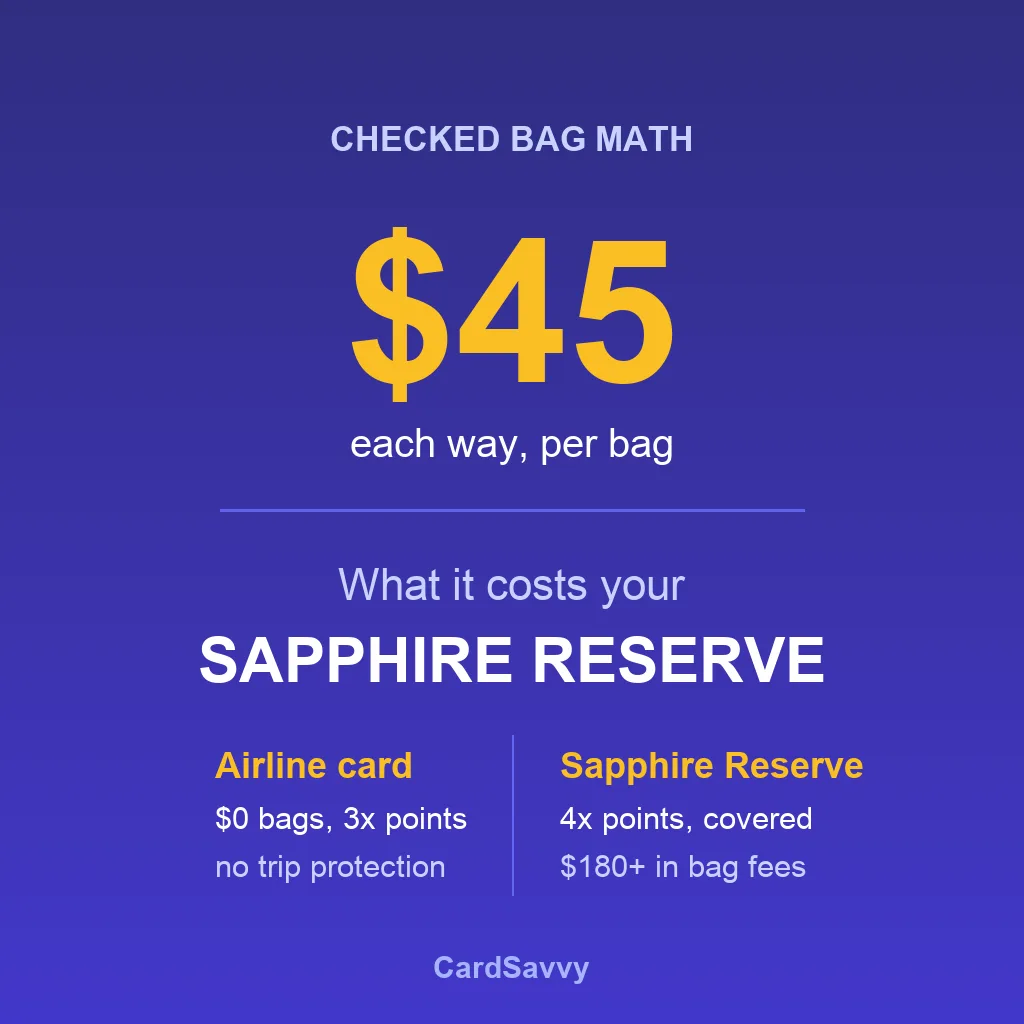
Airline Card vs Sapphire Reserve: What Checking Bags Costs You in 2026
Checked bags now cost $45 each way, and the waiver requires buying the ticket with the airline card. That decision quietly moves your airfare off the Sapphire Reserve, taking the 4x category and the trip protections with it. Here is what that is worth.

Chase Says the Sapphire Reserve Is Worth $5,500+. Here Is the Real Math.
Chase claims $5,500+ in first-year value for the Sapphire Reserve. We break down every credit line by line to show what most cardholders actually get.
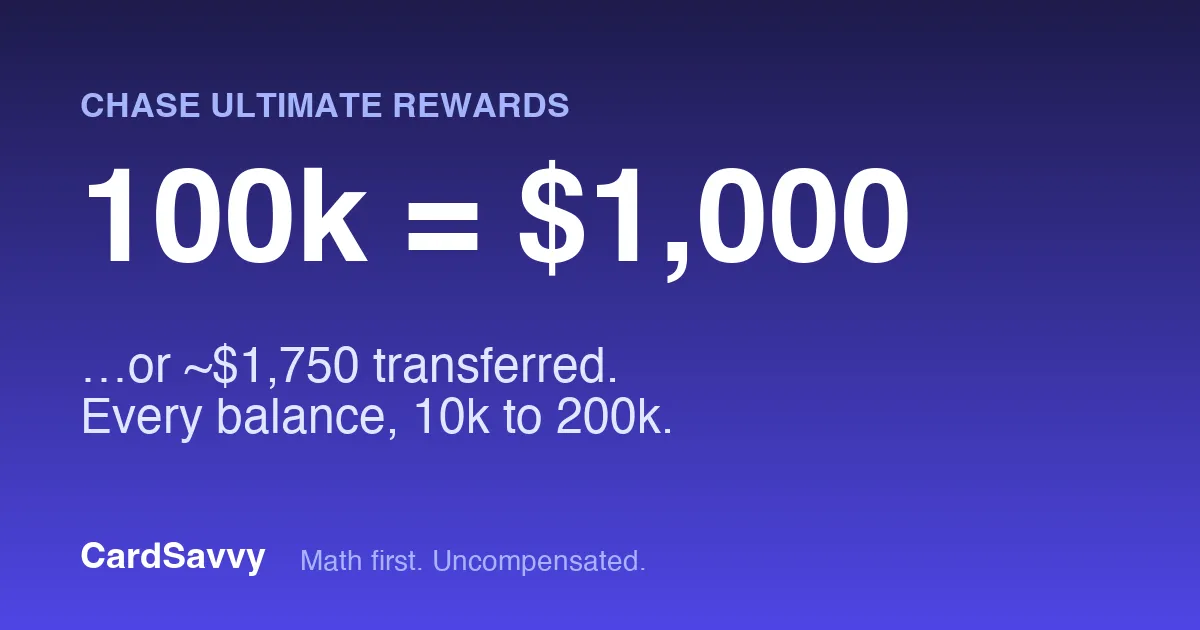
How Much Are Chase Points Worth? 10,000 to 200,000 Points in Dollars (2026)
100,000 Chase Ultimate Rewards points are worth $1,000 as cash, about $1,500 on a Points Boost booking, and about $1,750 transferred to a good airline or hotel award. Here is the dollar value of every common balance, and which card you need for each.

Does Airbnb Count as Travel for Chase Sapphire? CSP vs CSR (2026)
Does the Chase Sapphire Reserve give 3x points on Airbnb? No. Direct Airbnb bookings earn 1x on the Reserve. Chase's June 2026 refresh added 3x on Airbnb to the cheaper Sapphire Preferred instead. Here's the math.
Get smarter with your cards
Math-first card strategy posts, sent when we publish — not on a schedule. No spam. Unsubscribe anytime.
We respect your inbox.
See the math for yourself
Is the $795 annual fee worth it?
Free calculator. No signup required.
Try the CSR Calculator →