The Summer Vacation Credit Card Audit: Rewards, Fees, Credits, and Interest
Summer is one of the easiest times to rationalize credit card complexity. One card earns 5% on gas, another earns 3x on dining, a premium card promises travel credits, and a hotel card dangles status. AAA projected a record 72.2 million Americans traveling for the July 4 week alone. (AAA) That is a lot of spending running through a lot of cards.
A summer vacation card audit answers one question: did your card setup save you money after rewards, credits, fees, interest, foreign fees, and complexity? The best travel card is the one that fits your trip, your spending, and your ability to pay the bill in full.
Audit your spend in the optimizer →
Just want the quick post-holiday version? Start with the 4th of July credit card audit, then come back here for the full framework.
What a summer vacation card audit is
The audit replaces advertised value with realized value. Card marketing shows you the biggest possible number. The audit shows you what you captured.
The formula is simple:
Net card value = rewards earned + credits you used + protections you claimed − annual fee − interest − foreign fees − any portal price penalty
Everything below is a test that feeds one of those terms. Work through them in order. The first one decides whether the rest even matter.
Test 1: The pay-in-full gate
Before optimizing a single reward, answer one question. Can you pay the full statement balance by the due date?
If yes, keep going. If no, stop optimizing rewards and focus on the balance. The average credit card APR was 21.00% across all accounts in Q1 2026, and 21.52% on accounts charged interest. (Federal Reserve) A card earning 2% to 5% while you carry a balance at 21% is losing money every month.
Rewards are a rebate for people who pay in full. They are not a rescue plan for vacation debt. We ran the interest-versus-rewards math in why a rewards-first mindset backfires under high APRs, and the rewards-to-wealth calculator lets you see how fast interest overtakes your rewards.
Test 2: The category match
Break your trip spending into categories: flights, hotels, rental cars, gas and EV charging, dining, groceries, transit, parking, and attractions. For each, ask which card you used and whether it earned meaningfully more than a flat 2%.
Two things trip people up here. First, rotating-category cards need activation. As a current example, Chase Freedom's Q3 2026 categories include gas and EV charging, public transit, select live entertainment, and United Way, at 5% on up to $1,500 after activation. (Chase) Discover's Q3 2026 list adds flights alongside gas, transit, and drugstores. (NerdWallet) Always check the current quarter before you rely on any category.
Second, foreign spending can carry a 3% fee that wipes out the rewards. Use a no-foreign-transaction-fee card abroad, and check per purchase with the best-card picker.
For most people the answer is simpler than the marketing suggests. We covered which categories move the needle in the 80/20 of credit card rewards and showed how a two-card wallet beats most trifectas.
Test 3: Fees and credits reality check
This is where premium cards get audited. The trap is counting advertised credits instead of used credits.
Bad valuation: "I have $1,500 of possible credits, so the $795 annual fee is fine." Better valuation: "I used $300 of travel credit, $120 of rideshare credit, and $75 of dining credit without changing my behavior, so my realized credit value is $495."
The Chase Sapphire Reserve is a clean example. Its $300 annual travel credit applies automatically to a wide range of travel, but it sits against a $795 annual fee, and many other credits require specific portals, split periods, or minimum stays. Count only what you use. We scored the major premium cards on realized credit value in the coupon-book scorecard, and worked the renew-versus-downgrade decision in the annual-fee math post.
The calculator below runs the whole audit. Enter your trip spend, your realized credits, any foreign fees, and a carried balance, and it compares the card against a plain 2% card.
Test 4: Portal versus direct booking
Many travel cards push you toward their booking portal with a higher earn rate. Sometimes that wins. Often it does not.
Direct booking can beat a portal on hotel elite status, points earning, easier changes and cancellations, direct customer service, and member rates. A portal that earns 8x but costs $40 more and has worse cancellation terms can easily lose to a direct booking that earns 4x, earns hotel points, and protects your status.
Use a portal when the price, credit, and cancellation terms match or beat direct booking. The points valuation framework and the Chase transfer partners guide show when transferring or booking direct returns more than the portal multiplier.
Test 5: Travel protections
Summer travel is when card protections earn their keep, and they only work if you paid with the right card and kept the paperwork.
Run this checklist:
- Did you pay with the card that carries the benefit?
- Does it cover trip delay, cancellation, interruption, baggage delay, or rental car damage?
- For rental cars, is the coverage primary or secondary? Most cards are secondary, meaning they pay after your own auto insurance. A few premium cards are primary.
- Did you decline the rental company's collision damage waiver, as most card benefits require?
- Are award tickets covered when you paid the taxes and fees with the card?
Card protections vary and almost always require reading the benefit guide. Do not treat advertised coverage as money in hand. It is worth nothing until you file and receive a claim, which is why the calculator asks only for protection you have claimed.
Test 6: Airline refund rights are separate from card insurance
People confuse two different things: your legal refund rights and your card's travel insurance.
Under the U.S. Department of Transportation rule in effect since October 2024, when an airline cancels or makes a significant change to your flight and you decline the rebooking or a travel credit, the airline must issue an automatic refund to your original form of payment. The deadline is 7 business days for credit card purchases and 20 calendar days for other payment methods. (U.S. DOT) The refund is automatic now, so you should not have to fight for it.
Card travel insurance is a separate layer. It can reimburse costs the airline will not, such as a hotel during a covered delay, but it depends entirely on your card's benefit terms. Claim your DOT refund first, then look to the card for the gaps.
Test 7: Disputes and documentation
Credit cards give you real dispute rights, and those rights have deadlines. Under the Fair Credit Billing Act, you generally must dispute a billing error in writing within 60 days of the first statement showing it. The issuer must acknowledge your dispute within 30 days and resolve it within two billing cycles, and no more than 90 days. (FTC) Send the dispute in writing to the billing-inquiries address, not the payment address, to preserve your full rights.
For summer travel that means duplicate hotel charges, rental car damage billed after the fact, canceled tours, and missing refunds are all disputable. Save the documentation before you need it:
- Hotel folios and rental car agreements
- Flight delay or cancellation notices
- Baggage delay or loss reports
- Receipts for meals, toiletries, and replacement items during a delay
- Screenshots of activated offers and cancellation policies
- Confirmation emails and any chat transcripts
Test 8: The simplicity test
The last test is the one card marketing never runs. Did the extra complexity actually change the outcome?
Rewards cards reward disciplined users and can quietly cost everyone else. A Federal Reserve staff working paper, "Who Pays For Your Rewards?" (2023), found that sophisticated cardholders profit from rewards at the expense of less sophisticated ones regardless of income, partly because rewards cards induce more spending and higher unpaid balances. (Federal Reserve) The CFPB has separately documented how rewards get devalued, blocked, or revoked through buried conditions, in both a May 2024 research spotlight and its December 2024 enforcement circular.
The best setup captures most of the value with the fewest moving parts, without changing how you spend. If you are tracking five cards in a spreadsheet to justify their fees, the spreadsheet is the answer.
Your 15-minute checklist
- Confirm you can pay the trip balance in full. If not, stop here and attack the balance.
- Match each trip category to the card that earned the most, and activate any rotating categories.
- Add up the credits you used, not the advertised total.
- Compare portal bookings against direct on price, points, and cancellation terms.
- Confirm you paid for travel with the card whose protections you understand.
- Claim any DOT refund you are owed, then look to card insurance for the gaps.
- Save your receipts and folios, and dispute errors in writing within 60 days.
- Ask whether a simpler two-card setup would have done almost as well.
Run your real numbers through the optimizer →
Frequently Asked Questions
Related on Learn
Hand-picked based on topic and reader interest

The 4th of July Credit Card Hangover: A 15-Minute Summer Rewards Audit
You already spent the money on July 4 travel, gas, and dining. Here's a 15-minute audit to check whether your cards earned what they should have, avoid interest, and set up the rest of summer.
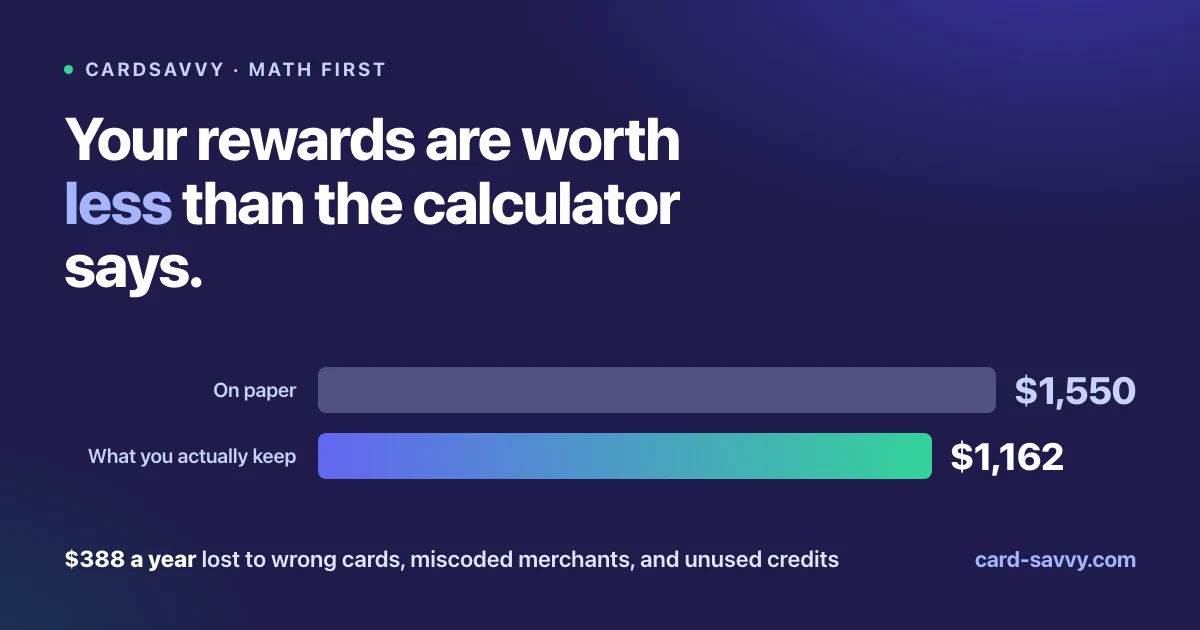
Why Your Credit Card Rewards Are Worth Less Than the Calculator Says
The optimization math is solved. Getting the money is not. Seven measurable gaps between the rewards a calculator promises and the value you actually keep, with the number attached to each.

What Should You Do After Optimizing Your Credit Cards?
Credit card rewards are the smallest lever in your financial life. Here is the hierarchy that matters more, the research behind it, and a calculator that shows what your rewards are actually worth.

The 2-Card Wallet That Beats 90% of Trifectas
Stop juggling 5 cards. We break down three 2-card setups that mathematically outperform most complex trifectas—with half the mental overhead.
Get smarter with your cards
Math-first card strategy posts, sent when we publish — not on a schedule. No spam. Unsubscribe anytime.
We respect your inbox.
Ready to optimize your wallet?
Get personalized card recommendations and spending strategies in under 2 minutes.
Free to use. No signup required.
Get My Strategy →Just need an answer for one purchase? Best Card →