Are Premium Card Credits Real Value or Forced Spending? A “Coupon-Book” Scorecard (2026)
Premium cards keep raising annual fees… and “offsetting” them with a growing pile of statement credits. If you’ve ever felt like you’re doing homework just to justify keeping a credit card in your wallet, you’ve officially experienced coupon-book economics.
The promise is always the same: "This card pays for itself!" But that’s only true if you behave exactly the way the issuer wants you to.
At CardSavvy, we believe in math, not marketing. This post gives you a simple rubric to evaluate these credits honestly, so you can answer the question: “Is this card actually worth it for me, or am I being nudged into spending money I wouldn’t otherwise touch?”
Below, we score the biggest premium cards of 2026, the Amex Platinum, Chase Sapphire Reserve, Venture X, and Amex Gold, using a strict "Real Value" rubric.
What is a “Credit Card Coupon Book”?
A coupon-book card is one where the high annual fee isn't justified by the points you earn, but rather by a stack of specific credits. These are often split into monthly or semi-annual chunks, limited to specific merchants, and usually require manual enrollment.
Why do banks do this? Two words: Breakage. Issuers know that a meaningful percentage of cardholders will forget to use a $10 monthly credit, or won't use the full value of a semi-annual perk. That unused value (breakage) keeps the program profitable for them.
So when an influencer says a card has "$1,500 in value," the real question isn't "is the credit real?" The real question is: "Does it pay for itself without changing my existing habits?"
The Coupon-Book Scorecard Rubric
To separate real value from fluff, score every credit on four dimensions:
1. Ease (1–5)
How much effort does it take to extract the value?
- 5: Automatic statement credit on broad spend (e.g., any travel purchase).
- 3: Monthly credits you have to remember, but at easy merchants.
- 1: Requires enrollment + a special portal + narrow rules + timing constraints.
2. Natural Spend Alignment (1–5)
Would you have bought this anyway?
- 5: Matches your existing budget (groceries, commuting, dining).
- 3: Sometimes (you might use it, but it’s not a guarantee).
- 1: You’d never buy it otherwise (forced “lifestyle” spend).
3. Breakage Risk (1–5)
How likely are you to forget it?
- 5: One annual credit, broad category, impossible to miss.
- 3: Monthly credits or semi-annual segments (easy to slip your mind).
- 1: Narrow merchant list + short expiration windows.
4. Restriction Level (1–5)
How constrained is the usage?
- 5: Works at many merchants, few exclusions.
- 3: Restricted to a specific platform (portal or app) but offers many options.
- 1: Single merchant, limited SKUs, or requires a minimum stay.
The "Real Value" Haircut
A credit’s face value is rarely its real value to you. Apply this quick rule of thumb before you apply for a card:
- High Quality (mostly 4–5s): Value it at 80–100% of face value.
- Medium (mix of 2–4s): Value it at 40–70%.
- Low (many 1–2s): Value it at 0–30%.
Use this formula to find the truth:
Effective Fee = Annual Fee − (Sum of credits × your “Real Value” %)
2026 Scorecard: Which Premium Cards Have “Real” Credits?
Note: The scores below evaluate the credits only, not the rewards rates or insurance perks.
Capital One Venture X — The Anti-Coupon Book
Why it’s different: The Venture X remains the simplest player in the premium space. It relies on one big travel credit and anniversary miles.
- The Credits: $300 annual Capital One Travel credit and 10,000 anniversary miles.
- Ease: 4/5 (One annual credit, requires portal use).
- Natural Spend: 4/5 (Most travelers spend $300/year easily).
- Breakage Risk: 4/5 (Annual, not monthly).
- Restriction Level: 3/5 (Must use the portal).
Verdict: High “Real Value.” If you travel even once a year, the Venture X credits are as close to cash as you can get in this tier.
Chase Sapphire Reserve — Powerful, But Increasingly Complex
The Shift: Chase’s refreshed CSR leans hard into multiple semi-annual and monthly credits, often tied to specific "lifestyle" partners.
- The Fee: $795 Chase Media Center.
- The Credits: $300 broad travel credit, plus "lifestyle bundles" (Apple subscriptions, DoorDash promos, The Edit hotel credits).
- Ease: 2/5 (Multiple credits, activations, and schedules).
- Natural Spend: 3/5 (Great if you already subscribe to these services; useless if you don't).
- Breakage Risk: 2/5 (Monthly + semi-annual segmentation increases "forgotten value").
- Restriction Level: 2/5 (Many credits tied to specific platforms) The Points Guy.
Verdict: The CSR is incredible if you already use the partner services. If you aren't a natural DoorDash or curated luxury hotel user, the $795 fee can feel like forced spending very quickly.
Amex Platinum — The King of Coupon Books
The Model: Amex has doubled down on the "stacked perks" model. The fee is high, but the potential value is higher—if you fit the mold.
- The Fee: $895.
- The Credits: Resy, Hotel credits, Uber Cash, Airline incidentals, Digital Entertainment, and more.
- Ease: 2/5 (Requires enrollment, specific merchant rules, and tracking).
- Natural Spend: 2–4/5 (Ranges wildly. Frequent luxury travelers score this high; others score it very low).
- Breakage Risk: 2/5 (Many credits are monthly or semi-annual and easy to miss).
- Restriction Level: 2/5 (Partner and portal constraints are common) American Express.
Verdict: If your life already includes the Platinum’s partners, this card is a massive win. If not, it is the easiest card to overpay for because the "headline" credit number simply won't match your real life.
Amex Gold — “Coupon Book Lite”
The Daily Driver: Gold isn’t as "premium" as Platinum, but it’s a vital case study because the credits often align better with daily habits.
- The Fee: $325 American Express.
- The Credits: Dining credits and Uber/Rideshare cash.
- Ease: 3/5 (Monthly credits exist, but for common use cases).
- Natural Spend: 4/5 (Most people already spend on dining/delivery).
- Breakage Risk: 3/5 (The monthly cadence still causes missed value if you aren't diligent).
- Restriction Level: 3/5 (Partners matter, but are broad enough for most city dwellers).
Verdict: Gold’s credits are more likely to match normal spending than the Platinum or CSR “lifestyle stacks,” but you still need to remember to use them every single month.
The Big Takeaway
Here is the trap many fall into:
"I got $1,500 in value from these credits!" ...but you spent $600 extra to "unlock" them, and you forgot to use $250 worth.
That’s not saving. That’s just relabeling your spending.
How to avoid the trap: When you look at a card on CardSavvy, or do the math yourself, be ruthless:
- Would I buy this anyway? If no → Value at $0.
- Will I remember to use it? If maybe → Value at 50%.
- Is it broadly usable? If yes → Value closer to 100%.
Only then should you calculate if the annual fee makes sense.
FAQ
Are Amex credits worth it? Sometimes. Amex credits can be incredibly valuable, but many are partner-specific or require active management (like choosing a specific airline for the fee credit). Always use a "haircut" when valuing them unless they replace spending you are already doing.
What is a credit card “coupon book”? This refers to a card where the value depends on redeeming many small, restricted credits (often monthly or semi-annually) rather than straightforward rewards or broad perks.
Which premium card has the easiest credits? The Capital One Venture X is currently the simplest in the premium tier, offering one annual portal credit plus anniversary miles, rather than a dozen monthly allowances.
Do premium cards force you to spend more? They can. If you find yourself buying things solely to "use up" a credit, you are likely turning perks into extra spending, negating the value of the rewards.
Cards Mentioned in This Article
Click any card above to see if it's worth adding to your wallet — personalized verdict in 30 seconds.
Related on Learn
Hand-picked based on topic and reader interest

Chase Says the Sapphire Reserve Is Worth $5,500+. Here Is the Real Math.
Chase claims $5,500+ in first-year value for the Sapphire Reserve. We break down every credit line by line to show what most cardholders actually get.

Amex Gold vs Platinum 2026: Gold Wins for Most Households
Amex Gold ($325) earns 4x on dining and groceries and breaks even at lower spend. The Platinum ($895) pays off only if you fly often and use its lounges and credits.

Venture X vs. Sapphire Reserve: The 2026 Showdown
A clear, 2026-updated showdown between the simple Capital One Venture X and the perk-heavy Chase Sapphire Reserve.
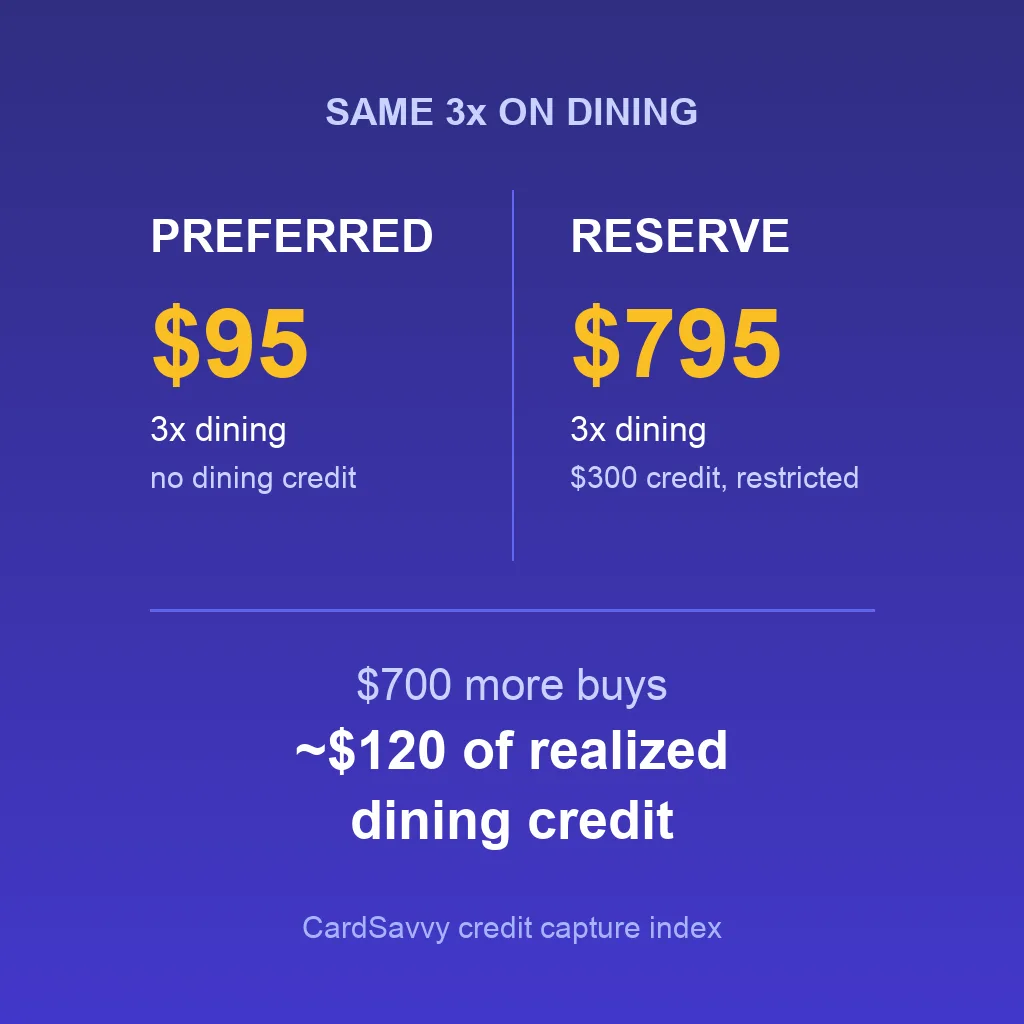
Sapphire Reserve vs Preferred for Dining: Is $700 More Worth It?
The $795 Sapphire Reserve and the $95 Sapphire Preferred earn the same 3x on dining. The Reserve's entire dining premium is one restricted credit, and our capture index values it near $120. Here is when that still makes sense.
Get smarter with your cards
Math-first card strategy posts, sent when we publish — not on a schedule. No spam. Unsubscribe anytime.
We respect your inbox.
Ready to optimize your wallet?
Get personalized card recommendations and spending strategies in under 2 minutes.
Free to use. No signup required.
Get My Strategy →Just need an answer for one purchase? Best Card →