How to Value Credit Card Points (Without Lying to Yourself)
Here's the dirty secret of credit card points: most people have no idea what they're worth.
Not because the math is hard—it isn't. But because the internet is full of valuations designed to make points seem more valuable than they are. When a blog tells you Chase points are worth "2.05 cents each," they're not lying exactly. They're just describing a best-case scenario that most people will never achieve.
Then there's the opposite problem: people who cash out their points at terrible rates because they don't realize better options exist.
This guide is about finding the realistic middle ground. Not the fantasy valuation that makes you feel like a genius. Not the floor value that leaves money on the table. The number that reflects how you will actually use your points.
Set your personal point values in the optimizer →
The Core Problem: CPP Is Not Point Value
Before we go further, let's clear up a confusion that causes most of the trouble.
Cents per point (CPP) is a metric for a specific redemption. If you spend 50,000 points on a flight that costs $750 cash, you got 1.5 CPP on that booking. That's math.
Point value is a decision metric for whether you should earn points or cash back going forward. It's what you can expect to get on average, given your travel patterns and effort tolerance.
These are not the same thing.
When someone brags about getting "4 CPP on a business class flight," that's a data point about one redemption. It doesn't mean their points are "worth" 4 cents each. It means they found one good deal. Their next ten redemptions might average 1.2 CPP.
Value points by their expected value — what you'll typically realize across all your redemptions, not the highlight reel.
The Two-Number Framework: Floor and Expected Value
Here's a simple model that keeps you honest:
Floor Value
The floor is what you can get with zero effort and near-guaranteed availability. It's the "worst case that still makes sense."
For most point currencies, the floor is some form of cash-out or statement credit:
- Chase Ultimate Rewards: 1.0¢ (statement credit)
- Amex Membership Rewards: 0.6¢ (statement credit) to 1.1¢ (Schwab cash-out)
- Capital One Miles: 0.5¢ (cash back) to 1.0¢ (travel eraser)
- Citi ThankYou: ~1.0¢ (statement credit)
- Bilt Points: 0.55¢ (rent redemption) to 1.25¢ (travel portal)
If you're ever tempted to let points expire, the floor is your backstop. But it shouldn't be your goal.
Expected Value
Your expected value is what you'll typically realize given how you actually travel. It accounts for:
- The mix of portal bookings vs. transfer redemptions
- How often you find award availability
- Your willingness to be flexible with dates and destinations
- The friction you're willing to tolerate
For most people, expected value falls somewhere between the floor and those fantasy blog valuations:
- Chase: 1.25–1.75¢ for portal users, higher for transfer ninjas
- Amex: 1.0–1.6¢ depending on cash-out path and transfer usage
- Capital One: 1.0–1.4¢ for travel portal users
- Bilt: 1.25–1.5¢ for portal users, higher for Hyatt transfers
The key insight: your expected value is personal. A road warrior who books 30 flights a year will realize different value than someone who takes two vacations.
Realistic Valuations by Currency
Let's look at what each major points currency is actually worth—floors, typical ranges, and the traps to avoid.
Chase Ultimate Rewards
Chase points are the most flexible currency, which makes them both valuable and confusing.
Floor value: 1.0¢ per point
- Statement credits via Pay Yourself Back (non-promotional categories)
- Cash back deposit to bank account
Portal value: Variable (1.0–2.0¢ depending on offer)
- Chase introduced "Points Boost" in June 2025, replacing the old fixed multipliers
- The new system shows "up to" values on select offers, but NerdWallet and others have documented that many bookings now show lower value than before
- Don't assume 1.5¢ or 1.25¢ anymore—check each booking
Transfer value: 1.5–2.5¢ for good redemptions
- Best partners: Hyatt (consistently strong), Southwest, United, British Airways
- Sweet spots exist, but require flexibility and research
Conservative range: 1.25–1.75¢ for most travelers
If you have a Chase Sapphire Reserve, you'll generally land in the upper half of this range thanks to the travel portal. If you're willing to do transfer partner research, you can occasionally beat it. But banking on 2+ CPP as your baseline is fantasy.
Amex Membership Rewards
Amex points have the widest spread between floor and ceiling—which means the most room for self-deception.
Floor value: 0.6¢ per point
- Statement credits via "Cover Your Charges" redemptions
- This is genuinely low, and it's why cashing out MR is usually a mistake
Schwab cash-out: 1.1¢ per point
- If you have the Schwab Platinum, you can cash out at 1.1¢ to your brokerage
- This is a reasonable floor for Schwab cardholders, but not available to everyone
Transfer value: 1.5–2.5¢ for good redemptions
- Best partners: ANA, Virgin Atlantic, Aeroplan, Singapore
- Business class sweet spots can hit 3–5¢, but require significant flexibility
Conservative range: 1.0–1.6¢ for most travelers
The Amex Gold and Platinum are great earning cards, but MR value depends heavily on whether you'll actually use transfer partners. If you just want easy redemptions, the low statement credit rate hurts.
Capital One Miles
Capital One has simplified its value proposition: miles work like cash for travel, with transfer partners as a bonus.
Floor value: 0.5¢ per mile
- Cash back redemption (avoid this)
Travel eraser: 1.0¢ per mile
- Use miles to "erase" any travel purchase from your statement
- Easy, reliable, and the practical floor for most users
Portal booking: 1.0–1.25¢ per mile
- Book through Capital One Travel, pay with miles
- Sometimes slightly better than eraser due to pricing
Transfer value: 1.25–2.0¢ for good redemptions
- Best partners: Turkish Miles&Smiles, Air Canada Aeroplan, Virgin Atlantic
- Fewer truly amazing sweet spots than Chase or Amex
Conservative range: 1.0–1.4¢ for most travelers
The Capital One Venture X makes this simple: you earn 2x on everything, miles are worth about 1.0–1.25¢ each, so you're getting 2.0–2.5% back on travel. That's the math.
Citi ThankYou Points
Citi ThankYou points are underrated but come with card-specific quirks that affect transfer options.
Floor value: ~1.0¢ per point
- Statement credit or direct deposit
- Better floor than Amex MR
Portal value: 1.0–1.25¢ per point
- Book through ThankYou travel portal
Transfer value: 1.25–2.0¢ for good redemptions
- Partners include Turkish, Singapore, Virgin Atlantic, Avianca LifeMiles
- But: transfer access depends on which Citi card you have—not all cards can transfer to all partners
Conservative range: 1.0–1.5¢ for most travelers
The Citi Strata Premier is a solid way to earn ThankYou points on everyday spending, and the 1.0¢ floor means you're never trapped with worthless points.
Bilt Points
Bilt is unique because you can earn points on rent—but the redemption values vary wildly.
Rent redemption: 0.55¢ per point
- Using points to pay rent is a terrible deal
- Only do this if points are about to expire
Travel portal: 1.25¢ per point
- Book through Bilt Travel
- Solid everyday value
Transfer value: 1.5–2.5¢ for good redemptions
- Best partner: Hyatt (1:1 transfer, excellent value)
- Transfer minimums vary by Bilt status tier—friction is real
Conservative range: 1.25–1.75¢ for most travelers
Bilt's value proposition is earning on rent, not extraordinary redemption rates. The transfer partners are good, but the floor (rent redemption) is so low that you need to be intentional about how you use these points.
The 5 Biggest Point Valuation Lies
1. Using a price you'd never actually pay
This is the biggest one. Someone books a $15,000 business class ticket with 100,000 points and claims they got 15 CPP. But would they have paid $15,000 cash? Almost certainly not.
If you'd have flown economy for $800, your real value is closer to 0.8 CPP (the economy fare you avoided). The rest is "house money"—nice to have, but not real savings.
The fix: Value points against what you would have paid, not list price.
2. Ignoring taxes and fees
Award tickets often come with carrier-imposed surcharges, especially on international flights. A "free" business class ticket might cost $600 in taxes and fees.
The fix: Always subtract taxes and fees before calculating CPP.
3. Pretending availability doesn't matter
Blog valuations assume you can always find award availability at saver rates. In reality, popular routes and dates often have no availability—or only "everyday" rates that deliver terrible value.
The fix: Discount your expected value for availability friction. If you can only find good awards 30% of the time, your average redemption value drops accordingly.
4. Ignoring opportunity cost
When you book an award ticket, you don't earn miles on that purchase. If you'd paid cash with a 3% card, you'd have earned more points for next time.
The fix: Subtract the points you would have earned by paying cash. Some CPP calculators include this as an option.
5. Treating blog valuations as universal truth
TPG, Bankrate, NerdWallet, and Frequent Miler all publish point valuations. They're useful as reference ranges, but they're not your personal value. They reflect different methodologies, assumptions about award availability, and (yes) business incentives.
The fix: Use published valuations as a starting point, then adjust based on your actual travel patterns.
How to Calculate Your CPP
The standard formula:
Example:
- Cash flight price: $450
- Award booking: 25,000 points + $35 in taxes
- Your CPP: ($450 - $35) ÷ 25,000 × 100 = 1.66 CPP
For a more realistic calculation, adjust for:
- What you would have paid (maybe you'd have booked a cheaper flight)
- Points you would have earned paying cash (opportunity cost)
- Time and effort spent finding the award (your time has value)
A Simple Decision Framework
Not sure how to value your points? Here's a practical guide:
"I just want this to be easy" → Use floor value. Cash out or book through the portal without stress. You'll leave some value on the table, but you'll actually use your points.
"I travel a few times a year and want decent value" → Use floor + portal. Book through your bank's travel portal when prices look reasonable. Don't obsess over transfer partners.
"I'll do transfers when it's obviously worth it" → Use expected value (a weighted average). Sometimes you'll book through the portal, sometimes you'll transfer for a sweet spot. Your average will land between 1.5–2.0 CPP for most currencies.
"I'm an award travel nerd" → Track CPP per redemption, but think about your portfolio. You'll have some 3 CPP wins and some 1.2 CPP "just needed to book something" redemptions. Your average is what matters.
Why This Matters for Earning Strategy
Point valuations aren't just academic. They determine whether you should earn points or cash back.
The math:
If you value Chase points at 1.5¢ each, then a Chase Sapphire Preferred earning 3x on dining gives you 4.5% back on restaurants. That beats most cash back cards.
But if you realistically value Chase points at 1.0¢ (because you just cash out), then 3x dining = 3% back. A flat 3% cash back card would be simpler and equivalent.
The CardSavvy approach:
When you use our optimizer, you set your own point valuations. We don't assume you'll achieve 2 CPP on every redemption. You tell us what you actually expect, and we calculate based on that.
Cash back people: set points at floor value. Portal users: set points at 1.0–1.25¢. Transfer ninjas: set points at your expected value based on history.
Set your personal point values →
The Bottom Line
Points are worth what you'll actually get for them—not what a blog says, not the best redemption you saw on Reddit, and definitely not the retail price of a flight you'd never pay cash for.
Three principles for realistic valuation:
-
Know your floor. This is your guaranteed minimum. Don't let points expire before using this option.
-
Estimate your expected value. Based on how you actually travel, what will you typically realize? This is the number that matters for earning decisions.
-
Don't chase unicorns. One 5 CPP redemption doesn't make your points worth 5¢ each. It means you found one good deal. Your average is what matters.
Points can absolutely be more valuable than cash back, but only if you value them realistically.
Reference: Redemption Floors by Currency
| Currency | Cash-Out Floor | Practical Floor | Typical Range |
|---|---|---|---|
| Chase UR | 1.0¢ | 1.0¢ | 1.25–1.75¢ |
| Amex MR | 0.6¢ | 1.1¢ (Schwab) | 1.0–1.6¢ |
| Capital One | 0.5¢ | 1.0¢ (eraser) | 1.0–1.4¢ |
| Citi TY | 1.0¢ | 1.0¢ | 1.0–1.5¢ |
| Bilt | 0.55¢ | 1.25¢ (portal) | 1.25–1.75¢ |
Frequently Asked Questions
What is a good cents-per-point (CPP) redemption?
It depends on the currency. For Chase, Amex, and Bilt, 1.5¢+ is solid and 2.0¢+ is excellent. For Capital One and Citi, 1.25¢+ is good. Anything above the floor is "not wasting points," and anything above 2.0¢ means you found a genuinely good deal.
Are points worth more than cash back?
They can be, but not automatically. If you value Chase points at 1.5¢ and earn 3x dining, you're getting 4.5% back—better than most cash cards. But if you just cash out at 1.0¢, you're getting 3%—same as a cash card without the complexity. Points are only worth more if you actually use them well.
Why does my Chase portal show different values now?
Chase introduced Points Boost in June 2025, replacing the old fixed multipliers (1.5x for CSR, 1.25x for CSP). The new system shows variable offers per booking. Many travelers have noticed that some bookings now show lower value than before. Always check the specific offer rather than assuming a multiplier.
What's the minimum value I should accept for points?
Never go below the cash-out floor unless you're about to lose points. For Chase, that's 1.0¢. For Amex without Schwab, it's 0.6¢. For Bilt, don't redeem toward rent (0.55¢) unless there's no other option. Any redemption above the floor is technically "fine," even if not optimal.
Should I save points for a big trip or use them for small redemptions?
There's no wrong answer, but consider: points sitting unused are worth nothing. A 1.4 CPP redemption today beats a hypothetical 3.0 CPP redemption next year that might never happen. If you have a specific goal and timeline, saving makes sense. Otherwise, using points reasonably as you go is often the smarter move.
Cards Mentioned in This Article
Click any card above to see if it's worth adding to your wallet — personalized verdict in 30 seconds.
Related on Learn
Hand-picked based on topic and reader interest

The Best Credit Card Trifecta in 2026: The Math After Fees
We priced the Chase, Citi, Capital One, Wells Fargo and Amex combos on one $60,000 budget. At 1 cent per point, a free 2% card beats three of them. Here is when each one pays.
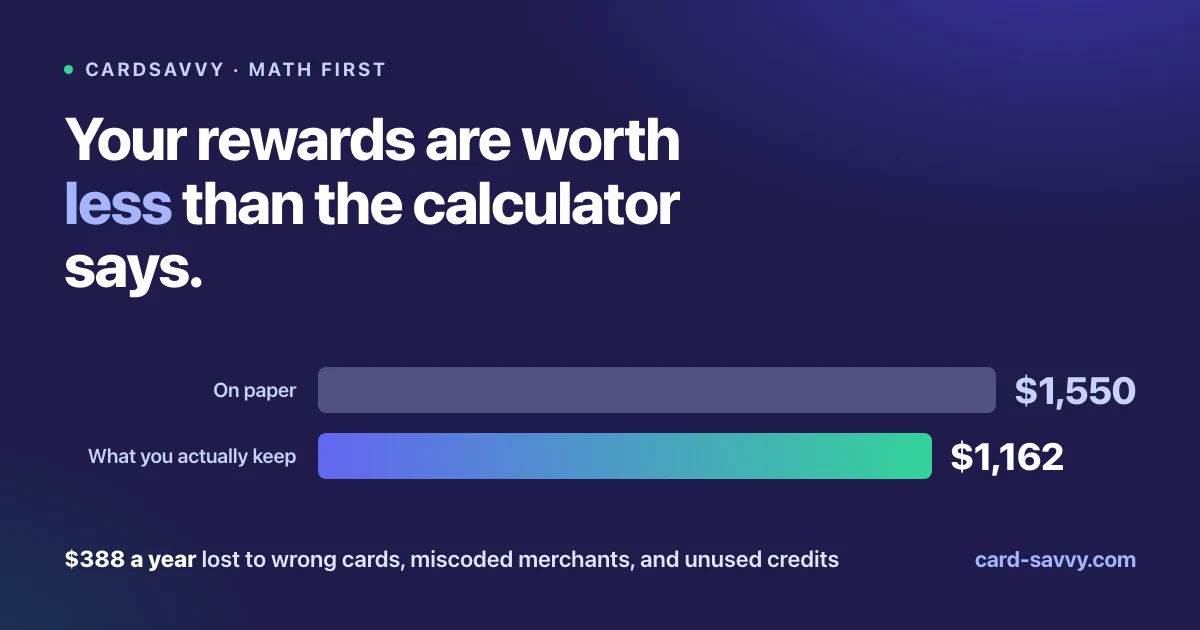
Why Your Credit Card Rewards Are Worth Less Than the Calculator Says
The optimization math is solved. Getting the money is not. Seven measurable gaps between the rewards a calculator promises and the value you actually keep, with the number attached to each.

The Summer Vacation Credit Card Audit: Rewards, Fees, Credits, and Interest
A repeatable summer travel credit card audit: check whether your card beat a 2% card after fees, the credits you used, interest, and foreign fees, plus the travel protections and refund rights most guides skip.

The 4th of July Credit Card Hangover: A 15-Minute Summer Rewards Audit
You already spent the money on July 4 travel, gas, and dining. Here's a 15-minute audit to check whether your cards earned what they should have, avoid interest, and set up the rest of summer.
Get smarter with your cards
Math-first card strategy posts, sent when we publish — not on a schedule. No spam. Unsubscribe anytime.
We respect your inbox.
Ready to optimize your wallet?
Get personalized card recommendations and spending strategies in under 2 minutes.
Free to use. No signup required.
Get My Strategy →Just need an answer for one purchase? Best Card →