Cancel vs. Downgrade in 2026: The Annual Fee Math for Sapphire Reserve, Venture X, Platinum, and Gold
A premium credit card renewal is a subscription decision. The fee just posted, and the question is whether the credits, points, and perks are worth more to you than the annual price.
The marketed value never matches the realistic value. Amex Platinum advertises more than $3,500 in annual value. Sapphire Reserve markets a long stack of credits on top of a $795 fee. The honest question is not "does this card offer more credits than the fee?" It is: would you willingly pay for these benefits at your own personal value, compared with the best downgrade or no-fee alternative?
This guide walks the math for the four most-renewed premium cards in 2026.
See which cards in your wallet actually earn their fee →
The Personal-Value Question
A credit is worth what it is worth to you, not what the issuer prints on the benefits page. A $300 dining credit that requires booking through a specific portal at a specific restaurant is not $300 if you would not otherwise eat there. A $120 Uber credit split into $10 monthly windows is not $120 if you forget two months.
Run this four-step check before deciding.
Step 1: Add up only the credits you used last year. Look at the calendar year you just lived through. Sum the dollar value of credits you actually redeemed, not the value the issuer prints on the card page.
Step 2: Add the rewards value you would lose by closing. That includes 4x dining or 3x travel multipliers if you cannot replicate them elsewhere in your wallet, plus the points you currently hold that depend on this account staying open.
Step 3: Subtract the annual fee. If the result is positive, renew. If negative, continue to step 4.
Step 4: Compare the gap to the best downgrade or alternative. A downgrade to a lower-fee card in the same family often keeps points, account age, and your line of credit intact. Cancelling makes sense when no downgrade target fits and you have already protected your points.
The rest of this post does this math card by card.
Should I Cancel or Downgrade My Chase Sapphire Reserve in 2026?

Sapphire Reserve charges a $795 annual fee. The credit stack is long, but most of it is restricted or split into time windows: a $300 annual travel credit (flexible), up to $500 for The Edit hotel bookings, up to $300 in Sapphire Exclusive Tables dining credits, up to $300 in StubHub credits, plus DoorDash, Lyft, and Peloton credits that require activation.
The clean way to think about it: the $300 travel credit is the only one most cardholders capture at face value. After that credit, you still need roughly $495 of additional personal value from points, lounges, travel protections, and restricted credits to clear the fee.
For a deeper breakdown of CSR's actual usable value, see our $5,500 CSR value math post.
Renew if you naturally use the $300 travel credit, visit Chase Sapphire Lounges or Priority Pass several times a year, and capture at least two of the restricted credits (The Edit, Exclusive Tables, StubHub, DoorDash, Lyft, Peloton).
Downgrade to Sapphire Preferred ($95) if you want to keep Ultimate Rewards transfer partners but cannot justify $795. The Preferred earns 5x on Chase Travel, 3x on dining, streaming, and online groceries, and 2x on other travel. It keeps full transfer access and only needs about $100 of net rewards to clear its own fee.
Downgrade to Freedom Unlimited or Freedom Flex ($0) if you have a separate Ink card keeping your transfer access alive. Without an Ink, Freedom downgrades turn your Ultimate Rewards into 1¢ cash back, which destroys most of their value.
Cancel only after you have moved or redeemed your Ultimate Rewards points. Chase points stay alive while any Ultimate Rewards-earning account is open. If Sapphire Reserve is your last one, transfer your balance to a travel partner or move points to a household member's account before closing.
Run your CSR numbers through the optimizer →
Is Venture X Still Worth the Annual Fee in 2026?

Venture X is the cleanest renewal case in the premium category. The $395 annual fee comes with a $300 Capital One Travel credit and 10,000 anniversary miles. If you book one trip through Capital One Travel each year and value the 10k miles at roughly $100, the fee is essentially neutralized before lounge access enters the picture.
The cautions are smaller. The $300 credit must be redeemed through Capital One Travel and does not earn rewards on the credited portion. The Global Entry or TSA PreCheck credit (up to $120 every four years) is real but should be amortized to about $30 per year, not counted as $120 annually.
Renew if you take at least one trip per year and are comfortable booking $300 of travel through Capital One Travel.
Downgrade to Capital One Venture ($95) if you want to keep simple 2x miles earning and some travel benefits but skip the portal credit and lounges.
Downgrade to Capital One VentureOne ($0) if the portal credit creates friction or you do not need lounge access. VentureOne now keeps access to Capital One transfer partners at no annual cost, though the earn rate drops to 1.25x miles on most purchases.
Do not renew blindly if you are pricing lounge access at sticker but rarely actually visit lounges. The math falls apart fast when lounge "value" is theoretical.
Honest call: most Venture X holders should renew. It is the rare premium card where the math is straightforward.
Should I Cancel Amex Platinum After the Fee Increase?

Amex Platinum carries an $895 annual fee in 2026 and advertises more than $3,500 in annual value. That value comes through a long list of fragmented credits: up to $600 hotel credit, $400 Resy credit, $300 digital entertainment credit, $300 lululemon credit, $200 Uber Cash, $120 Uber One credit, $200 airline fee credit, $209 CLEAR Plus credit, $155 Walmart+ credit, $200 Oura Ring credit, and $300 Equinox credit.
This is the purest coupon-book card on the market. Each credit requires a specific behavior, a specific merchant, or a specific spending pattern. The realistic value depends almost entirely on which credits already overlap with how you live.
The decision rule: Platinum works for people whose lives already match the credit map. It does not work for people who would have to change their behavior to capture the credits. If you are paying for lululemon items or Equinox memberships purely to use the credit, the credit is not free value.
Renew if you already use airport lounges several times a year, book at Fine Hotels + Resorts or The Hotel Collection, eat at Resy restaurants regularly, take enough Uber rides to clear $200 a year, and use at least two of the streaming, CLEAR, Walmart+, lululemon, Oura, or Equinox credits at face value.
Call for a retention offer before doing anything else. Amex's retention department sometimes offers $100-$300 in statement credits or Membership Rewards bonuses for keeping the card open another year. Include only that one-year value in your math.
Downgrade to Amex Green ($150) if preserving Membership Rewards matters and you do not have another MR-earning Amex card. Green earns 3x on travel and transit and keeps full transfer partner access at one-sixth the fee.
Cancel if the credits would be mostly breakage and you have another Amex card or Amex checking account keeping your Membership Rewards alive. If Platinum is your last Amex account, your unredeemed Membership Rewards points are forfeited immediately on closure. Move points to a partner first.
Platinum has the largest gap between marketed and realistic value in the premium lineup. Be honest about which credits you would have spent on anyway.
Is Amex Gold Worth $325 in 2026?

Gold is a food-spend card with a monthly-credit habit tracker attached. The $325 annual fee comes with up to $120 in dining credits (Grubhub, Five Guys, Cheesecake Factory, Wonder, Goldbelly), $120 in Uber Cash ($10 monthly), $100 in Resy credits (split into two halves of the year), and $84 in Dunkin' credits ($7 monthly).
The earn structure carries more weight than the credits: 4x on restaurants worldwide, 4x at U.S. supermarkets up to $25,000 per year, 5x on prepaid hotels through Amex Travel, and 3x on flights booked directly or through Amex Travel.
A household spending $15,000 on dining and groceries combined earns roughly 60,000 Membership Rewards per year. At a conservative 1.5¢ transfer value, that is $900 in points before credits.
Renew if you spend heavily at restaurants and U.S. supermarkets, already use Uber or Uber Eats monthly, eat at Resy restaurants, and pick up Dunkin' regularly.
Be skeptical if you are forcing monthly credits. A $10 Uber credit is not worth $10 if it triggers an incremental delivery fee or a ride you would not otherwise take.
Downgrade to Amex Green ($150) if you want to keep Membership Rewards but your food spend dropped or the monthly credit chase got annoying.
Cancel if you can match the dining and grocery rewards on a no-fee card and you have already protected your Membership Rewards balance.
For the head-to-head with Platinum, see our Amex Gold vs. Platinum 2026 post.
Downgrade vs. Cancel: What Happens to Your Points
This is the part most people get wrong. Closing the wrong card can vaporize points worth more than the annual fee.
Chase Ultimate Rewards. Points stay alive while at least one Ultimate Rewards-earning account is open. If you have Sapphire Reserve, Sapphire Preferred, and Ink Cash, you can close one and keep the points. If Sapphire Reserve is your only UR card, points downgrade to 1¢ cash back if you product-change to a Freedom card, and disappear entirely if you cancel without redeeming.
Amex Membership Rewards. Points are forfeited immediately if you close your last Amex card or Amex checking account without first redeeming or transferring them. There is no grace period. Always transfer or redeem before closing.
Capital One Miles. Miles transfer to any other Capital One rewards account in your name. If you have Venture X and VentureOne, you can close Venture X without losing miles.
Citi ThankYou Points. Points expire 60 days after you close your last ThankYou-earning account. Move them before that window closes.
The safe order is always: redeem or transfer points first, then make the cancel or downgrade call.
What to Do Before Your Annual Fee Posts
The 30 days before your annual fee posts is the highest-leverage window. Use it.
Check your last 12 months of credit usage. Most issuers show this in the card's online benefits tracker. Add up only the credits you actually redeemed.
Pull your last 12 months of category spend. If you have a tool that breaks down spend by category (the CardSavvy optimizer does this), you can see exactly how many bonus points you earned on this card.
Check whether a downgrade target exists. Each issuer has a different list of cards you can product-change to. Confirm the target card is open to product change before calling.
Move or redeem any points that depend on this card. If this is your only Membership Rewards account, transfer your balance to an airline or hotel partner before doing anything else.
Set a calendar reminder for 25 days after your fee posts. Most issuers will refund the fee if you cancel or product-change within 30 days. Missing that window costs you the full fee.
CardSavvy sends annual fee reminders to logged-in users 30 days before each card's fee posts. Save your wallet to get them automatically.
How to Ask for a Retention Offer
Retention offers are statement credits or points bonuses that issuers extend to keep you from closing the card. They are most common at Amex and Chase, less common at Capital One.
Call the number on the back of the card. Online chat sometimes works for Amex but phone is more reliable.
Tell the rep you are considering closing the account because the annual fee is hard to justify. Be honest, not performative.
Ask whether any retention offers are available. Common offers include $100-$300 in statement credits, 5,000-15,000 points after a spend threshold, or a partial fee waiver.
Do the math on the spot. A $200 statement credit on a $795 fee changes the picture but does not flip it. Only accept if your realistic value plus the offer clears the fee.
If no offer is available or the offer is too small, ask to downgrade. Most reps can process a product change on the same call.
Retention offers are not guaranteed. Some accounts get them, some do not. There is no penalty for asking.
Best Downgrade Paths by Issuer
| From | To (Fee) | What You Keep | What You Lose |
|---|---|---|---|
| Sapphire Reserve ($795) | Sapphire Preferred ($95) | UR transfer partners, 3x dining, 2x other travel | 8x Chase Travel, 4x direct flights/hotels, lounges, travel credit, restricted credits |
| Sapphire Reserve ($795) | Freedom Unlimited or Flex ($0) | Cash back earning, account history | UR transfer partners (unless you keep an Ink) |
| Venture X ($395) | Venture ($95) | 2x miles on everything, transfer partners | Lounges, travel credit, anniversary miles |
| Venture X ($395) | VentureOne ($0) | No-fee Capital One relationship, transfer partners | Lounges, travel credit, anniversary miles, drops to 1.25x earn |
| Amex Platinum ($895) | Amex Green ($150) | MR transfer partners, 3x travel/transit | Lounges, hotel credits, coupon-book credits |
| Amex Platinum ($895) | Amex Gold ($325) | MR partners, 4x dining and groceries | Lounges, hotel benefits |
| Amex Gold ($325) | Amex Green ($150) | MR transfer partners, 3x travel/transit | 4x dining/grocery, dining credits |
| Amex Gold ($325) | Blue Cash Everyday ($0) | No-fee Amex relationship | All Membership Rewards earning |
Two mechanical notes:
Always say "product change" or "downgrade" when calling, not "I want a new card." A new application creates a hard inquiry and a new account. A product change preserves your account number, history, and credit line.
Amex product changes between very different families (Platinum to Green, Gold to Green) are usually allowed, but Amex restricts some moves. Confirm with the rep before assuming.
Bottom Line
The cancel-vs-downgrade decision is a single subtraction. Personal value minus annual fee.
If it is positive, renew. If it is negative, look for a downgrade target that preserves your points and account history. If no downgrade target fits, close after redeeming points.
The strongest defaults across the four cards:
Venture X usually renews. The fee math is the cleanest in the premium category if you can use the $300 travel credit.
Amex Gold renews for high food spenders. If you spend more than $10,000 a year on combined dining and groceries and use the monthly credits without changing your behavior, it pencils.
Sapphire Reserve and Amex Platinum need harsher personal-value math. Their headline value depends on restricted, fragmented, or lifestyle-specific credits. Run the credit-by-credit audit honestly and downgrade if the gap does not close.
Save your wallet and get personalized annual fee reminders →
Cards Mentioned in This Article
Click any card above to see if it's worth adding to your wallet — personalized verdict in 30 seconds.
Related on Learn
Hand-picked based on topic and reader interest
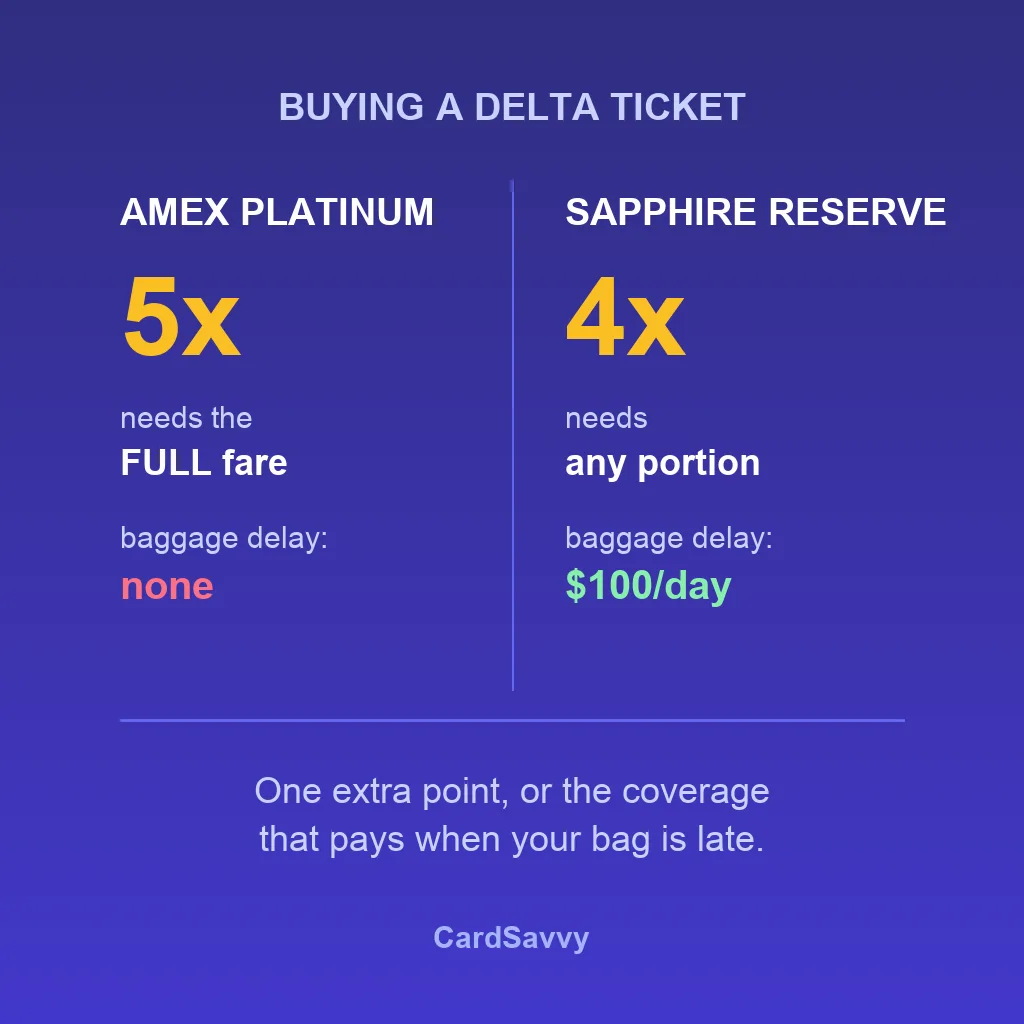
Which Card Should You Actually Buy Delta Tickets With?
Amex Platinum earns 5x on Delta airfare against the Sapphire Reserve's 4x. But Platinum requires the full fare charged to it and covers no baggage delay, which matters more than one extra point if you check bags.

Chase Sapphire Reserve StubHub Credit: $300 Guide (2026)
The Chase Sapphire Reserve's $300 StubHub credit is real, but resale markups and fees can quietly eat the value. Here's how to use it and what to actually count.

How to Use the CSR's $300 Dining Credit: Exclusive Tables Guide (2026)
The Chase Sapphire Reserve's $300 Exclusive Tables dining credit is narrow but real. Here's how to use it, the gotchas, and when it's actually worth it.

How to Actually Use the CSR's $500 Edit Credit Without Overpaying (2026 Guide)
The Chase Sapphire Reserve's $500 Edit credit sounds generous — until you overpay through the portal. Here's the math-first strategy to maximize it.
Get smarter with your cards
Math-first card strategy posts, sent when we publish — not on a schedule. No spam. Unsubscribe anytime.
We respect your inbox.
Ready to optimize your wallet?
Get personalized card recommendations and spending strategies in under 2 minutes.
Free to use. No signup required.
Get My Strategy →Just need an answer for one purchase? Best Card →