The 4th of July Credit Card Hangover: A 15-Minute Summer Rewards Audit
You already spent the money. By July 4, most of the summer travel bill is done. AAA expected a record 72.2 million Americans to travel at least 50 miles from home between June 27 and July 5. (AAA) If you were one of them, the gas, flights, hotels, dining, and event tickets are already sitting on a statement somewhere.
This is not a "best cards to apply for" post. The spending happened. The useful question now is whether your card setup quietly cost you more than it earned, and what you can still fix before the next trip. Give it 15 minutes.
Audit your actual spend in the optimizer →
First: don't let the rewards distract from the bill
Before optimizing a single reward, look at the balance. If July 4 spending turns into revolving debt, the rewards stop mattering.
The average credit card APR was 21.00% across all accounts in Q1 2026, and 21.52% on accounts charged interest, per the Federal Reserve's G.19 release. (Federal Reserve) A 3% cash-back win disappears in a few weeks once the balance sits at 21%.
A 2024 CFPB report put numbers on the imbalance: cardholders who carry balances earn about 27% of all rewards while paying roughly 94% of the interest and fees. (CFPB) The report also found that around 4% of accountholders lose access to at least some of their rewards each quarter through forfeiture rules.
So the first audit step is boring, and it is the one that matters: can you pay the July statement in full? If yes, keep reading. If not, the rewards math is a rounding error next to the interest, and the priority is the payoff plan. We walked through why a rewards-first mindset backfires under high APRs in our look at the 10% rate-cap idea.
Did you use the right card?
Now the audit itself. Break your summer spending into categories and ask one question for each: did it land on a card earning meaningfully more than 1-2%?
| Summer purchase | Flat-card rate | What a category card can earn |
|---|---|---|
| Gas / EV charging | 1-2% | 3-5% |
| Groceries / warehouse club | 1-2% | 3-6% |
| Dining / takeout | 1-2% | 3-5% |
| Flights / hotels | 1-2% | 3-5x points |
| Transit / tolls / parking | 1-2% | up to 5% |
| Live entertainment / parks | 1-2% | up to 5% |
| Drugstores / travel meds | 1-2% | up to 5% |
If everything went on a single flat-rate card, that is fine for simplicity, but you may have left money on gas, dining, and travel. If you own category cards and forgot to reach for them, that is the recoverable lesson for the rest of summer.
Two rotating-category programs are worth a specific check, because their summer categories line up with July 4 spending and both need activation.
Chase Freedom and Freedom Flex are running 5% back (on up to $1,500 in combined purchases) for Q3 2026 on gas stations and EV charging, public transit, select live entertainment, and United Way donations. You have to activate by September 14, 2026. (Chase)
Discover it added flights to its Q3 2026 list: gas stations and EV charging, public transit, flights, and drugstores, at 5% on up to $1,500 after activation. (NerdWallet) One caveat: after the Capital One acquisition, Discover's rotating-category format may not last long term, so treat it as accurate for this quarter and confirm before you count on it next year.
If you drove this summer and paid for gas or charging on a flat card, our gas and EV card breakdown shows what those categories can earn.
See which card should have caught each purchase →
Credits you may have already triggered
If you carry a premium card, treat it like a coupon book and check which coupons your summer spending already covered.
The Chase Sapphire Reserve, for example, includes a $300 annual travel credit that applies automatically to a wide range of travel purchases and resets on your cardmember anniversary rather than the calendar year. If you booked flights or a hotel for a July trip, some or all of that $300 may already be spent without you noticing. That credit sits against a $795 annual fee, so tracking it is the difference between the card paying for itself and quietly costing you.
Do not read this as a pitch to apply for the Sapphire Reserve. The goal is to audit whether the credits you already pay for matched what you bought. We scored the major premium cards on how usable their credits really are in the coupon-book scorecard, took apart Chase's headline value claim in the real CSR math, and laid out the renew-versus-downgrade decision in the annual-fee math post.
Would a boring 2% card have been simpler?
Here is the test that keeps the whole exercise honest. Add up your real category spend and compare what a complicated card earned against a flat 2% no-fee card, after the annual fee. Sometimes the trifecta wins. Sometimes it does not, once you subtract the fee and the credits you never used.
The calculator below runs that comparison. Enter your spend by category and it shows net value over a plain 2% baseline, after the annual fee and a realistic haircut on credits.
If the flat card comes out ahead or close, that is a signal to simplify. We compared the best flat-rate options in how to beat 2% on everything, and showed how a two-card setup beats most elaborate trifectas in this breakdown.
Save receipts before you need them
Summer travel is when card protections earn their keep, and they only work if you kept the paperwork. Before the trip fades from memory, save:
- Hotel folios and rental car agreements
- Flight delay or cancellation notices
- Baggage delay or loss reports from the airline
- Receipts for meals, toiletries, and replacement items bought during a delay
- Screenshots of any card offers or rotating categories you activated
Trip delay, baggage, and rental car coverage often reimburse real costs, but the claims want documentation you cannot recreate later.
Set up the rest of summer
Close the audit with a short forward-looking checklist:
- Activate your Q3 rotating categories if you have Chase Freedom or Discover.
- Move gas, transit, and live-entertainment spend onto the card that earns the most for the rest of the season.
- Use a card with no foreign transaction fee for any international trip.
- Book rental cars on the card whose coverage you actually understand.
- Redeem points on purpose. Hoarding them invites the next devaluation. Here is how to value points without fooling yourself.
- Skip opening a new card to justify spending that already happened. A signup bonus earned by chasing unplanned spend is not a win.
- Pay the July statement in full.
That last one is worth more than any category bonus on the list.
Run your real numbers through the optimizer →
Frequently Asked Questions
Related on Learn
Hand-picked based on topic and reader interest

The Summer Vacation Credit Card Audit: Rewards, Fees, Credits, and Interest
A repeatable summer travel credit card audit: check whether your card beat a 2% card after fees, the credits you used, interest, and foreign fees, plus the travel protections and refund rights most guides skip.
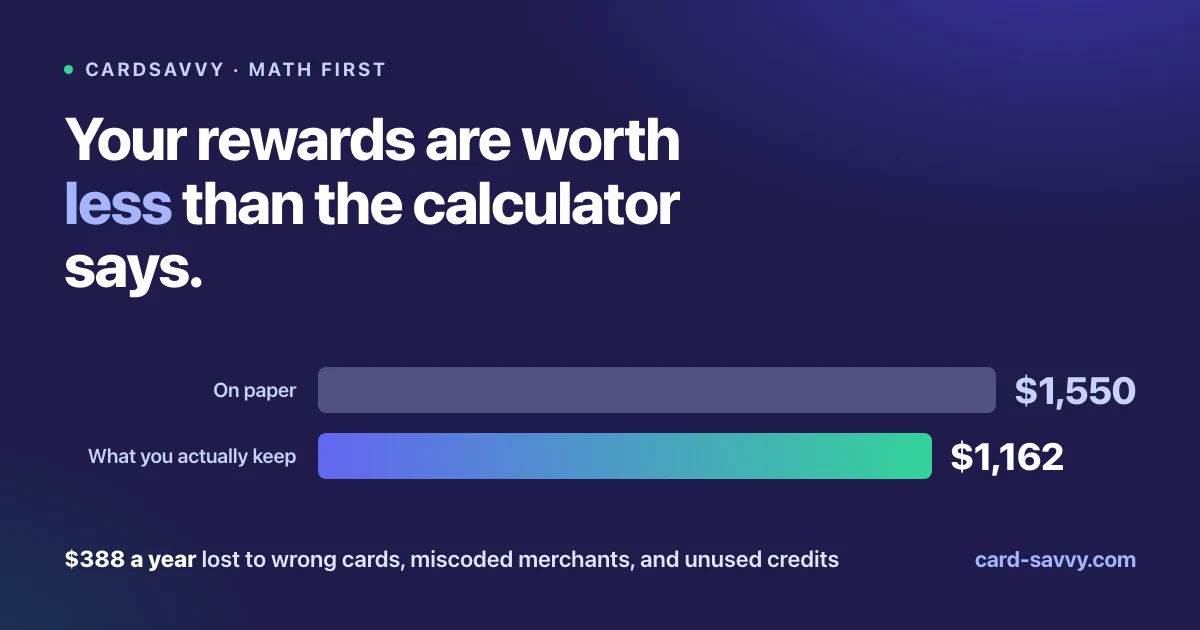
Why Your Credit Card Rewards Are Worth Less Than the Calculator Says
The optimization math is solved. Getting the money is not. Seven measurable gaps between the rewards a calculator promises and the value you actually keep, with the number attached to each.

What Should You Do After Optimizing Your Credit Cards?
Credit card rewards are the smallest lever in your financial life. Here is the hierarchy that matters more, the research behind it, and a calculator that shows what your rewards are actually worth.

The 2-Card Wallet That Beats 90% of Trifectas
Stop juggling 5 cards. We break down three 2-card setups that mathematically outperform most complex trifectas—with half the mental overhead.
Get smarter with your cards
Math-first card strategy posts, sent when we publish — not on a schedule. No spam. Unsubscribe anytime.
We respect your inbox.
Ready to optimize your wallet?
Get personalized card recommendations and spending strategies in under 2 minutes.
Free to use. No signup required.
Get My Strategy →Just need an answer for one purchase? Best Card →