Robinhood Platinum Card Review: Worth $695 for $15K+ Diners (2026)
TL;DR: Robinhood's Platinum Card offers a best-in-class 5% cash back on dining, but $1,750+ in "credits" rely heavily on portal-only bookings, monthly allowances, and niche wellness perks. For urban power diners spending $15k+ at restaurants, the math works. For most people, the Robinhood Gold Card at $0 effective cost is the smarter play.
Jump to: Credits breakdown | Break-even math | Comparison table
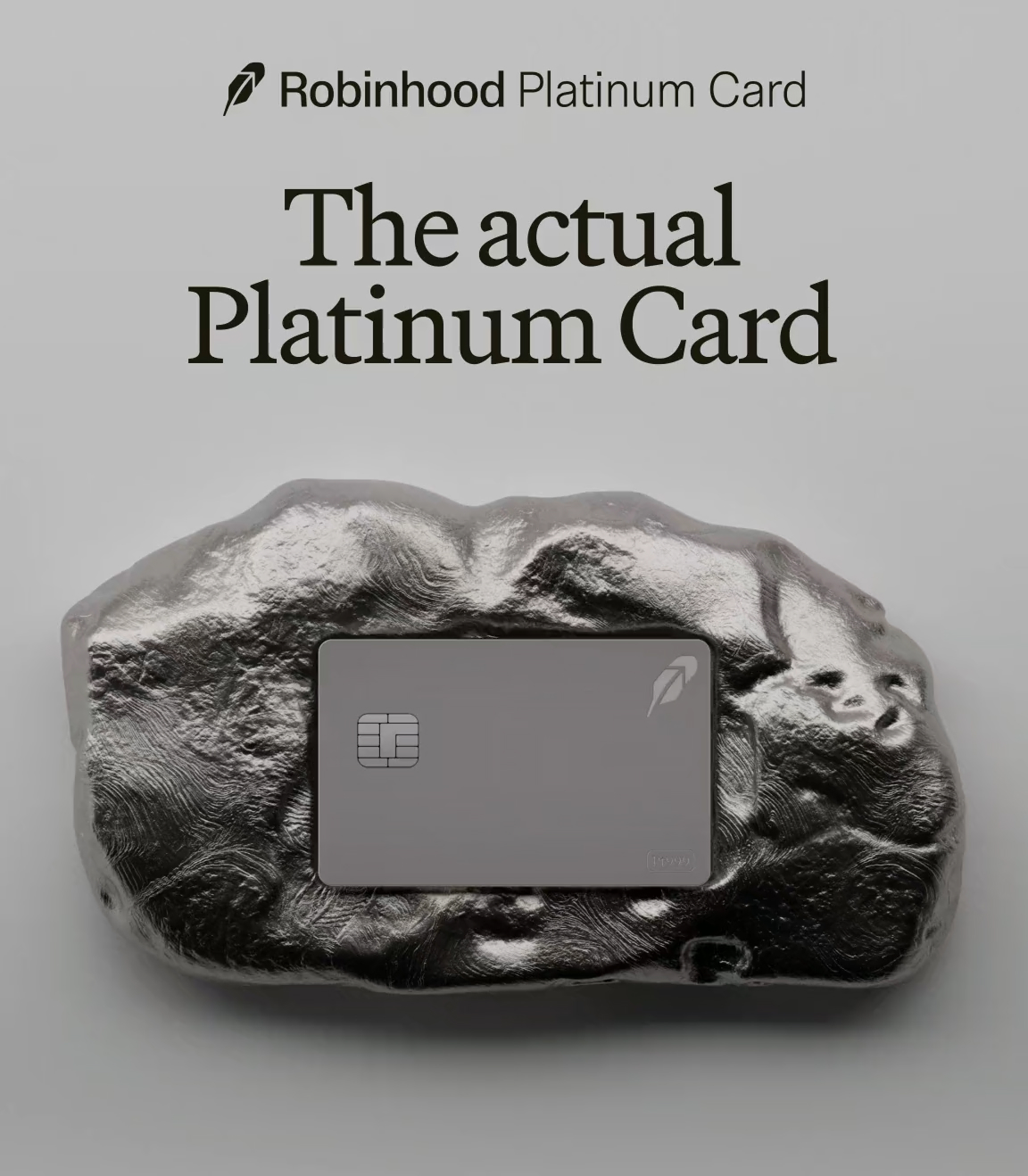
Robinhood just crashed the premium credit card party.
At its "Take Flight" event on March 4, 2026, the fintech unveiled the Robinhood Platinum Card, a metal card with a $695 annual fee, 5% dining cash back, and a benefits list long enough to make Amex nervous. It is the company's second credit card product, following the Robinhood Gold Card that turned heads with its flat 3% cash back structure.
The pitch is bold: premium travel perks at a lower price point than the Amex Platinum ($895) or the Chase Sapphire Reserve ($795). But as we have learned from years of coupon-book economics, a big benefits list does not automatically mean big value. The question is whether the math holds up for real spending patterns.
See how a $695 card fits your wallet math →
At a Glance
| Detail | Value |
|---|---|
| Annual Fee | $695 |
| Network | Visa |
| Dining | 5% cash back (up to $50k/yr) |
| Flights | 5% via Robinhood Travel |
| Hotels/Cars | 10% via Robinhood Travel |
| Everything Else | 1% cash back |
| Travel Credit | $300/year (broad) |
| Total Claimed Credits | $1,750+ |
| Lounge Access | Priority Pass |
| Availability | Invite-only (March 2026) |
| Requirement | Robinhood brokerage account |
Rewards Deep Dive
5% Dining: Best-in-Class Cash Back
The headline number is real, and it is impressive. At 5% cash back on dining, the Robinhood Platinum beats every major competitor on raw rate:
- Amex Gold: 4x Membership Rewards (worth ~4% at best)
- Chase Sapphire Reserve: 3x Ultimate Rewards
- Citi Strata Premier: 3x ThankYou Points
There is a cap at $50,000 per year in dining spend, after which you drop to 1%. For context, that is over $4,100 per month at restaurants. Most diners will never hit this ceiling.
If you spend $10,000 per year on dining, the Platinum earns $500 in cash back from restaurants alone. At $15,000, that jumps to $750. These are meaningful numbers that do real work toward offsetting the annual fee.
For more on the dining card landscape, see our full Best Dining Credit Cards 2026 guide.
Portal-Only Travel: 5% Flights, 10% Hotels
Here is where the asterisks start piling up. The 5% rate on flights and 10% on hotels and rental cars only apply to bookings made through Robinhood Travel, the company's proprietary travel portal.
This is a significant caveat. Portal pricing for travel has a mixed track record across the industry. Chase Travel, Amex Travel, and Capital One Travel all occasionally show prices above direct booking rates. Robinhood's portal is brand new, with no track record to evaluate.
What this means in practice: If a $200/night hotel costs $220 through the portal, that 10% "savings" of $22 barely covers the $20 portal markup. You need to compare prices every time, which adds friction.
We will withhold judgment until real-world pricing data emerges. For now, treat the portal rates as a best-case scenario, not a guarantee.
The "No Points on Credited Purchases" Gotcha
One detail buried in the reward terms: you do not earn cash back on purchases that are offset by statement credits. If you use your $300 travel credit on a flight, you earn 0% on that portion.
This is not unique to Robinhood (Amex does this too), but it does slightly reduce the net value of the rewards structure.
Redemption Lock-In
Your cash back lives inside the Robinhood ecosystem. You need an active Robinhood brokerage account to hold the card and redeem rewards. Cash back can be deposited into your brokerage account or used through Robinhood's platform, but there are no transfer partners and no points-to-miles conversions.
For people who already use Robinhood for investing, this is a non-issue. For travel hackers who rely on transfer partners to extract outsized value from Amex or Chase points, this is a dealbreaker. If you just want straightforward cash back without ecosystem lock-in, our best unlimited cash back cards guide covers the simplest options.
The Credits "Coupon Book": Easy, Medium, Hard
Robinhood claims over $1,750 in annual credits. As we have written about extensively in our coupon-book analysis and premium credits scorecard, the real question is not "how much is listed?" but "how much will you actually capture?"
Easy Credits (High Capture Rate)
These credits require minimal effort and align with common spending patterns.
$300 Travel Credit — Applies broadly to travel purchases (airlines, hotels, car rentals, transit). Unlike portal-restricted credits, this works on direct bookings. This is the single most valuable credit on the card because it resembles real money.
Priority Pass Lounge Access — Standard premium card perk. If you fly 4+ times per year, you know the value. Guest access details are still TBD.
TSA PreCheck / Global Entry — Up to $100 every 4-5 years. Nice to have, but not a major value driver.
Medium Credits (Moderate Effort Required)
These require monthly attention or specific merchant usage.
$250 Restaurant Credits ($20/month) — Monthly restaurant statement credits. If you dine out regularly, this should flow naturally. But monthly cadences mean you lose any month you forget or skip. Realistic capture rate: 70-90%.
$250 Autonomous Ride Credits ($20/month) — Credits for Waymo and similar autonomous ride services. This is a genuinely novel perk, but only useful if you live in a city with active Waymo service (currently San Francisco, Phoenix, Los Angeles, Austin). For everyone else, this is $250 of phantom value. Realistic capture rate: 0-80% depending on location.
Hard Credits (Low Capture Rate for Most)
These credits sound impressive but carry significant restrictions.
$250 DoorDash Credits — Requires a minimum $50 order to trigger the credit. This nudges you toward spending more per order than you normally would. If you already order large family meals on DoorDash, it works. If you are a solo orderer averaging $25, you are doubling your spend to capture the credit. Realistic capture rate: 40-70%.
$500 Hotel Credits — Only valid through Robinhood Travel portal, requires a 2-night minimum stay, and appears limited to "luxury" hotel inventory. This is the single biggest credit on the card and also the hardest to use naturally. If you take 2-3 luxury hotel trips per year through the portal, it is excellent. If you book through Hilton or Marriott direct for status and points, this credit sits unused. Realistic capture rate: 20-60%.
Lifestyle-Dependent Credits
These are valuable only if you already subscribe to these services.
| Credit | Annual Value | What It Covers |
|---|---|---|
| Function Health | $365 | Health testing membership |
| One Medical | $199 | Primary care membership |
| Oura Ring | $70 | Smart ring subscription |
| Wearables | $200 | Fitness devices |
Total lifestyle credits: $834. But if you do not use Function Health, do not have a One Medical membership, and do not wear an Oura ring, this entire block is worth exactly $0 to you.
Credits Summary
| Category | Credits | Capture Rate | Realistic Value |
|---|---|---|---|
| Easy | $300 travel + lounge | 90-100% | $270-$300 |
| Medium | $500 dining + rides | 50-85% | $250-$425 |
| Hard | $750 DoorDash + hotel | 20-60% | $150-$450 |
| Lifestyle | $834 wellness | 0-100% | $0-$834 |
| Total | $2,384 | $670-$2,009 |
The gap between the claimed $2,384 and the realistic $670-$2,009 is where issuers make their money. As we explained in our coupon-book post, that unused value is called breakage, and it is the business model.
Break-Even Profiles: Who Actually Wins?
Let us run three real-world scenarios to see when this card makes financial sense.
Scenario 1: Urban Power Diner
- Dining: $15,000/year
- Lives in a Waymo city: Yes
- Takes 3+ hotel trips via portal: Yes
- Uses DoorDash regularly: Yes (large orders)
| Line Item | Value |
|---|---|
| 5% dining cash back | +$750 |
| Travel credit | +$300 |
| Restaurant credits | +$225 |
| Autonomous ride credits | +$200 |
| DoorDash credits | +$175 |
| Hotel credits | +$250 |
| Priority Pass | +$160 |
| Annual fee | -$695 |
| Net value | +$1,365 |
This is the card's sweet spot. If this profile sounds like you, the Platinum delivers real value.
Scenario 2: Frequent Traveler
- Dining: $8,000/year
- Lives outside Waymo cities: Yes
- Takes 4+ hotel stays: Yes (but books direct for status)
- Occasional DoorDash: Yes
| Line Item | Value |
|---|---|
| 5% dining cash back | +$400 |
| Travel credit | +$300 |
| Restaurant credits | +$200 |
| Autonomous ride credits | +$0 |
| DoorDash credits | +$100 |
| Hotel credits | +$100 |
| Priority Pass | +$160 |
| Annual fee | -$695 |
| Net value | +$565 |
Positive, but not by a huge margin. This traveler might get more value from the Amex Platinum with its Centurion Lounges and extensive transfer partners.
Scenario 3: Casual Spender
- Dining: $5,000/year
- No Waymo access
- Rarely travels
- Light DoorDash use
| Line Item | Value |
|---|---|
| 5% dining cash back | +$250 |
| Travel credit | +$150 |
| Restaurant credits | +$150 |
| Autonomous ride credits | +$0 |
| DoorDash credits | +$50 |
| Hotel credits | +$0 |
| Annual fee | -$695 |
| Net value | -$95 |
The math does not work. This person should stick with the Robinhood Gold Card (3% everywhere with a $50/year Gold subscription), a no-fee dining card, or a simple two-card setup that covers the basics.
Robinhood Platinum vs Amex Platinum vs CSR
| Feature | Robinhood Platinum | Amex Platinum | CSR |
|---|---|---|---|
| Annual Fee | $695 | $895 | $795 |
| Dining Rate | 5% cash back | 1x MR | 3x UR |
| Flight Rate | 5% (portal only) | 5x (direct + portal) | 3x (direct + portal) |
| Hotel Rate | 10% (portal only) | 5x (prepaid via portal) | 3x (direct + portal) |
| Travel Credit | $300 (broad) | $200 airline + hotel credits | $300 travel + $500 Edit |
| Lounge | Priority Pass | Centurion + Priority Pass | Priority Pass |
| Transfer Partners | None | 20+ airlines/hotels | 14+ airlines/hotels |
| Points Currency | Cash back (Robinhood) | Membership Rewards | Ultimate Rewards |
The elephant in the room: No transfer partners. Amex and Chase points can be transferred to airline and hotel programs for outsized value (often 2-5 cents per point on premium redemptions). Robinhood's cash back is worth exactly 1 cent per cent. For travel hackers, this is a fundamental limitation.
However, for people who want simple cash back without the complexity of transfer valuations and sweet-spot award charts, the Robinhood Platinum delivers higher raw percentages in dining than either legacy competitor.
What We Still Don't Know
The card was just announced, and several important details remain unclear:
- Sign-up bonus: No bonus has been announced. Given the premium positioning, a launch bonus could significantly change the first-year math.
- Portal pricing: Will Robinhood Travel be price-competitive with direct bookings? This determines whether the 5% flight and 10% hotel rates deliver real savings or are offset by inflated portal prices.
- Authorized user pricing: Premium cards typically charge $175-$195 per additional user. Robinhood has not disclosed AU fees yet.
- Purchase protections: Extended warranty, purchase protection, cell phone insurance. These "invisible" benefits matter and details are pending.
- Upgrade path from Gold: Can existing Robinhood Gold cardholders upgrade seamlessly? Will they keep their account history and credit line?
- Long-term credit sustainability: Robinhood is a public company burning through customer acquisition costs. Will these generous credits survive the first annual review?
We will update this post as details emerge.
Quick Decision Guide
Get the Robinhood Platinum if...
- You spend $10,000+ per year on dining and want the highest cash back rate available
- You live in a Waymo-served city and can actually use the autonomous ride credits
- You prefer simple cash back over managing points transfers and award charts
- You already use Robinhood for investing and want everything in one ecosystem
Skip it if...
- You value transfer partners. Amex MR and Chase UR are far more flexible for premium travel redemptions.
- You book hotels direct for status. The $500 hotel credit requires portal bookings, which means forgoing Hilton/Marriott elite benefits.
- You spend under $8,000/year on dining. The 5% rate does not generate enough cash back to overcome the $695 fee when credits are hard to capture.
- You don't live near Waymo service. The $250 autonomous ride credits become $0 of real value.
FAQ
What is the Robinhood Platinum Card annual fee?
The Robinhood Platinum Card has a $695 annual fee. This is lower than the Amex Platinum ($895) and Chase Sapphire Reserve ($795), but higher than most mid-tier premium cards.
Can you hold both the Robinhood Gold and Platinum Card?
Reports indicate you cannot hold both cards simultaneously. You would need to upgrade from the Robinhood Gold Card to the Platinum. This means giving up the Gold Card's simple 3% everywhere structure in exchange for the Platinum's higher dining rate but more complex credit system.
Is the Robinhood Platinum Card available now?
The card launched as invite-only on March 4, 2026, at Robinhood's "Take Flight" event. Broader availability is expected in Q2 2026. If you are interested, joining the waitlist through Robinhood's app is the fastest path.
Does the 10% hotel rate work on any hotel booking?
No. The 10% rate only applies to bookings made through Robinhood's travel portal. Direct bookings with hotels (Marriott.com, Hilton.com, etc.) earn the standard 1% rate. This is an important distinction, especially for travelers who rely on direct bookings for elite status benefits and flexible cancellation policies.
The CardSavvy Verdict
The Robinhood Platinum Card is the most aggressive fintech play in the premium card space to date. The 5% dining rate is genuinely best-in-class, the $695 fee undercuts both legacy premium competitors, and the travel credit is refreshingly broad. For the right cardholder (urban, high dining spend, Robinhood user), this card can deliver $1,000+ in net annual value.
But "right cardholder" is doing a lot of heavy lifting in that sentence. The portal-only travel multipliers are unproven, the $500 hotel credit is restrictive, the autonomous ride credits are geographically limited, and the lack of transfer partners removes the single most powerful tool in a travel hacker's arsenal. Robinhood is essentially betting that simplicity (cash back) and raw percentages (5% and 10%) can beat the flexibility of Amex and Chase ecosystems.
If you are not sure whether the Platinum's credit stack aligns with your actual spending, do not guess. Run your numbers through the optimizer and let the math decide.
Card image courtesy of Robinhood.
Related on Learn
Hand-picked based on topic and reader interest
AAA Credit Cards Review (2026): The 5% Is Real, but Mind the Caps
AAA's Daily Advantage and Travel Advantage cards pay 5% on groceries or gas with no annual fee. We do the cap math most reviews skip and show who actually comes out ahead.

Coinbase One Card Review: 4% Bitcoin Back Is Real, but Most People Won't Earn It
The Coinbase One Card offers up to 4% bitcoin back on purchases. We break down the asset tiers, monthly caps, and membership costs to show who actually benefits.
Citi Strata Premier Review 2026: The Underrated 3x Grocery + Gas Travel Card
Citi Strata Premier earns 3x on groceries, gas/EV, dining, and travel for $95/year—plus a $100 hotel benefit. Here is the 2026 math on points value, transfer partners, and the cash-out change you need to know about.
Best Credit Cards for Coffee Shops and Cafés in 2026: The MCC Decides
Which card earns the most at coffee shops in 2026, why bakery cafés and hotel lobby counters quietly lose your dining bonus, and how much optimizing a $5.54 latte is actually worth.
Get smarter with your cards
Math-first card strategy posts, sent when we publish — not on a schedule. No spam. Unsubscribe anytime.
We respect your inbox.
See the math for yourself
Is the $695 annual fee worth it?
Free calculator. No signup required.
Try the Robinhood Platinum Calculator →