Credit Card Retention Offers: How to Ask, and the Number to Know Before You Call
A retention offer is a statement credit or points bonus an issuer gives you to keep a card you were about to close or downgrade. Whether to take it comes down to one comparison: the card with the offer against your plan if you say no. If keeping comes out at least $10 ahead, accept.
Work out the smallest offer that clears that bar before you call. We call it the walk-away number. On a $99 card you'd otherwise downgrade to a free card, using none of its perks, it is $109, or 8,385 miles with no spending.
When to Call
Call after the annual fee posts. That is when the decision is real. Thrifty Traveler found that many successful Sapphire Reserve retention calls came after the fee posted, while cardholders were still inside the refund window.
Don't wait past the refund window. Federal Regulation Z requires issuers to send a notice before a renewal fee hits your statement. You then have at least 30 days or one billing cycle, whichever is shorter, to close the account, and the issuer must reverse the fee if you do.
A downgrade isn't a closure, so the refund on a product change is issuer policy. The Points Guy reports that Chase typically refunds the fee only within 30 days of it posting. One Mile at a Time reports Citi refunds for up to 37 days. Ask on the call how much comes back before you agree to anything.
Your Walk-Away Number
Everything that both choices keep drops out of the math. A downgrade keeps the account's age and credit line, and points you can still use either way stay put. For example, any open AAdvantage card keeps American miles from expiring, so the $0 MileUp protects them as well as the $99 Platinum Select does.
What's left is the yearly difference between keeping the card and switching:
- What switching costs you: credits you'd actually use, free checked bags, extra rewards the card earns over your other cards, and lounge visits you'd otherwise pay for. Subtract whatever the downgrade card gives back.
- The fee difference: this card's fee minus the downgrade card's fee. Closing the card, or switching to a no-fee card, counts as $0.
Your break-even is the fee difference minus what switching costs you. Add $10 and you have the walk-away number. The $10 margin is the tie threshold CardSavvy's card comparisons use. Below it, the two choices are too close to call.
Count a credit only if you'd use it without the card nudging you. Our points valuation guide uses the same rule, and the gap between paper and realized rewards is usually wider than people expect.
How to Ask
Call the number on the back of the card. Amex sometimes handles these requests by chat.
Say you're thinking about closing the account because the annual fee is hard to justify, and ask whether any retention offers are available. Keep it plain. You don't need a speech, and you shouldn't threaten to close a card you plan to keep.
When the rep makes an offer, ask for the exact terms: the credit or points, any spending requirement, and the deadline. Then check it against your walk-away number. If there's no offer, or it falls short, ask for the product change on the same call.
What Issuers Have Offered Recently
Retention offers are personal. Two people with the same card can hear different offers, and some hear none. The list below comes from Travel on Points, whose readers reported these offers in a post updated October 17, 2026. Issuers don't publish retention offers, so reader reports are the best data available.
| Card | Offers readers reported |
|---|---|
| Amex Platinum | 15,000 points after $3,000 spend (most common lately), up to 50,000 |
| Amex Gold | 20,000 points after $2,000 spend (most common lately) |
| Chase Sapphire Reserve | $100 to $400 statement credit, no spend |
| Chase Sapphire Preferred | $60 or $65 statement credit, no spend |
| Citi Strata Premier | 10,000 points after $3,000 spend |
| Citi / AAdvantage Platinum Select | 10,000 miles after $1,000 spend; $100 after $3,000 |
| Capital One Venture X | $200 travel credit after $2,000 spend; $100 travel credit |
A bigger number isn't always a better offer. The spending requirement decides a lot of these, as the next section shows.
Check an offer against your walk-away number →
Worked Example: Platinum Select vs. the $0 MileUp
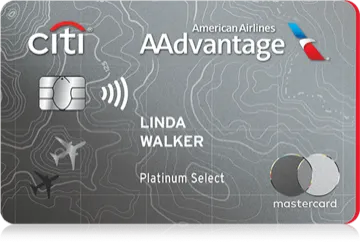
Take a Platinum Select holder at the current $99 fee who doesn't fly American and doesn't use the card's credits. If they say no, they switch to the $0 AAdvantage MileUp. We value AAdvantage miles at 1.3 cents, and their everyday card earns 2.3%, so every dollar moved onto the Platinum Select's 1 mile per dollar gives up 1 cent.
Switching costs them nothing, so the break-even is the $99 fee and the walk-away number is $109. Renewals on or after January 24, 2027 bill $150, which moves the walk-away number to $160.
| Offer | Worth | vs. MileUp | Verdict |
|---|---|---|---|
| Fee waived | $99 | $0 | Close call |
| $50 credit | $50 | -$49 | Switch |
| $100 after $3,000 spend | $70 | -$29 | Switch |
| 10,000 miles after $1,000 spend | $120 | +$21 | Accept |
| 10,000 miles after $3,000 spend | $100 | +$1 | Close call |
| 10,000 miles, no spend | $130 | +$31 | Accept |
The two offers readers reported on this card land on opposite sides. 10,000 miles after $1,000 of spending is worth $130 in miles minus $10 of rewards given up, so it clears the bar. $100 after $3,000 of spending costs $30 to earn, nets $70, and falls short.
A fee waiver only ties. It makes the card free for a year, which is what the MileUp already is. If you'll fly American with checked bags, the answer changes: one round trip for two people saves $180 in bag fees and pays for the card without any offer. The bag fee calculator covers other airlines.
Worked Example: Sapphire Reserve vs. Sapphire Preferred

The same math works with a fee on both sides. Say a Sapphire Reserve holder uses the $300 travel credit and nothing else, and would downgrade to the $95 Sapphire Preferred, using none of its credits. The fee difference is $700. Switching costs them the $300 credit. Break-even is $400, and the walk-away number is $410.
The largest Reserve offer readers reported, a $400 statement credit, only ties. A $250 credit leaves them $150 behind the downgrade.
Most Reserve holders get more than the travel credit, so their number is lower. Put lounge visits you'd pay for and the card's extra points on dining and travel into "anything else you'd lose" in the calculator. The optimizer shows what the Reserve adds to your wallet over your other cards. Our Sapphire Reserve value breakdown goes credit by credit.
Before You Accept
Get the terms in writing in the chat, or note the rep's name and the date on a phone call. Confirm these:
- The deadline and the spending window. Most reported points offers give you 3 months.
- When the credit or points post. Don't close or downgrade until they do.
- How long you need to keep the card. Amex's welcome-offer terms let it take points back if you cancel or downgrade within 12 months. Retention offers come without published terms, so plan to keep the card at least a year after accepting one.
If you switch instead, confirm how much of the fee comes back, whether your card number changes, and that your points or loyalty number stay linked. Our cancel vs. downgrade guide covers which points survive which move.
Quick Decision Guide
- The offer is worth at least your walk-away number: accept it, and keep the card for a year.
- The offer is within $10 of break-even: either choice is fine. Pick the simpler one.
- The offer falls short: ask for the product change on the same call.
- No downgrade keeps your points: move or redeem them before you close the card.
- The card already earns its fee for you: keep it. Any offer is extra.
- The offer needs spending you'd do anyway: count the spending as free.
Frequently Asked Questions
When should I ask for a retention offer?
After the annual fee posts and before the refund window closes. Federal rules give you at least 30 days or one billing cycle after the renewal notice to close the account and have the fee reversed. Refunds on a product change are issuer policy; Chase typically refunds within 30 days of the fee posting.
How much should a retention offer be worth?
At least your walk-away number: the fee difference between keeping the card and your downgrade, minus what switching would cost you in credits, bags and other perks, plus a $10 margin. For a $99 card you'd otherwise downgrade to a $0 card with nothing lost, that is $109.
Is a fee waiver a good retention offer?
Only if the card gives you something a no-fee card doesn't. A full waiver makes the card free for a year, which ties with switching to a $0 card unless you'd use its credits, bags or other perks.
How do I value a retention offer that requires spending?
Subtract the rewards you give up by moving that spending from your best card. 10,000 miles worth 1.3 cents each is $130, but meeting a $3,000 requirement on a 1.3% card instead of a 2.3% card costs $30, so the offer is worth $100. If you'd put the spending on the card anyway, it costs nothing.
Should I downgrade or cancel if I turn down the offer?
Downgrade when a no-fee or lower-fee card in the same family keeps your points alive. A product change keeps the account open with its age and credit line. Closing can raise your credit utilization, according to the CFPB.
Related on Learn
Hand-picked based on topic and reader interest
Cancel vs. Downgrade in 2026: The Annual Fee Math for Sapphire Reserve, Venture X, Platinum, and Gold
Your premium card's annual fee just posted. Should you renew, downgrade, or cancel? Here is the personal-value math for Chase Sapphire Reserve, Capital One Venture X, Amex Platinum, and Amex Gold in 2026.
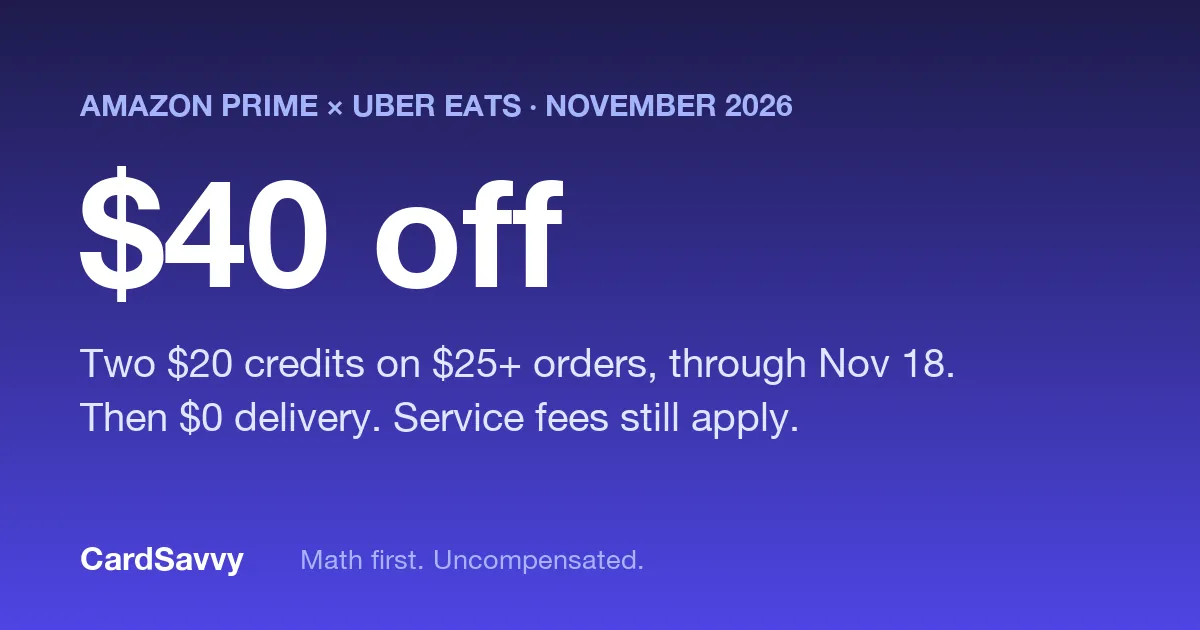
Amazon Prime Uber Eats: $40 Off + $0 Delivery Fee (November 2026)
Prime members get $20 off each of two $25+ Uber Eats orders through Nov 18, then a $0 delivery fee via Amazon. What still costs extra, and the card to use.
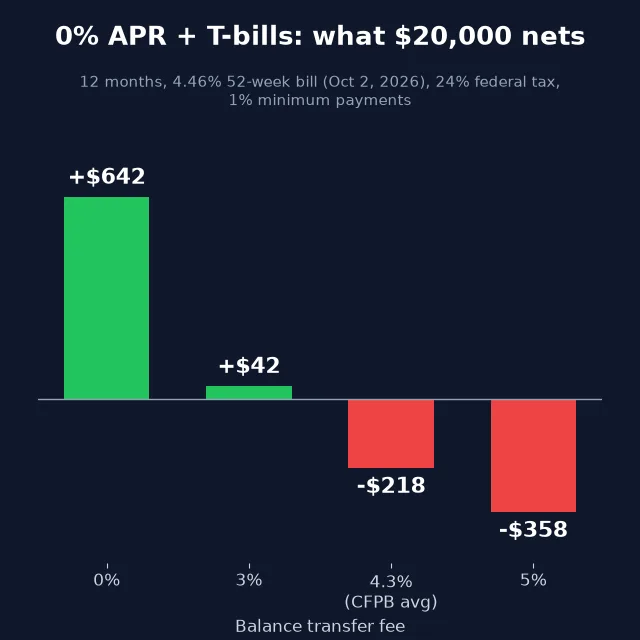
Using a 0% APR Card to Earn Interest: Credit Score and Fine-Print Risks (2026)
Parking a 0% APR balance in T-bills can pay, but the transfer fee, a lost grace period, utilization and mortgage timing decide whether it does. The fine print, checked.

Delta Gold Is a Card to Hold, Not a Card to Spend On
The $150 Delta Gold earns its fee through the checked-bag waiver and TakeOff 15, not through 2x SkyMiles. That distinction decides who should carry it and what belongs on it.
Get smarter with your cards
Math-first card strategy posts, sent when we publish — not on a schedule. No spam. Unsubscribe anytime.
We respect your inbox.
Ready to optimize your wallet?
Get personalized card recommendations and spending strategies in under 2 minutes.
Free to use. No signup required.
Get My Strategy →Just need an answer for one purchase? Best Card →