X Money Review (2026 Update): 6% APY, Up to 3% Debit Cash Back, and the $10M FDIC Fine Print
X Money is now a documented product instead of a beta built on screenshots. X has published a rate disclosure, cash back terms, a fee schedule and a Cross River Bank account agreement. Since September 23 it no longer requires an X subscription: $1,000 of qualifying direct deposit every 34 days earns 6% APY and up to 3% back on eligible debit purchases.
Our updated verdict: X Money is legitimate and worth opening as a second account if you can route that deposit. Use the X Card as a 3% gap-filler where your best card earns 2%. Keep your main checking account and emergency fund at an institution with a longer track record, because the rate is variable, the rewards terms give X broad discretion, and the exclusion list has already grown once.
What changed since July: we originally wrote this post when X Money was limited to Premium+ subscribers and had no binding disclosures. The Premium+ break-even math is gone, our Regulation II section was wrong for this card, and the FDIC, platform-risk and Reg E sections are now more precise.
This post has no referral or affiliate links, and CardSavvy is uncompensated. We are not paid to recommend X Money either way.
Run your own numbers in the optimizer →
What X Money is now
X Payments LLC runs the app and is not a bank. The deposit account (formally a "Stored Value Account") and the Visa debit card are issued by Cross River Bank, Member FDIC, a New Jersey bank that powers many fintech products. Cross River announced the partnership on July 27, 2026. (Cross River)
The account agreement is also on file with the CFPB, listed as the "X Money Stored Value Account" with a September 14, 2026 agreement date. (CFPB) A listing there is a filing requirement, not an endorsement. It does show this is a regulated consumer account with published terms.
Functionally it works like a checking account. You get routing and account numbers, direct deposit, ACH transfers, wires, mobile check deposit, cash loads at retailers, free peer-to-peer payments, up to three secondary accounts, and Plaid connections. (X Money FAQ) There is no overdraft feature. X still describes the service as rolling out to U.S. residents, and you need to be 18 or older with an X account in good standing.
Rates by tier
| Tier | APY | Debit cash back |
|---|---|---|
| No subscription or Basic | 4%, or 6% with qualifying deposit | 1%, or up to 3% with qualifying deposit |
| Premium | 4%, or 6% with qualifying deposit | Up to 3% |
| Premium+ | 6% | Up to 3% |
A qualifying deposit is $1,000 or more within a trailing 34 days, made up of ACH direct deposits with SEC code PPD (the code payroll uses) or X creator payouts. (X Money rates) P2P payments, wires and cash loads don't count. Whether a transfer you push from your own bank counts depends on the code your bank uses, and X doesn't say. The safest route is redirecting part of a paycheck.
You don't have to use the X Card to earn 6%. The rate terms set no spending requirement or minimum number of purchases; the only conditions are Premium+ or the $1,000 qualifying deposit. Card spending affects only cash back. Because the window is 34 days, a paycheck paid monthly or twice a month keeps you qualified as long as at least $1,000 of it lands in X Money.
The 6% APY corresponds to a 5.83% interest rate, and 4% to 3.92%. X's disclosure says the "APY and interest rate are variable and subject to change at any time," and the account agreement allows X to discontinue interest. We found no promotional end date and no balance cap.
New York residents earn no interest at any tier. X instead offers them a one-time $300 bonus after $3,000 of qualifying deposits within 90 days.
Premium, about $84 a year on the web, gets you 3% cash back without the deposit. Premium+, about $395 a year, gets 6% and 3% automatically. For X Money alone, neither is worth buying if you can route $1,000 of paycheck.
Is 6% worth it?
The Fed raised its target range to 3.75% to 4.00% on September 17. (Federal Reserve) On October 2 the 3-month Treasury bill yielded 4.11% on a coupon-equivalent basis. (Treasury) The best ordinary high-yield savings accounts paid about 4.2% to 4.3%. So 6% sits roughly 1.7 to 1.9 points above comparable safe cash.
On $25,000 that is about $450 a year before tax against a 4.2% savings account. Add $20,000 of eligible spending moved from a 2% card to the X Card, and the extra point of cash back adds $200. Together that comes to $650 a year.
Taxes shrink the yield edge. X interest is ordinary income. Treasury interest is exempt from state and local tax. (IRS) For someone in the 24% federal bracket paying 9.3% state tax, the after-tax edge on $25,000 is about $300 against a savings account and about $220 against T-bills.
The base 4% tier earns roughly what T-bills earn, so without the qualifying deposit or Premium+ the yield adds nothing. Enter your own numbers below. The calculator models the tier rules, the deposit requirement and taxes, and shows how far X's rate can fall before your balance is better off where it is.
Is it really FDIC insured?
Yes, with conditions that the "$10M FDIC" headline leaves out.
X Payments itself is not insured. Your money sits at Cross River Bank and is swept through IntraFi's ICS program to other FDIC-insured banks. That raises coverage to as much as $10 million in aggregate per ownership category. (X Money FAQ) The $250,000 limit still applies at each bank, counted per depositor and per ownership category.
The account agreement adds three conditions. (Stored Value Account Agreement)
- No guarantee of staying under $250,000 at each bank. The sweep "is designed so that no more than $250,000 of your funds will be placed at any single Destination Institution, there is no guarantee that the Sweep Program will achieve that objective."
- You cannot exclude a bank. If you already keep $200,000 at a bank in the network and the sweep places $100,000 more there, $50,000 is uninsured. Your only alternative is opting out of the sweep, which leaves your money at Cross River with $250,000 of coverage.
- Per-bank balances take effort to see. The FAQ says statements list each bank holding your funds. The agreement also lets you request per-bank balances once a month, with a reply within 15 business days.
FDIC insurance also covers only the failure of an insured bank. The FDIC states that "nonbank companies themselves are never FDIC-insured," and coverage does not protect you if the fintech fails, freezes your account, or goes offline. (FDIC) Pass-through coverage depends on accurate records of who owns what. When the middleware firm Synapse collapsed in 2024, gaps in those records left fintech customers unable to reach their money for months. The FDIC proposed a recordkeeping rule for these custodial accounts in October 2024, and it is still not final. (Federal Register)
For balances under $250,000, the insurance claim holds up. Above that, check your statements against your other bank deposits, and we would not consolidate seven-figure cash here.
The 3% fine print
The cash back terms say percentages "may differ based on purchase categories, and the total amount of Cashback Rewards may be capped," with X choosing the rate "in our sole discretion." (Cashback terms) X publishes no numeric cap, and Doctor of Credit reports none has been observed.
Four conditions are easy to miss:
- Purchases earn cash back only if your account has a positive balance at the time of purchase.
- Cash back posts every seven days, and anything not yet posted is forfeited if the account closes.
- X can claw back rewards it considers manufactured spending.
- Transactions with no merchant category code earn nothing.
The excluded categories now include utilities, wholesale clubs (Costco, Sam's Club), insurance premiums, rent and real estate payments, colleges, taxes, fines, government services, postal services, jewelry and precious metals, wires and money orders, financial institutions and brokers, account funding, gambling, and video game digital goods. Taxes and money orders were excluded from the start. Utilities, wholesale clubs, insurance, colleges and several others were added on September 22. (Doctor of Credit)
That first expansion came within two months of launch, and it removed the large recurring bills people were most likely to move to a 3% card. Expect more changes.
Why 3% debit cash back pencils out (for now)
Our July post said Regulation II caps debit interchange, so 3% debit cash back could not fund itself. That cap, 21 cents plus 0.05% of the transaction plus a 1-cent fraud adjustment, applies only to issuers with $10 billion or more in assets.
Cross River is on the Federal Reserve's list of exempt small issuers, based on assets as of December 31, 2025. (Federal Reserve) FDIC call reports put it at about $8.5 billion on June 30, 2026. Exempt issuers are not bound by the cap and earn substantially more per debit transaction. That makes 3% far more plausible than we said.
It still probably costs X money on many purchases once fraud and operating costs are counted, which is why the exclusion list is growing. The exemption also depends on Cross River staying under $10 billion at each year-end measurement. If X Money deposits push it over, it would lose the exemption the following July. Separately, a federal district court vacated the Reg II fee standard in 2025, and that ruling is on hold while the Fed appeals. (Cooley)
Where the X Card fits in your wallet
Treat the X Card as a catch-all for purchases where your best option earns 2% or less and you don't need credit card protections. It is a debit card, so the money leaves your X balance at purchase.
| Purchase | Best choice |
|---|---|
| Dining, groceries, gas with a 3x to 5x card | Your category card |
| Flights, hotels, rental cars | A travel credit card |
| Electronics or big-ticket items | A credit card with purchase protection |
| Unbonused purchases where your best card earns 2% | X Card at 3% |
| Utilities, Costco, insurance, rent, tuition, taxes | Another card (X pays 0%) |
| ATM cash and foreign spending | X Card (fee refunds, no foreign fee) |
If you already carry a 3% credit card, the X Card adds nothing on spend. The Robinhood Gold Card earns 3% on everything (redeemed to a brokerage account) for a $50 a year Gold membership, with credit card float and dispute rights. The X Card wins for people whose catch-all is a 2% card like those in our flat-rate cash back guide and who don't want another credit card.
The card details are good. You get a virtual card and an optional metal card with separate numbers on the same account, and the metal card has no printed number, expiration date or CVV. It works in Apple Pay and Google Pay. The metal card costs $25 without Premium or Premium+.
X charges no foreign transaction fee, although the cardholder agreement reserves the right to add one. ATM operator fees are reimbursed without limit for Premium and Premium+ members. Everyone else gets up to $4 per withdrawal, twice a month.
Debit protections
X requires a passkey to sign in to Money, so a stolen password alone does not open the account. Card purchases carry Visa's Zero Liability policy. X says it issues provisional credit within 10 business days on eligible disputes, most disputes resolve in 30 to 45 days, and rare cases take up to 120. (X Money FAQ)
Federal debit rules (Regulation E) set your liability for unauthorized transfers. (CFPB) If your card or login is lost or stolen, you owe at most $50 if you report within two business days of noticing, and up to $500 after that. Separately, you must report an unauthorized transfer within 60 days of the statement that shows it. Miss that window and you can be liable for further unauthorized transfers that happen afterward.
The practical difference from a credit card is whose money is at stake during a dispute. With debit, the disputed amount comes out of your balance until it is resolved. With a credit card, it is the issuer's money. Credit cards also add purchase protection, extended warranties and travel coverage. Our summer travel audit shows which protections ride on which cards.
Platform and account risk
X's FAQ spells out when an X suspension affects your money. Suspensions under the Child Safety, Violent and Hateful Entities, or X Money Acceptable Use policies end your Money access, and your remaining funds are mailed to you by check. For any other policy, X says "you will continue to be able to use all Money features with no interruption." X can also lock an account temporarily to review possible fraud or a Terms of Service violation. (X Money FAQ)
On September 1, attackers mass-triggered password reset emails to X users. X told TechCrunch it "found no evidence of any breaches." (TechCrunch) The episode shows that a social account with money attached is a bigger target. Turn on a passkey or two-factor authentication for your X account as well.
On the bank side, Cross River entered a 2023 FDIC consent order over fair lending in its lending programs, and Senator Elizabeth Warren questioned the X partnership in an April 2026 letter. (Payments Dive) We found no enforcement action against X Money itself.
X creators
Since September 2, X pays U.S. creators for Original Content Rewards and creator subscriptions through X Money instead of Stripe, and the switch is required. (TechCrunch) Creator payouts count as qualifying deposits. A creator earning $1,000 or more every 34 days gets 6% and 3% without redirecting a paycheck.
For creators the account is effectively required. Use it, earn the rate, and sweep balances you don't need for spending to your main bank on a regular schedule.
Quick Decision Guide
- You can route $1,000 of paycheck every 34 days: open it, hold a balance you'd be comfortable having frozen for a few weeks, and use the X Card where your best card earns 2%.
- You only want the yield: route $1,000 of paycheck every 34 days and leave the card in a drawer.
- You can't redirect direct deposit and don't pay for X: skip it. At 4% and 1% it trails a good savings account and any 2% card.
- You're thinking of buying Premium+ for X Money: don't. The $1,000 deposit gets you the same rates at no cost.
- You already carry a 3% credit card: the X Card adds nothing on spend. The 6% APY can still be worth it on its own.
- You live in New York: you earn no interest. The $300 bonus is the only cash incentive.
- You hold more than $250,000 in cash: keep most of it elsewhere, or check the sweep banks on every statement against your other deposits.
- You're an X creator: you're already in. Sweep excess cash out regularly.
How CardSavvy helps
CardSavvy turns headline rewards into net value. The optimizer shows which cards to use for your real spending, the best-card picker answers a single purchase, and the calculator above shows what X Money adds after taxes and the deposit rules. Our reviews of Robinhood Gold and the Apple Card run the same math on other fintech products. If you are optimizing past cards, read what to do after optimizing your credit cards.
Frequently Asked Questions
Related on Learn
Hand-picked based on topic and reader interest
Mercury IO Review for Solo Founders: Great Business Banking Stack, But Is the Card Worth It?
Mercury IO is a cash-underwritten business charge card, not a normal rewards card. An honest, math-first look at who it's for, the FDIC nuance, and how it really stacks up against a 2% business card.

Is the Amex Platinum Worth $895 in 2026? Run Your Own Break-Even
The Amex Platinum now costs $895 and lists over $3,000 in credits. Here is the honest break-even: which credits are easy to use, which are dead weight, and who actually comes out ahead.
When Is the Cheapest Time to Book a Flight? What Five Years of Google Data Shows
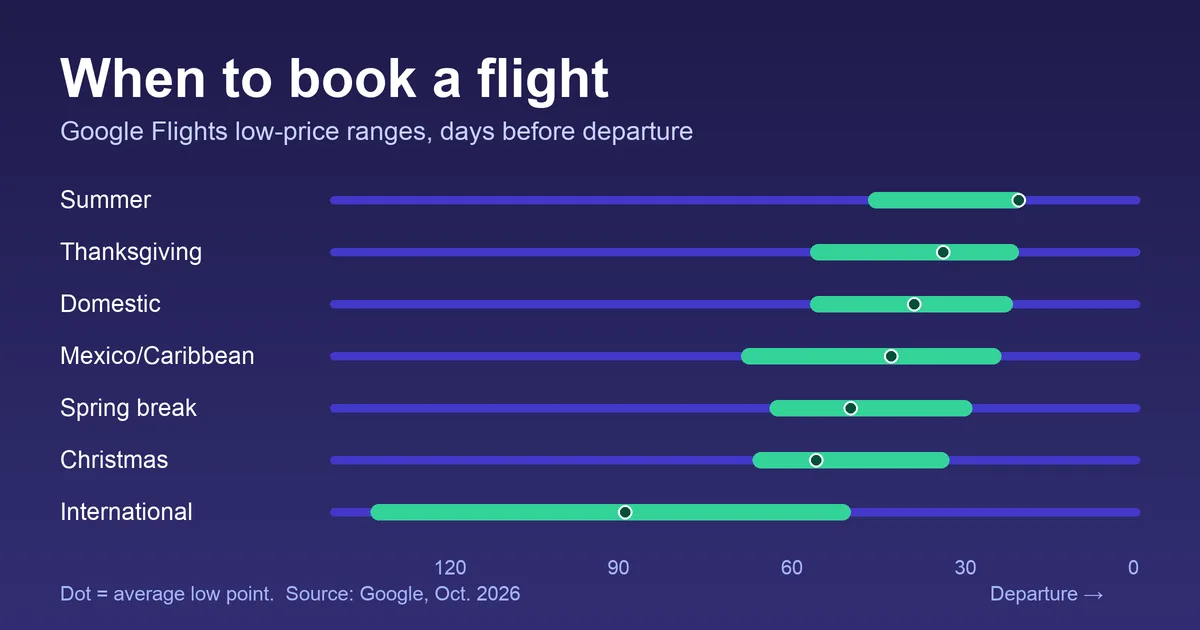
Google Flights data puts the average domestic low at 39 days before departure and Christmas at 56, inside ranges several weeks wide. Here is what those numbers mean for your dates, why Google, Expedia and Kayak disagree, and which levers save more than timing.
Using a 0% APR Card to Earn Interest: Credit Score and Fine-Print Risks (2026)
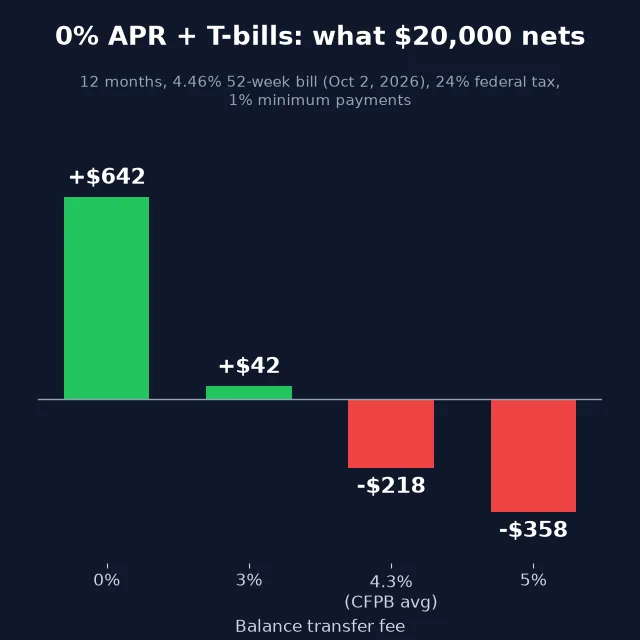
Parking a 0% APR balance in T-bills can pay, but the transfer fee, a lost grace period, utilization and mortgage timing decide whether it does. The fine print, checked.
Get smarter with your cards
Math-first card strategy posts, sent when we publish — not on a schedule. No spam. Unsubscribe anytime.
We respect your inbox.
Ready to optimize your wallet?
Get personalized card recommendations and spending strategies in under 2 minutes.
Free to use. No signup required.
Get My Strategy →Just need an answer for one purchase? Best Card →