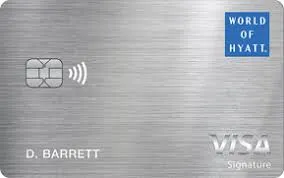
World of Hyatt Credit Card Review 2026: Is the $95 Fee Worth It?
Hotel cards live or die by the free-night math. For the World of Hyatt Credit Card, that math is unusually clean.
Pay $95. Get a Category 1-4 free night certificate on your anniversary. One night at a Hyatt Place, Hyatt House, or off-peak Hyatt Regency covers the fee outright. Everything else the card earns (elite nights, bonus points, the $15k spend kicker) is value on top.
That is the hook. The question is whether the rest of the card backs up the cover-charge math. After running the numbers through our calculator and pulling the real award-chart ceilings, here is what we found.
Updated 2026-05-06: corrected the free-night certificate validity (12 months, not 6), clarified that Discoverist status is automatic, fixed the Explorist via-spend threshold to $65,000, refreshed the Sapphire Reserve comparison rates, and added a note on Hyatt's May 2026 award-chart change.
See if the $95 fee actually pays off for your spend →
Quick verdict
Worth it if you stay at Hyatt 3+ nights per year, or if you are already a Chase Ultimate Rewards earner and want a floor on your Hyatt points value. Skip it if your travel patterns do not naturally include Hyatt properties.
The card is not flashy. Its best feature is a piece of paper (the free-night certificate), not a statement credit or an airline incidental. That is a feature, not a bug. Certificates translate cleanly to value without the use-it-or-lose-it coupon-book fatigue that plagues premium cards.
The math: $95 fee vs the free night
Through May 2026, Hyatt's standard-room award chart prices Category 1-4 properties between 3,500 and 18,000 points. At 1.7 cents per Hyatt point (CardSavvy's conservative default):
- Cat 2 standard night (8k points) → $136 value
- Cat 3 standard night (12k points) → $204 value
- Cat 4 standard night (15k points) → $255 value
- Cat 4 peak night (18k points) → $306 value
Redeem your anniversary certificate at any Cat 3 or Cat 4 property and you have cleared the $95 annual fee by $100-$200 on a single stay. That is the lowest break-even bar in the hotel-card category, period.
Starting May 2026, Hyatt is moving from three redemption tiers per category to five (Lowest, Low, Moderate, Upper, Top). The eight hotel categories themselves are not changing, and the certificate is still valid at any Category 1-4 property. Hyatt has not yet published the new per-category point ranges, so we will refresh the table above once the chart is live.
The certificate is issued after your cardmember anniversary and is valid for 12 months, so the real risk is not a tight expiration window. It is whether your travel pattern actually includes a Category 1-4 Hyatt before the next anniversary lands. For anyone who takes one domestic weekend away a year (visiting family, a conference, a long weekend) it is hard to miss.
How you earn points (the 9x claim, explained)
Hyatt markets "9 points per dollar at Hyatt." It is true, but the breakdown is:
- 4x bonus on Hyatt purchases from the card itself
- 5x base that World of Hyatt members automatically earn on all Hyatt spend (not a card benefit; you get this without the card)
So the card's incremental earning at Hyatt is 4x, not 9x. The 9x headline assumes you would be earning the 5x anyway as a Hyatt member. Fine, but worth understanding before you compare against cards that genuinely earn 3x or 4x on hotels as their own bonus category.
Everywhere else, the card earns:
- 2x on dining, airline tickets, transit and rideshare, and fitness or gym purchases
- 1x everything else
A traveler who puts $6,000/year directly on Hyatt stays earns 24,000 bonus points from the card, on top of 30,000 base member points (plus elite-night points, if they apply). At 1.7cpp, that is $408 of value just from card earning, on top of the free-night certificate.
Elite status through spending (the sleeper benefit)
The card gives you Discoverist status automatically the moment you are approved, regardless of spend. Beyond that, it hands you 5 elite-qualifying nights every calendar year just for holding it, plus 2 more nights for every $5,000 in spend, uncapped. Elite-night credits only post in $5,000 increments, so spending $4,999 earns no extra nights and $5,000 earns 2.
Mapped against Hyatt's status tiers:
| Your card spend | Elite nights from card | Status implication |
|---|---|---|
| $0 (card alone) | 5 | Discoverist (automatic with the card) |
| $15,000 | 11 | Discoverist + second Cat 1-4 certificate |
| $25,000 | 15 | Discoverist |
| $65,000 | 31 | Enough for Explorist via card spend alone |
| $140,000 | 61 | Globalist via spend alone (rarely a good idea) |
Discoverist is yours from day one. The card's real status job is accelerating Explorist or Globalist for travelers already on that path. To hit Explorist purely through card spend takes $65,000 in a year (the threshold is $65k rather than $62.5k because credits post at each $5,000 increment, not continuously). If you start from zero Hyatt nights, manufacturing status through card spend alone is usually a poor use of capital.
The $15,000 spend bonus free night: trap or prize?
Hit $15k in card spend during a calendar year and Hyatt credits you a second Category 1-4 certificate.
The math works only when two things are true at once. First, you would actually use a second certificate (a real Hyatt stay you would otherwise pay cash for). Second, the spend was going to land on the Hyatt card anyway through 9x Hyatt or 2x dining, airline, transit, or gym categories. If you are routing $15k of plain 1x spend away from a 2% cash-back card or a Chase Sapphire Reserve at 4x on direct hotels and flights and 8x through Chase Travel, the lost earning probably exceeds the certificate value.
Rule of thumb: take the bonus if you would clear $15k naturally. Force the threshold only when you have a confirmed Hyatt stay where the certificate would otherwise be paid in cash.
Run your Hyatt spend through the calculator to see your real break-even →
Who this card is for
1. The loyal Hyatt traveler (5+ nights per year). If you already know where your Hyatt properties are (work travel, family city, favorite vacation spot) the card is a no-brainer. Annual free night alone covers the fee, elite-night boost accelerates status, and bonus earning on stays compounds on top.
2. The Chase UR stacker. If you hold a Chase Sapphire Reserve, Preferred, or Ink business card, you can already transfer UR to Hyatt 1:1. But the Hyatt card gives your Hyatt points a floor (you can earn them directly at 9x without the transfer step) and the free-night certificate is irreplaceable via any UR strategy.
3. The status climber. If you are already working toward Hyatt elite status and getting to 20-30 nights naturally, the card's 5 base elite nights plus $15k bonus nights shorten your path meaningfully. Globalist stays out of reach via the card alone, but Explorist becomes achievable with reasonable spending.
Who should skip it
Non-Hyatt loyalists. If your travel patterns point to Marriott, Hilton, or IHG, the certificate value drops fast. You would need to book a Hyatt stay you would not otherwise take, which is negative value. Compare against the options in our best hotel credit cards guide.
International travelers outside Hyatt's footprint. Hyatt is thinner overseas than Marriott or Hilton. If you travel abroad frequently, a more versatile program usually wins.
Anyone whose home-market Hyatts are all Cat 5+. The certificate is Cat 1-4 only. If the nearest Cat 4-or-below Hyatt is a three-hour drive, the effective value of the certificate drops.
How it compares to other $95 hotel cards
| Card | Annual fee | Anniversary night | Best use case |
|---|---|---|---|
| World of Hyatt | $95 | Cat 1-4 free night | Best points-per-dollar value if you stay at Hyatt |
| Marriott Bonvoy Boundless | $95 | 35k-point certificate | Widest hotel footprint, weakest per-point value |
| IHG One Rewards Premier | $99 | Free night up to 40k points (top-off option) | Best if you like Kimpton or InterContinental |
| Hilton Honors Surpass | $150 | Free weekend night (after spend) | Only if you heavily prefer Hilton |
Hyatt wins on per-point value. Marriott wins on footprint. IHG wins on mid-tier flexibility with the top-off feature. Hilton's higher fee is a harder sell at this price tier.
For the full head-to-head, see our best hotel credit cards guide and the best $95 annual fee cards roundup.
The transfer partner angle (earn via UR, not the card)
Here is a strategy most Hyatt travelers miss. If you earn Chase Ultimate Rewards on a Sapphire Reserve, Preferred, or Ink card, you can transfer UR to Hyatt at 1:1. Hyatt is Chase's single most valuable transfer partner at our 1.7cpp default.
That means:
- A Sapphire Reserve earning 4x on direct flights and direct hotels effectively earns 6.8 cents per dollar of Hyatt value on those purchases (4 × 1.7cpp).
- A Sapphire Reserve booking through the Chase Travel portal at 8x earns up to 13.6 cents per dollar of Hyatt value, though portal pricing can carry its own haircut versus booking direct.
- A Sapphire Preferred at 3x on dining transfers to 5.1 cents per dollar of Hyatt value.
The CSR + Hyatt setup is a perks pairing, not a spending stack. Run dining, direct travel, and general spend on the CSR or Preferred, where the points are flexible and earn rates are higher. Hold the Hyatt card for the certificate, automatic Discoverist, and elite-night credits. Those are benefits no UR card can replicate.
Full Chase UR transfer playbook: Chase Ultimate Rewards Transfer Partners Guide. For more on why Hyatt's award chart is valued at 1.7cpp, see how to value credit card points.
Smaller perks worth knowing
Beyond the certificate and elite nights, the card includes one year of complimentary DashPass for DoorDash and Caviar (activate by Dec 31, 2027) and $10 off quarterly on non-restaurant DoorDash orders through Dec 31, 2027. Useful, but I would not bake the DashPass value into your "is this card worth it" math. Chase rotates this kind of merchant benefit on and off other cards, and the activation deadline matters.
The card also has no foreign transaction fees, which keeps it usable for Hyatt stays abroad. Travel and purchase protections (baggage delay reimbursement, lost luggage coverage, trip cancellation, secondary auto rental coverage in the U.S.) are present but not premium-tier. Fine as a fallback, not a reason to use the card.
Bottom line
The World of Hyatt Credit Card does one thing extraordinarily well: it pays for itself with a single annual free night. Everything else (the elite-night boost, the 4x card bonus on Hyatt spend, the Category 1-4 spending certificate) is upside stacked on top of a break-even you have already cleared.
If you are a Hyatt traveler, this is the easiest-to-justify $95 annual fee in the hotel-card category. If you are not, it is not the card to force into your wallet.
Run your numbers and see if the $95 fee pays off for you →
Frequently Asked Questions
Is the World of Hyatt card worth $95 a year?
Yes, if you stay at a Hyatt property at least once a year. The anniversary Category 1-4 free night is worth $150-$300 depending on the property, which covers the $95 fee with $55-$200 of value left over. If you do not stay at Hyatt annually, the card is hard to justify.
What Hyatt properties are Category 1-4?
Category 1-4 covers most Hyatt Place, Hyatt House, Hyatt Regency, and many Andaz, Grand Hyatt, and Hyatt Centric properties in secondary cities. Top-tier resorts (Alila, Park Hyatt, Miraval) and major-city luxury properties are usually Category 5-8. Hyatt publishes a searchable list on their site; filter by Cat 1-4 to see what is eligible for your certificate.
How much are Hyatt points worth?
CardSavvy values Hyatt points at 1.7 cents per point as a conservative baseline. Individual redemptions can reach 2.0-2.5 cents per point at off-peak Cat 4-5 properties where the cash rate is high relative to the points cost. Hyatt consistently ranks as the most valuable hotel point in the industry because of its published (no-surge) award chart.
How do I earn free nights and elite status with the Hyatt card?
Discoverist status is automatic the moment you are approved, with no spend required. The anniversary Category 1-4 free night posts after each cardmember anniversary and is valid for 12 months. The card also gives 5 elite-qualifying nights per calendar year automatically, plus 2 additional nights every time you cross another $5,000 in annual card spend (credits post in $5,000 increments). To reach Explorist purely through card spend takes $65,000 in a year.
Should I earn Hyatt points directly or transfer from Chase Ultimate Rewards?
Both, depending on where you are spending. Use the Hyatt card for direct Hyatt purchases (9 points per dollar) and the free-night certificate. Use a Chase Sapphire Reserve or Preferred for dining, travel, and other bonus categories, then transfer UR points 1:1 to Hyatt when you need a big redemption. The two strategies complement, not compete.
Is the $15,000 spend bonus free night worth chasing?
Only if you would naturally clear $15k in card spend through Hyatt stays or 2x categories (dining, airline, transit, gym). If you would have to reroute $15k of everything-else spend from a 2% cash-back card or a Chase Sapphire Reserve, the math does not work. The certificate is worth $200-$300, but you would forfeit more earning than that to force the threshold.
Related on Learn
Hand-picked based on topic and reader interest
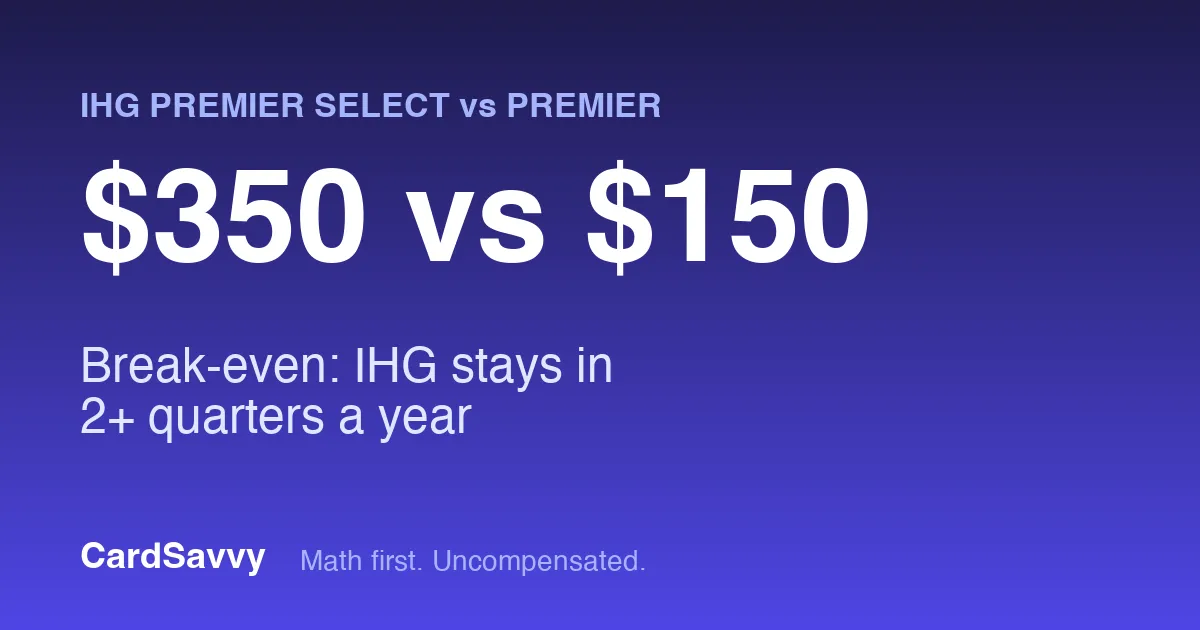
IHG Premier Select vs Premier (2026): Is the New $350 Card Worth It?
Chase launched the $350 IHG Premier Select on Oct. 1, 2026 and raised the Premier to $150. We compare the credits, free nights and status, and find the break-even: the extra $200 pays off only if you stay at IHG in two or more quarters a year.

Walmart OnePay CashRewards Card Review 2026: Is 5% Back Actually Worth It?
The Walmart OnePay card earns up to 5% back at Walmart for Walmart+ members. We run the breakeven math on the $98 membership, the 1.5% non-Walmart rate, and how it pairs with a 2% catch-all.

Apple Card Review 2026: When 3/2/1% Cash Back Beats 2% Flat
Apple Card earns 3% at Apple and select merchants, 2% on Apple Pay, and 1% everywhere else. We run the math on when that beats a flat 2% card, who should keep it, and what the Chase transition changes.
AAA Credit Cards Review (2026): The 5% Is Real, but Mind the Caps
AAA's Daily Advantage and Travel Advantage cards pay 5% on groceries or gas with no annual fee. We do the cap math most reviews skip and show who actually comes out ahead.
Get smarter with your cards
Math-first card strategy posts, sent when we publish — not on a schedule. No spam. Unsubscribe anytime.
We respect your inbox.
Ready to optimize your wallet?
Get personalized card recommendations and spending strategies in under 2 minutes.
Free to use. No signup required.
Get My Strategy →Just need an answer for one purchase? Best Card →