The Battle of the $95 Annual Fee Cards (2026)
The $95 annual fee tier is the most competitive battlefield in credit cards. It's where issuers fight for the "everyday premium" customer—people who want real rewards and perks but aren't ready to pay $500+ for a metal card with lounge access.
The problem is there are at least 15 genuinely good options at this price point. Every card positions itself as the "best value," and the marketing noise makes it nearly impossible to compare them objectively. Chase emphasizes transfer partners. Citi pushes category multipliers. Capital One sells simplicity. Hotel chains dangle free nights. Airlines promise bag fees you'll never pay.
At CardSavvy, we don't have affiliate deals driving our rankings. We have math. So let's cut through the noise and figure out which $95 card actually deserves a spot in your wallet.
See which $95 card wins for your spend →
Ground Rules
Before we compare cards, we need to establish how we're doing the math.
Scope: We're looking at cards with annual fees between $90 and $100. This includes the $95 standard cards and $99 airline cards.
Ignoring welcome bonuses: Sign-up bonuses are one-time windfalls. They're great, but they don't tell you whether a card is worth keeping long-term. We focus on ongoing value—what the card earns and costs year after year.
Net fee calculation: Marketing materials love to show you the "effective annual fee" after credits. But that math only works if you actually use those credits without changing your behavior. Our formula:
Net Fee = Annual Fee − Credits You Would Have Spent Anyway
A $50 hotel credit is worth $50 if you book hotels anyway. It's worth $0 if you're forcing a hotel stay just to use it.
Skepticism on portal multipliers: Earning 10x when you book through a specific portal sounds amazing. But portal rates are often higher than booking direct, and you lose elite status benefits and direct booking guarantees. We weight direct earning rates more heavily than portal-only multipliers.
The Four Archetypes
Not all $95 cards are doing the same job. They fall into four distinct categories, and picking the wrong category is a bigger mistake than picking the wrong card within a category.
- Flexible Travel Points — Transferable points to airlines and hotels
- Cash Back Specialists — Straightforward percentage returns
- Hotel Keepers — Free nights that exceed the annual fee
- Airline Utility Cards — Perks for airline loyalists
Let's break down each battlefield.
Battle #1: Flexible Travel Points
This is the main event. If you want a card that earns points transferable to multiple airlines and hotels, these five cards are your contenders.
The Contenders
| Card | Annual Fee | Key Credits | Net Fee | Best 3x+ Categories |
|---|---|---|---|---|
| Chase Sapphire Preferred | $95 | $50 hotel (anniversary) | ~$45 | Dining, travel |
| Citi Strata Premier | $95 | $100 hotel ($500+ stay) | -$5 to $95 | Groceries, gas, dining, travel |
| Capital One Venture | $95 | None | $95 | None (flat 2x) |
| Wells Fargo Autograph Journey | $95 | $50 airline credit | ~$45 | Hotels, flights, dining, transit |
| Bank of America Premium Rewards | $95 | $100 airline + TSA/GE | ~$0 | Dining, travel |
Chase Sapphire Preferred: The Default Choice
The CSP has held the "best mid-tier travel card" crown for nearly a decade, and in 2026 it's still the card to beat.
The earning structure:
- 3x on dining worldwide
- 3x on online groceries (excluding Target, Walmart, wholesale clubs)
- 2x on all travel
- 1x on everything else
The $50 hotel credit: Chase added a $50 anniversary credit for hotel stays booked through Chase Travel. This drops your effective annual fee to $45 if you book one hotel stay per year through the portal. Unlike some credits, this one is easy to use—no minimum spend requirement, and Chase's hotel prices are generally competitive.
Transfer partners: This is where CSP shines. You get access to World of Hyatt (consistently the highest-value hotel transfer), United, Southwest, British Airways, and a dozen other partners. If you're willing to spend 20 minutes searching for award availability, CSP points are worth 1.5–2 cents each.
Trip protections: CSP includes primary rental car coverage and trip delay/cancellation insurance. These protections alone can justify the fee if you use them once.
The math for a typical household:
Let's assume $6,000/year in dining and $2,000/year in travel:
Dining: $6,000 × 3x = 18,000 points Travel: $2,000 × 2x = 4,000 points Total: 22,000 points Value at 1.5 cpp: $330 Net fee: $45 Net value: $285
That's solid for a card you don't have to think about.
Citi Strata Premier: The Math Surprise
The Strata Premier is the card that should be getting more attention. Its category coverage is broader than CSP, and its $100 hotel credit creates a fascinating math problem.
The earning structure:
- 3x on groceries
- 3x on gas and EV charging
- 3x on restaurants
- 3x on air travel and hotels
- 10x on Citi Travel portal bookings
- 1x on everything else
That 3x on groceries and gas is a genuine differentiator. CSP gives you just 1x on groceries (unless you're buying online, excluding major retailers). Strata Premier catches spend that CSP misses entirely.
The $100 hotel credit: Here's where it gets interesting. Citi offers $100 off a single hotel stay of $500 or more booked through Citi Travel once per calendar year.
If you book one $500+ hotel stay annually, your math looks like this:
$95 fee − $100 credit = -$5 effective annual fee
You're getting paid to keep this card. But the constraint is real: you need to book a $500+ stay through the portal. If you don't travel much, or you need to book direct for status benefits, this credit is worthless.
Transfer partners: Citi's ThankYou partners include American Airlines (unique among transferable currencies), JetBlue, Virgin Atlantic, and Singapore Airlines. The AA partnership is a killer feature for domestic travelers.
The catch: Cash redemptions are now 0.75 cents per point (down from 1 cent as of August 2025). This isn't a cash-back card anymore—you need to engage with transfers or pair it with another Citi card to preserve 1cpp redemptions.
The math for a grocery-heavy household:
Assume $8,000/year groceries, $3,000 gas, $5,000 dining, $2,000 travel:
Groceries: $8,000 × 3x = 24,000 points Gas: $3,000 × 3x = 9,000 points Dining: $5,000 × 3x = 15,000 points Travel: $2,000 × 3x = 6,000 points Total: 54,000 points Value at 1.5 cpp: $810 Net fee (with hotel credit): -$5 Net value: $815
That's nearly three times CSP's value for the right spend profile.
Capital One Venture: The Simplicity Play
The Venture card has no category bonuses. It earns a flat 2x miles on everything, everywhere, with no caps or restrictions.
Why would anyone choose this?
Because simplicity has value. If you don't want to think about which card to use where, Venture guarantees you're never leaving more than 1% on the table (compared to the best 3% cards). You'll never accidentally put $500 on a 1x card when you should have used your 3x card.
The earning structure:
- 2x miles on everything
- 5x on hotels and rental cars booked through Capital One Travel
- 10x on hotels through Capital One's Lifestyle Collection
Transfer partners: Capital One miles transfer to a growing list of partners including Air Canada, British Airways, Emirates, and Turkish Airlines. Transfer ratios vary (some are 1:1, others are worse), but optionality exists.
No portal lock-in: Unlike CSP's hotel credit or Strata's $500 requirement, Venture's value isn't tied to booking behavior. Your $95 gets you 2x everywhere with no strings.
The math for a high-volume spender:
Assume $50,000/year total spend:
All spend: $50,000 × 2x = 100,000 miles Value at 1.0 cpp: $1,000 Net fee: $95 Net value: $905
Venture doesn't win any single category, but it's impossible to lose with.
Wells Fargo Autograph Journey: The Dark Horse
The Autograph Journey is Wells Fargo's entry into the transferable points game, and it deserves a look if you're in the WF ecosystem.
The earning structure:
- 5x on hotels
- 4x on airlines
- 3x on dining, transit, gas
- 1x on everything else
The $50 airline credit: Wells Fargo offers $50 in annual statement credits toward select airline purchases. Like CSP's hotel credit, this brings your effective fee down to $45 if you fly at least once a year.
Transfer partners: WF Rewards partners include Aer Lingus, British Airways, Emirates, and Turkish Airlines. The list is shorter than Chase or Citi, but it covers useful routes.
Who should consider it: If you already bank with Wells Fargo and want transfer partner access without managing multiple banking relationships, Autograph Journey is competitive with CSP.
Bank of America Premium Rewards: The Ecosystem Play
This card looks mediocre on paper: 2x on dining and travel, 1.5x on everything else. But if you have a large balance with Bank of America or Merrill, the math changes.
The credits:
- $100 airline incidentals credit
- Up to $100 TSA PreCheck/Global Entry credit every 4 years
Combined, these credits bring your effective annual fee to approximately $0.
The BofA Rewards boost: Bank of America replaced Preferred Rewards with BofA Rewards on May 27, 2026, and the 75% bonus moved to the Premier tier ($1M+). At $100,000 you now get 50%, turning 2x dining and travel into 3x and the 1.5x base into 2.25x. The old 3.5x and 2.625x figures now require $1M. See our breakdown of the change.
Who should get it: Wealthy Bank of America customers who want a low-friction travel card. If you don't have significant BofA assets, skip it—the base earning rates don't compete with CSP or Strata Premier.
Flexible Points Verdict
| If You... | Get This Card | Why |
|---|---|---|
| Want the safest default | Chase Sapphire Preferred | Transfer partners, protections, easy $50 credit |
| Have heavy grocery/gas spend | Citi Strata Premier | 3x on categories CSP misses, possible negative net fee |
| Hate optimizing | Capital One Venture | 2x everywhere, no thinking required |
| Already bank with Wells Fargo | Autograph Journey | Competitive earn rates within their ecosystem |
| Have $100k+ at Bank of America | BofA Premium Rewards | Low effective fee with the BofA Rewards boost |
Battle #2: Cash Back Specialists
If you don't want to deal with points, transfers, or travel portals, there's really only one $95 card worth considering.
American Express Blue Cash Preferred
The Blue Cash Preferred isn't a travel card—it's a grocery card that happens to have an annual fee.
The earning structure:
- 6% at U.S. supermarkets (on up to $6,000/year, then 1%)
- 6% on select U.S. streaming subscriptions
- 3% at U.S. gas stations and transit
- 1% on everything else
No intro fee: Amex often waives the first year's $95 fee. If you can get the intro offer, year one is essentially a free trial.
Break-even math:
At 6% back (vs. a 2% flat card's 4% opportunity cost difference):
Break-even grocery spend: $95 ÷ 4% = $2,375/year
If your household spends more than $200/month at supermarkets, this card pays for itself.
The $6,000 cap: After $6,000 in grocery spend, you drop to 1%. That's $360 in rewards before the cap kicks in. For most households, this is plenty—but big families might hit the cap by September.
Who should get it: Households prioritizing cash simplicity over travel flexibility. If you don't want to think about points valuations and just want dollars deposited into your account, BCP is the best option at this price point.
Battle #3: Hotel Keepers
Here's a secret that travel bloggers undersell: the best value in the $95 tier often isn't earning rates—it's free nights.
Hotel cards offer annual free night certificates that typically exceed the annual fee in value. You're not earning your way to value; you're just getting a coupon worth more than you paid.
The Contenders
| Card | Annual Fee | Free Night Certificate | Typical Value | Net Fee |
|---|---|---|---|---|
| Marriott Bonvoy Boundless | $95 | 35,000 point cap | $150–250 | Negative |
| World of Hyatt | $95 | Category 1–4 | $150–300 | Negative |
| IHG One Rewards Premier | $99 | 40,000 point cap | $100–200 | ~$0 or negative |
Marriott Bonvoy Boundless
The free night: You get one free night certificate per account anniversary, valid at properties costing up to 35,000 Marriott points. That covers Category 5 hotels and below.
What 35k gets you: Courtyard, Residence Inn, SpringHill Suites, AC Hotels, and even some Autograph Collection properties. In most U.S. cities, you're looking at $150–200/night value. In expensive markets during peak season, you can stretch this to $250+.
Earning rates: 3x at Marriott properties, 2x everywhere else. The earning rates are mediocre compared to flexible point cards, but that's not why you get this card.
The math:
Free night value: ~$175 (conservative) Annual fee: $95 Net value from free night alone: $80
Everything you earn on the card is gravy.
World of Hyatt Card
The free night: One free night at any Category 1–4 Hyatt property per account anniversary. Hyatt's category system runs 1–8, so this covers the bottom half of their portfolio.
What Category 4 gets you: Hyatt Place, Hyatt House, Hyatt Regency (many locations), and some Andaz properties. In secondary markets, you can find Category 4 hotels worth $200+/night. In major cities during events, values can exceed $300.
Earning rates: 4x at Hyatt, 2x on dining, transit, and gym memberships, 1x everywhere else. Again, the rates are fine but not the point.
Elite status: You get automatic Discoverist status plus 5 elite qualifying nights, which starts you toward Globalist (Hyatt's top tier). For frequent Hyatt guests, this accelerated path to status has real value.
Why Hyatt is often the best keeper:
Hyatt's award chart tends to offer better value than Marriott's. A Category 4 Hyatt often represents a nicer stay than a 35,000-point Marriott. And Hyatt's partnership with Small Luxury Hotels expands your redemption options significantly.
IHG One Rewards Premier
The free night: One free night certificate per account anniversary, valid at properties costing up to 40,000 IHG points.
What 40k gets you: Holiday Inn, Holiday Inn Express, Staybridge Suites, and some InterContinental and Kimpton properties in off-peak periods. Values typically range $100–180.
The "top-off" feature: Unlike Marriott and Hyatt, IHG lets you add points to your certificate if a property costs more than 40k. This gives you flexibility to book nicer properties if you're willing to chip in.
Earning rates: 5x at IHG, 2x everywhere else. Plus, IHG Platinum Elite status with bonus points on stays.
Who should consider it: Road warriors who frequently stay at IHG properties (especially Holiday Inn Express for suburban/highway travel). The 40,000-point cap plus top-off feature makes this more flexible than Marriott's 35k cap.
Hotel Keeper Verdict
| If You... | Get This Card | Why |
|---|---|---|
| Want the best single-night value | World of Hyatt | Category 1–4 covers great properties |
| Need maximum footprint | Marriott Boundless | 8,100+ properties worldwide |
| Travel domestically by car | IHG Premier | Strong highway/suburban coverage, top-off option |
Key insight: These cards aren't earning machines—they're coupon books. If you naturally stay at these hotel chains once a year, the free night certificate pays for the card before you swipe it once.
Battle #4: Airline Utility Cards
Airline cards at the $95–99 tier are specialist tools. They make sense if (and only if) you're loyal to that specific airline.
The Contenders
| Card | Annual Fee | Key Perks | Best For |
|---|---|---|---|
| Southwest Rapid Rewards Plus | $99 | 3,000 anniversary points, free checked bags, priority boarding | SW loyalists |
| JetBlue Plus | $99 | 6x on JetBlue, first checked bag free, 50% off inflight purchases | JetBlue home-base flyers |
| AAdvantage Platinum Select | $99 | First bag free, preferred boarding, 2x on restaurants/gas/travel | AA flyers |
When Airline Cards Make Sense
Checked bags: If you check a bag every flight and fly the same airline 4+ times per year, the free bag perk ($30–40 per segment) pays for the fee fast.
Anniversary points: The Southwest card's 3,000 anniversary points (worth ~$45) partially offset the fee.
Status acceleration: Some airline cards include elite qualifying miles or credits that help you reach status faster.
When They Don't Make Sense
If you're not loyal: A flexible card like CSP earns transferable points that can book any airline. Locking yourself into one carrier limits optionality.
If you don't check bags: The primary value proposition disappears if you only carry on.
If you fly infrequently: A $99/year card that saves you $35/flight is only worth it if you fly that airline 3+ times annually.
Airline Card Verdict
| If You... | Get This Card | Why |
|---|---|---|
| Fly Southwest 4+ times/year with bags | SW Rapid Rewards Plus | Bag fees + anniversary points exceed fee |
| Have a JetBlue hub as home airport | JetBlue Plus | 6x on JetBlue + first bag free |
| Fly American frequently with checked bags | AAdvantage Platinum Select | First bag + category bonuses |
| Aren't loyal to one airline | Skip airline cards entirely | Flexible points beat locked-in miles |
The CardSavvy Scoring Framework
When evaluating $95 cards, we weight five factors:
1. Net Fee (30%)
What do you actually pay after subtracting credits you'd naturally use?
| Net Fee | Score |
|---|---|
| Negative | Excellent |
| $0–25 | Great |
| $26–50 | Good |
| $51–95 | Fair |
2. Earning Power (30%)
Effective percentage back on your real spend profile (not just advertised rates).
| Effective Return | Score |
|---|---|
| 3%+ | Excellent |
| 2–3% | Good |
| 1.5–2% | Fair |
| <1.5% | Poor |
3. Redemption Friction (15%)
How hard is it to get full value from your rewards?
- Excellent: Cash back or easy 1:1 transfers
- Good: Multiple transfer partners, competitive ratios
- Fair: Portal-dependent value
- Poor: Airline miles with limited routing
4. Protections (15%)
Trip insurance, rental car coverage, purchase protection. These are "invisible" perks until you need them.
5. Keeper Perks (10%)
Free nights, status, and other tangible benefits beyond points.
The Winner's Bracket
After running the math across all four archetypes, here are our picks.
Flexible Points Winners
| Category | Winner | Why |
|---|---|---|
| Default for most people | Chase Sapphire Preferred | ~$45 net fee, elite transfer partners (Hyatt!), solid protections |
| Dark horse (math surprise) | Citi Strata Premier | Negative net fee possible, 3x on groceries/gas/dining/travel |
| "I don't want to think" | Capital One Venture | 2x everywhere, no category tracking, growing transfer options |
| High multipliers + offset | Wells Fargo Autograph Journey | Strong travel categories + $50 airline credit |
| BofA ecosystem | BofA Premium Rewards | Near-zero net fee with airline + TSA/GE credits |
Hotel Keeper Winners
| Category | Winner | Why |
|---|---|---|
| Best value per night | World of Hyatt | Category 1–4 free night worth $150–300 |
| Biggest footprint | Marriott Bonvoy Boundless | 35k cap, 8,100+ properties worldwide |
| Road trip chain | IHG One Rewards Premier | 40k cap with top-off option for flexibility |
Cash Back and Airline Winners
| Category | Winner | Why |
|---|---|---|
| Cash back household | Blue Cash Preferred | 6% groceries, 6% streaming—simple math |
| Southwest loyalist | SW Rapid Rewards Plus | 3k anniversary points + free bags |
| JetBlue home base | JetBlue Plus | 6x JetBlue + free first bag |
| AA flyer | AAdvantage Platinum Select | First bag free + category bonuses |
Decision Tree: Which $95 Card Is Right for You?
Not sure where to start? Walk through this decision tree.
Do you want cash back or travel rewards?
- Cash back → Blue Cash Preferred (if you spend $2,400+/year on groceries)
- Travel rewards → Continue below
Do you have a preferred hotel chain you stay at 1+ times per year?
- Hyatt → World of Hyatt Card (Category 1–4 free night)
- Marriott → Marriott Boundless (35k free night)
- IHG → IHG Premier (40k free night with top-off)
- No preference → Continue below
Do you fly one airline 4+ times per year and check bags?
- Yes → Get that airline's card (SW/JetBlue/AA)
- No → Continue below
Do you want simplicity or optionality?
- Simplicity → Capital One Venture (2x everything, no categories)
- Optionality → Continue below
Where does your spend concentrate?
- Heavy dining, some travel → Chase Sapphire Preferred (3x dining, 2x travel, Hyatt transfers)
- Heavy groceries/gas/dining → Citi Strata Premier (3x on all three, AA transfers, possible negative fee)
Don't Get Burned: Important Caveats
Before you apply, keep these realities in mind.
Not All Credits Are Created Equal
A $50 hotel credit with no minimum is far easier to use than a $100 credit requiring a $500+ stay. When calculating net fees, be honest about whether you'll actually use the credit without changing your behavior.
Portal Multipliers Are Fragile
10x on a portal sounds amazing until the portal price is 15% higher than booking direct. Always compare portal rates to direct rates before assuming you're getting a deal.
Free Night Certificates Have Caps
A 35,000-point Marriott certificate doesn't get you into a Category 7 resort. Know what properties fall within your certificate's cap before counting on specific redemptions.
This Tier Changes Constantly
The United Explorer card moved from $95 to $150 in 2025. Cards shift pricing and benefits regularly. The analysis here is accurate for February 2026—but always verify current terms before applying.
Welcome Bonuses Expire
We ignored welcome bonuses in this analysis because they're one-time. But if you're choosing between two equally good cards, a strong welcome bonus can tip the scales.
The Bottom Line
The $95 annual fee tier offers genuine value—if you pick the right card for your spend profile.
For most people, the Chase Sapphire Preferred remains the default choice. The combination of 3x dining, solid transfer partners (especially World of Hyatt), and trip protections creates a well-rounded package with minimal friction.
The Citi Strata Premier is the math surprise of 2026. If you spend heavily on groceries, gas, and dining, and you'll actually use the $100 hotel credit, your effective annual fee can go negative. That's rare for a card with legitimate transfer partners.
If you hate tracking categories, the Capital One Venture gives you 2x on everything with no mental overhead.
And if you stay at a particular hotel chain at least once a year, a keeper card like World of Hyatt or Marriott Boundless can deliver $100+ in value from the free night alone.
The wrong card at this tier won't bankrupt you—$95 isn't a lot of money. But choosing the right card puts an extra $200–500 back in your pocket annually. That compounds.
Want to see which $95 card wins for YOUR wallet? Run the numbers →
Frequently Asked Questions
Is the $95 annual fee worth it for occasional travelers?
It depends on the card. Hotel keeper cards (Hyatt, Marriott, IHG) are worth it if you stay at that chain once per year—the free night certificate alone exceeds the fee. For flexible points cards, you generally need $5,000+ in category spend to beat a free 2% card.
Should I get a hotel keeper card if I don't stay at that chain often?
Only if the free night changes your behavior in a good way. If you'd enjoy a free night at a Hyatt or Marriott once a year, the card pays for itself. If you'd be forcing a stay just to use the certificate, skip it.
How does the Chase Sapphire Preferred compare to free cards like the Citi Double Cash?
CSP earns 3x on dining and 2x on travel, compared to Double Cash's flat 2%. If you spend $4,000/year on dining, CSP earns an extra $40 in value over Double Cash in that category alone. The question is whether the extra value from categories plus transfer partner access exceeds the $45 net fee (after the hotel credit). For most people who travel and dine out, it does.
Can I have multiple cards from this tier?
Absolutely. Many optimizers carry a Sapphire Preferred (for dining and travel transfers) plus a World of Hyatt (for the free night). The cards serve different purposes. Just make sure each card earns its annual fee independently.
What if I already have a premium card like the Sapphire Reserve or Amex Platinum?
At $500+ annual fees, those cards should be your primary earners in their bonus categories. A $95 hotel keeper card can still make sense alongside a premium card—the free night doesn't compete with your main card's earning.
Which card has the best welcome bonus right now?
Welcome bonuses change frequently, and we intentionally excluded them from this analysis (they're one-time, not ongoing value). Check current offers at each issuer's site before applying—sometimes the best bonus isn't on the "best" long-term card.
Cards Mentioned in This Article
Click any card above to see if it's worth adding to your wallet — personalized verdict in 30 seconds.
Related on Learn
Hand-picked based on topic and reader interest

The Best Credit Card Trifecta in 2026: The Math After Fees
We priced the Chase, Citi, Capital One, Wells Fargo and Amex combos on one $60,000 budget. At 1 cent per point, a free 2% card beats three of them. Here is when each one pays.
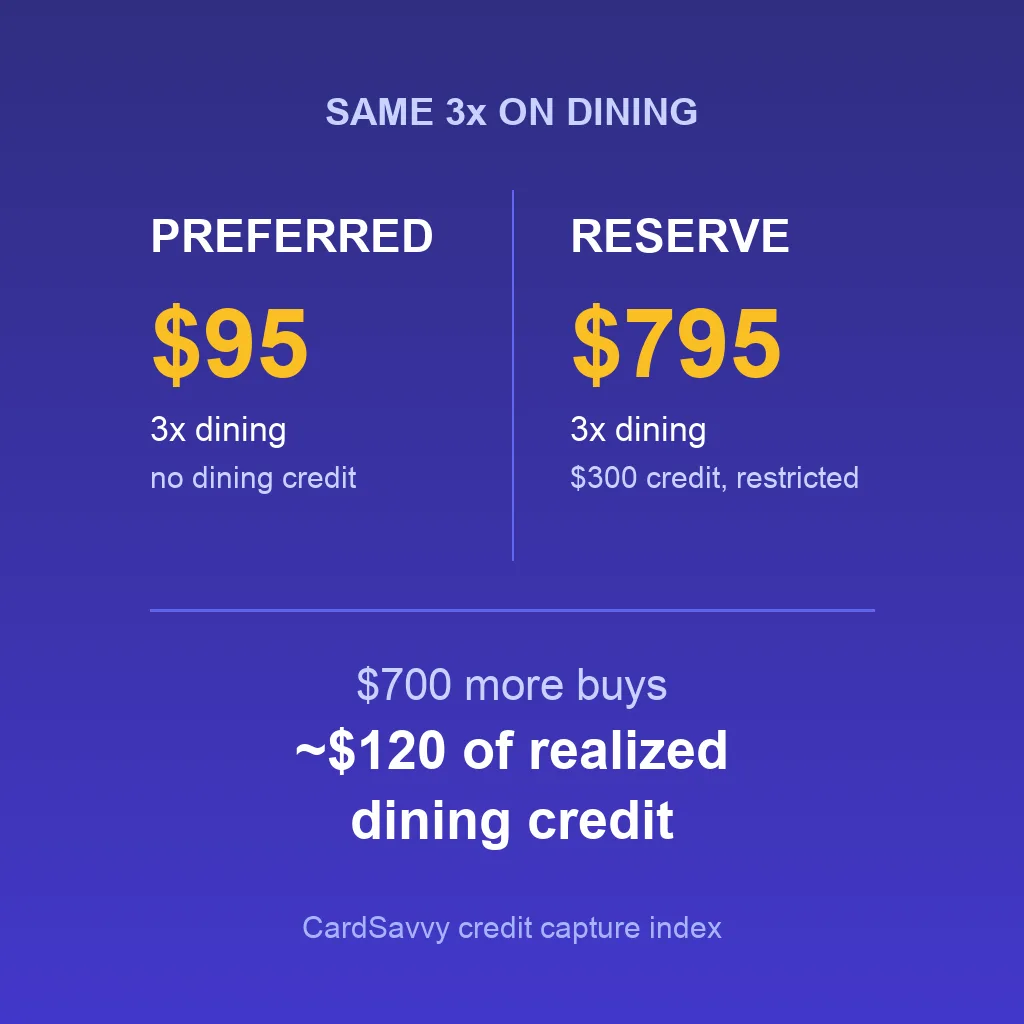
Sapphire Reserve vs Preferred for Dining: Is $700 More Worth It?
The $795 Sapphire Reserve and the $95 Sapphire Preferred earn the same 3x on dining. The Reserve's entire dining premium is one restricted credit, and our capture index values it near $120. Here is when that still makes sense.

Does Airbnb Count as Travel for Chase Sapphire? CSP vs CSR (2026)
Does the Chase Sapphire Reserve give 3x points on Airbnb? No. Direct Airbnb bookings earn 1x on the Reserve. Chase's June 2026 refresh added 3x on Airbnb to the cheaper Sapphire Preferred instead. Here's the math.

What's the Best Credit Card for Airbnb? 2026 Rankings by Use Case
Chase Sapphire Preferred now earns 3x on Airbnb booked direct, but the best card depends on whether you want cash back, no annual fee, or coding certainty. Ranked by use case with the math.
Get smarter with your cards
Math-first card strategy posts, sent when we publish — not on a schedule. No spam. Unsubscribe anytime.
We respect your inbox.
Ready to optimize your wallet?
Get personalized card recommendations and spending strategies in under 2 minutes.
Free to use. No signup required.
Get My Strategy →Just need an answer for one purchase? Best Card →