Three Ways a Rewards Optimizer Gives You the Wrong Answer (Ours Included)
Quick answer: Three assumptions drive most of the disagreement between rewards calculators: what a point is worth, how much of a card's credits you'll really use, and whether spending caps are modeled. On one average wallet, the first is worth $636 a year, the second $325. Below, all three, plus what our own model gets wrong.
Run the same wallet through three different rewards calculators and you'll get three different numbers, sometimes off by hundreds of dollars a year. Each one is applying a different set of assumptions about point values, credits, and caps, and most of them don't publish which.
We use the same wallet from our $34,800 walkthrough: Amex Gold, Fidelity Rewards Visa, Costco Anywhere Visa, against average US household spending. Every number below comes from the live solver, changing one variable at a time.
Test these assumptions on your own wallet →
1. What a point is worth
Rewards are earned as a multiplier and redeemed at a rate. The multiplier is a fact printed on the card. The rate is a guess about your future behavior, and it multiplies straight through to the answer.
Amex Membership Rewards are worth roughly 0.6 cents if you take the cash. Transfer them to an airline partner and redeem well and 2 cents is real. That's a 3.3x spread on identical spending.
Hold everything else fixed and move only that number:
| MR valued at | Wallet net value | Who wins groceries |
|---|---|---|
| 2.0 cents | $1,384.20 | Amex Gold |
| 1.5 cents | $1,141.20 | Amex Gold |
| 1.0 cents | $910.20 | Amex Gold |
| 0.6 cents | $748.20 | Fidelity Visa |
A $636 spread, and at the bottom of the range the recommendation itself changes.
This is why CardSavvy makes you choose a Redemption Strategy before showing a result. Whether the Gold card is worth its fee depends on whether you transfer points to partners like Aeroplan. Most cardholders never do.
What to do: pick the valuation that matches what you have actually done with points in the last year, not what you intend to do.
2. How much of the credits you'll really use
Premium cards are increasingly sold as coupon books. The Amex Gold advertises $424 in statement credits against a $325 annual fee, which on paper means the card pays you $99 to carry it.
Those credits are $120 of Uber Cash, $120 in dining credits at a specific restaurant list, $84 at Dunkin', and $100 at Resy restaurants. They arrive in monthly or quarterly slices and expire unused.
Same wallet, changing only how much of those credits you claim:
| Credit usage | Wallet net value |
|---|---|
| Full (100%) | $1,452.00 |
| CardSavvy default (80/80/30/40) | $1,384.20 |
| Partial (50%) | $1,339.00 |
| Maybe (25%) | $1,233.00 |
| None (0%) | $1,127.00 |
A $325 swing on one input, which is exactly the annual fee. Every dollar of credit you don't use is a dollar of fee you do pay.
Most calculators assume 100%. That's the assumption that makes premium cards look best, and it's the one least likely to be true.
What to do: go through the credits one at a time and ask whether you spent money at that merchant last year. Not whether you could.
3. Whether caps are modeled
Bonus rates come with limits that headline numbers omit. The Blue Cash Preferred earns 6% on groceries, on the first $6,000 a year, then 1%.
CardSavvy blends the two rates into one effective rate before solving, so caps influence which card wins rather than just being noted afterward:
| Grocery spend | Effective rate | Earns | A flat 2% card would earn |
|---|---|---|---|
| $6,000 | 6.00% | $360 | $120 |
| $9,000 | 4.33% | $390 | $180 |
The card still wins at $9,000, so the cap doesn't flip the recommendation. But look at the marginal dollars: grocery spending from $6,000 to $9,000 earns $30 on the Blue Cash Preferred, where a flat 2% card would pay $60.
That gap points at a genuine limitation, which brings us to the part most tools skip.
What CardSavvy gets wrong
Every model is wrong somewhere. Here is where ours is, specifically.
It can't split a category between two cards. The solver assigns each spending category to exactly one card. In the example above, the right real-world move is to put the first $6,000 of groceries on the Blue Cash Preferred and the rest on a 2% card. CardSavvy will tell you the Blue Cash Preferred wins groceries and won't tell you to switch cards partway through the year. Watch for this on any capped bonus category where your spending clears the cap.
We value Chase Sapphire Reserve points at 1.0 cent. Against a $795 annual fee, that's a materially harsher assumption than the 1.5 cents most rewards sites use, and it makes the card look worse in our tool than elsewhere. We use the cash-equivalent rate as the default because it's the floor. If you reliably transfer to Hyatt, override the point value and the card improves substantially.
Amex Gold's category caps aren't in our data. The real card caps 4x dining at $50,000 a year and 4x groceries at $25,000. Our catalog doesn't carry those limits, so if you enter very high dining or grocery spend, we overstate that card. Under those thresholds, which covers most households, the numbers are right.
The Cash Back redemption preset is too blunt. It sets point values by issuer, so it drops the Fidelity Rewards Visa to 1.0 cent and the Costco Anywhere Visa to 0.8 cents. Both are cash-back cards whose stated rate already is cash, so the preset understates them. Use the catalog defaults or set those cards manually until we fix it.
Rotating category data can lag. Chase Freedom Flex and Discover it rotate bonus categories quarterly, and our catalog currently still lists the Q2 2026 lineup. If you hold either card, check the current quarter yourself.
Two bugs we found while writing this post. Cards with capped categories, including the Costco Anywhere Visa and Blue Cash Preferred, were sending a malformed request that made the optimizer fail outright. Separately, every card's catch-all rate was being forced to 1x, which undercounted flat-rate cards like the Venture X and Wells Fargo Active Cash by up to $120 a year on the largest spending bucket. Both are fixed, with regression tests, as of July 30, 2026. If you ran a wallet containing those cards before that date, run it again.
The built-in check
Rather than asking you to trust a point estimate, the results page has a stress test. It re-runs the full allocation at point values from 70% to 130% of your assumption and reports whether the winning setup survives.
If the same cards win across that whole range, the result holds and you can stop thinking about it. If the allocation flips partway through, the tool says so, and you should treat the headline number as a range.
Here is what it returned for the wallet in this post:
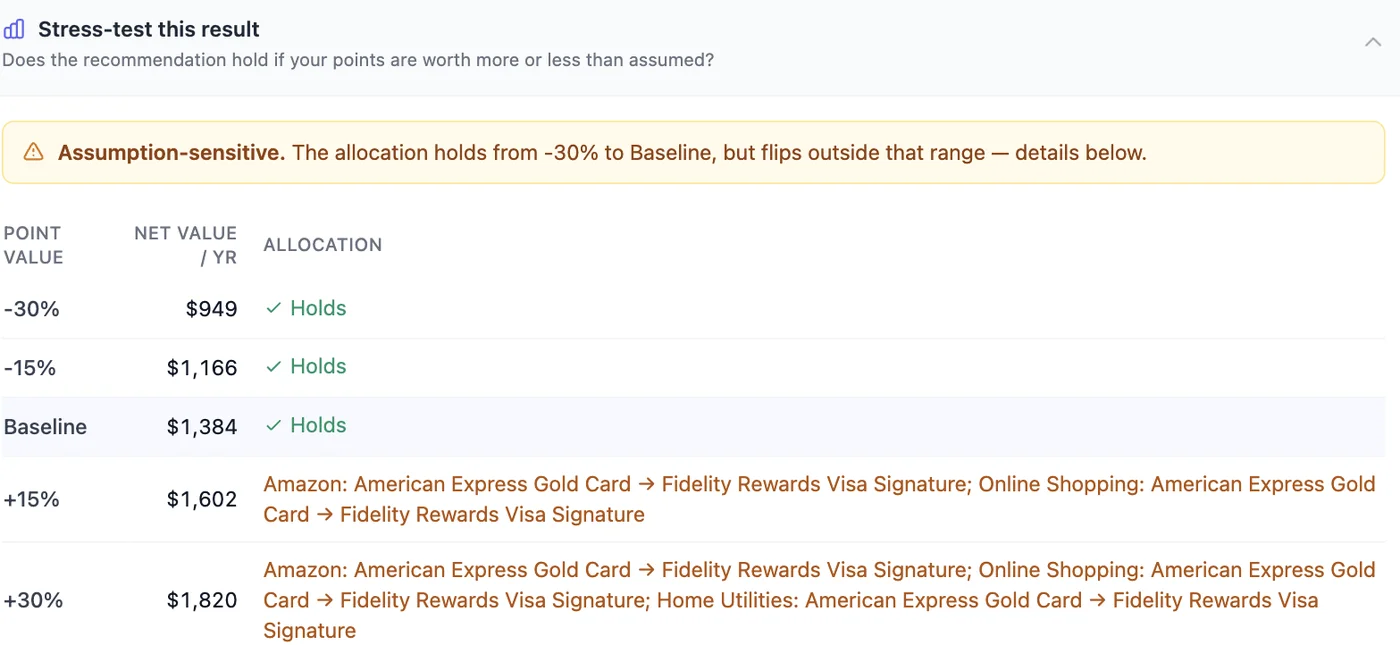
Captured July 30, 2026. Note the verdict is "Assumption-sensitive," not a clean pass.
That's the honest outcome for this wallet rather than a flattering one. The allocation is stable if points turn out to be worth less than assumed, but at 15% above baseline the Gold card stops winning Amazon and online shopping and the Fidelity Visa takes them. The dollar figure keeps rising across the range; it's the recommendation that moves.
Bottom Line
A rewards calculator that gives you one confident number without showing you the point valuation and credit-usage rate behind it isn't more accurate. It picked those for you and didn't say.
Ask any tool three questions: what is it assuming a point is worth, what fraction of credits is it counting, and does it model caps. If it can't answer, the number is decoration.
Frequently Asked Questions
Why do credit card rewards calculators give different answers?
Mostly three assumptions: point valuation, credit realization, and cap modeling. On the wallet above, point valuation alone moved the answer $636 a year and credit realization moved it $325.
How much is a credit card point worth?
It depends on redemption. Membership Rewards run about 0.6 cents cashed out and up to 2 cents transferred to airline partners. Chase Ultimate Rewards run about 1 cent cashed out and 1.5 cents through the travel portal on a Sapphire Reserve. See how to value credit card points.
Do optimizers account for bonus category caps?
CardSavvy blends the bonus and post-cap rates into one effective rate before solving. The limitation is that it can't split a single category across two cards.
Should I trust a credit card recommendation tool?
Trust the ones that show their inputs and let you change them. CardSavvy takes no affiliate or advertising revenue today, publishes a stress test, and documents its own failure cases, including on this page. See our promise.
Related on Learn
Hand-picked based on topic and reader interest

How Many Rewards Credit Cards Do You Actually Need?
How many credit cards should you have for rewards? We added cards one at a time to an average US household budget and measured what each one earned. The second card was worth 13 times the third.

How to Optimize Your Credit Card Rewards: A Real $34,800 Walkthrough
How much does optimizing your credit cards actually earn? We ran an average US household's $34,800 of spending through CardSavvy Optimize. Three cards, $1,384/yr net, and every number reproducible in the tool.
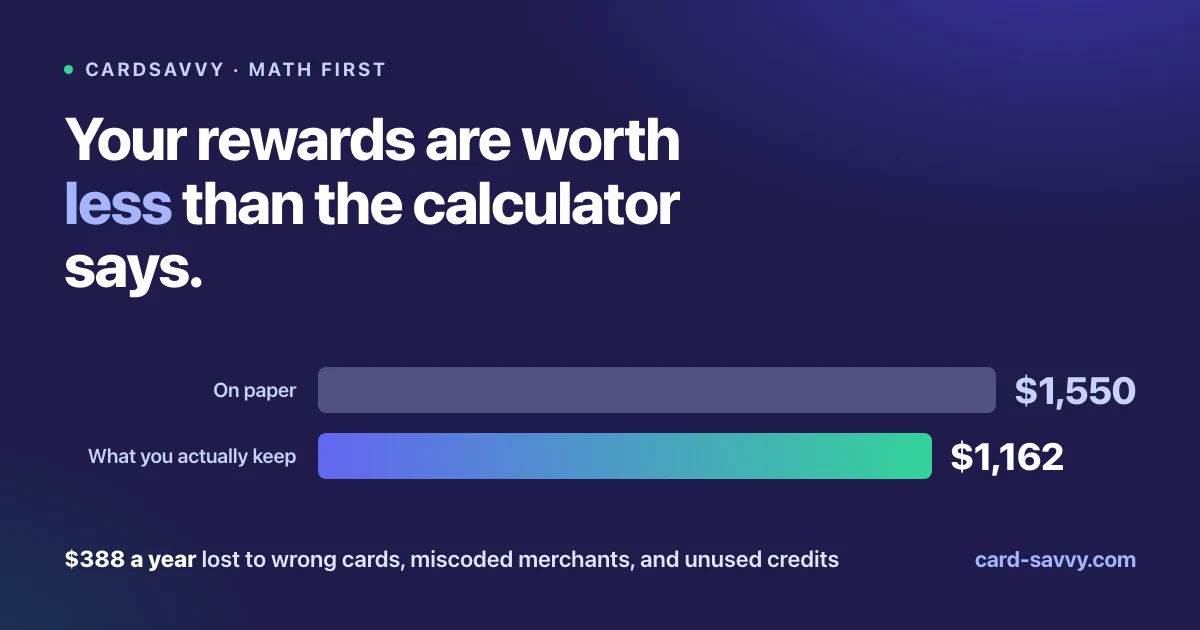
Why Your Credit Card Rewards Are Worth Less Than the Calculator Says
The optimization math is solved. Getting the money is not. Seven measurable gaps between the rewards a calculator promises and the value you actually keep, with the number attached to each.
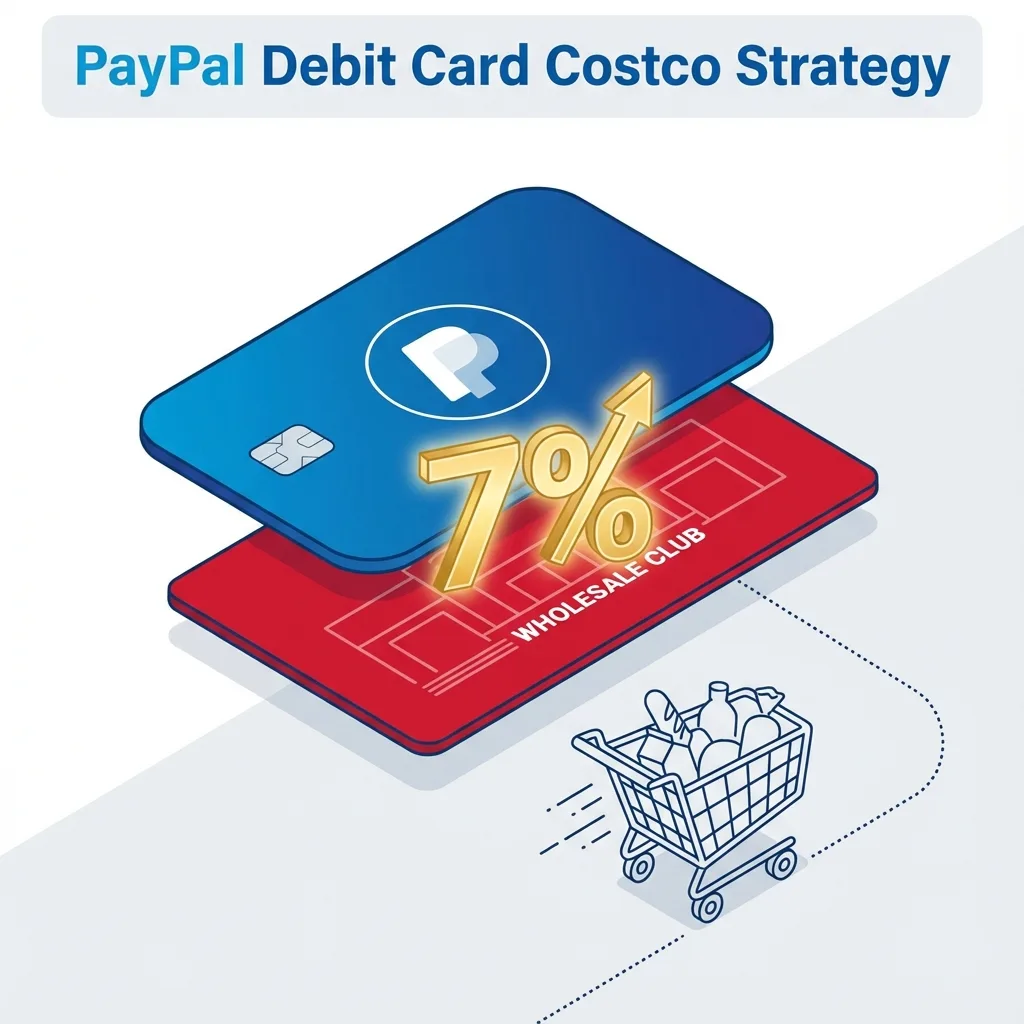
Costco PayPal Debit Card Strategy: How to Get 7% Cash Back (2026)
Costco does not accept PayPal directly, but the PayPal Debit Card earns 5% back and stacks with Executive membership for 7% total. Here's the complete strategy.
Get smarter with your cards
Math-first card strategy posts, sent when we publish — not on a schedule. No spam. Unsubscribe anytime.
We respect your inbox.
Ready to optimize your wallet?
Get personalized card recommendations and spending strategies in under 2 minutes.
Free to use. No signup required.
Get My Strategy →Just need an answer for one purchase? Best Card →