How Many Rewards Credit Cards Do You Actually Need?
Quick answer: Two cards captured 93% of the available value on an average US household budget. The second card was worth $640 a year, the third $48, and the fifth destroyed $417. More cards help only when each one wins a category your wallet was losing.
"How many credit cards should I have" usually gets answered with a philosophy. Here it gets answered with a number.
We took average US household spending of $34,800 a year and added cards one at a time, measuring what each new card changed about the wallet's net value after fees. Same solver as CardSavvy Optimize, same 137-card catalog.
Run the same test on your own spending →
The method
Start with one flat 2% card. Add a card. Re-solve the whole wallet, because adding a card can change where every other category goes. The difference in net value is what that card is worth to you.
That difference is the only number that matters. A card earning $300 a year is worth nothing if the cards you already hold would have earned $290 on the same spending.
CardSavvy's Compare Card mode uses three thresholds on that difference: over $50 a year is Add, between $0 and $50 is Consider, and anything at or below $0 is Skip.
The ladder
| Wallet | Net value | This card added | Verdict |
|---|---|---|---|
| Fidelity Rewards Visa alone | $696.00 | ||
| + Amex Gold | $1,336.20 | +$640.20 | Add |
| + Costco Anywhere Visa | $1,384.20 | +$48.00 | Consider |
| + Capital One Venture X | $1,456.20 | +$72.00 | Add |
| + Chase Sapphire Reserve | $1,039.20 | −$417.00 | Skip |
Four things in that table are worth pulling out.
Card two is worth 13 times card three
The jump from one card to two was $640.20. The jump from two to three was $48.
That ratio is the practical answer to the question. A second card that covers your largest bonus categories captures the overwhelming majority of what optimization is worth. On this budget, groceries and dining are $10,200 of the $34,800, and moving them from 2% to 8% is where nearly all the money is.
If you only ever do one thing, do that one.
The curve isn't smooth
The fourth card beat the third. Venture X added $72 while the Costco Visa added $48, even though Venture X charges $395 and the Costco Visa is free.
Two reasons. Venture X earns 10x on hotels, which no other card in the wallet came close to. And its $300 travel credit plus $100 anniversary miles roughly cancel its annual fee, so the earning is close to free.
Annual fee size tells you very little on its own. What matters is whether the card wins a category by enough to clear its fee net of the credits you would use.
The fifth card destroys $417
Adding a Chase Sapphire Reserve reduced net value by $417 a year. Not "earned less than expected." Reduced.
The arithmetic is clean. The Reserve won zero spending categories in this wallet. Amex Gold at 4x dining beats its 3x, and Venture X at 10x hotels beats its 8x. So it contributed no rewards at all, while charging $795 against $378 of credits we assumed would get used. That's exactly $417 of pure cost.
That result depends on our point valuation. CardSavvy values Ultimate Rewards at 1.0 cent on the Reserve, which is more conservative than most sites. If you reliably transfer to Hyatt at 2 cents, the card looks very different. We explain that choice, along with our other modeling limits, in three ways a rewards optimizer gives you the wrong answer.
The general point survives the assumption. A premium card that loses every category to cards you already hold is charging you a subscription for rewards it never earns.
Check whether a card you're eyeing is Add, Consider, or Skip →
Spending more moves the numbers, not the shape
Doubling every category to $69,600 a year raises every marginal value:
| Card added | At $34,800 | At $69,600 |
|---|---|---|
| Amex Gold | +$640.20 | +$1,348.20 |
| Costco Anywhere Visa | +$48.00 | +$96.00 |
| Capital One Venture X | +$72.00 | +$144.00 |
| Chase Sapphire Reserve | −$417.00 | −$417.00 |
Rewards scale with spending. Annual fees don't. That's why premium cards make more sense at higher spend, and it's why the Costco Visa moves from Consider to Add.
The Reserve stays at exactly −$417 no matter how much you spend, because it never wins a category. Spending your way out of a card that earns nothing doesn't work.
Shifting the shape of spending matters more than the size. On a travel-heavy profile with $9,000 of flights and $7,000 of hotels, Venture X jumps from +$72 to +$420.
The costs that aren't in the table
The math above counts dollars. Three real costs don't show up.
Issuer rules. Chase declines most applicants who have opened five or more cards in the previous 24 months. Spending that budget on cards that add $48 a year can block a card worth $600 later. See the 5/24 rule.
Tracking overhead. Every fee card needs an annual review, and every credit needs using. A $48-a-year card that costs you an hour of admin is not obviously worth it.
Behavior. Routing five cards correctly at the register is harder than routing two. If you use the wrong card half the time, half the modeled value never arrives. Best Card for This Purchase exists for that problem.
Quick Decision Guide
If you have one card: get a second that covers your biggest bonus category. This is worth several hundred dollars a year and nothing else comes close.
If you have two: you've captured most of it. Add a third only if it wins a category by more than $50 a year after its fee.
If you have four or more: run the wallet and look at the per-card net value column. Any card with a negative net is a cancel or downgrade candidate. See cancel vs downgrade.
If you're considering a premium card: check whether it wins any category against what you already hold. If it doesn't, no amount of credits makes it worth carrying.
Bottom Line
Two cards captured 93% of the available value on an average budget. The third added $48, the fourth $72, and the fifth cost $417.
The right number of cards is however many win a category you're currently losing. For most households that's two, sometimes three. Measure each card by what it earns above the wallet you already have.
Frequently Asked Questions
How many credit cards should I have for rewards?
Two covers most of the available value for a typical household. The second card was worth $640 a year on $34,800 of spending. The third added $48.
Does having more credit cards earn more rewards?
Only up to a point, and it can go negative. The fifth card in our test reduced net value by $417 a year because it won no categories and still charged its fee.
Is it worth getting a second rewards credit card?
For most people it's the highest-value move available, worth roughly 93% of everything optimization can do. Make it cover your largest bonus-eligible category.
Do more credit cards hurt your credit score?
New accounts create a temporary inquiry and lower average account age, while extra credit limit lowers utilization, which weighs more. The bigger practical limits are issuer rules like Chase 5/24 and the overhead of tracking fees and credits.
How do I know if a specific card is worth adding?
Run your wallet with and without it. Compare Card mode does this and returns Add, Consider, or Skip.
Related on Learn
Hand-picked based on topic and reader interest

How to Optimize Your Credit Card Rewards: A Real $34,800 Walkthrough
How much does optimizing your credit cards actually earn? We ran an average US household's $34,800 of spending through CardSavvy Optimize. Three cards, $1,384/yr net, and every number reproducible in the tool.

Three Ways a Rewards Optimizer Gives You the Wrong Answer (Ours Included)
Credit card rewards calculators disagree wildly. Here are the three assumptions that move the answer most, run on one wallet, plus a list of what CardSavvy's own model gets wrong and why.
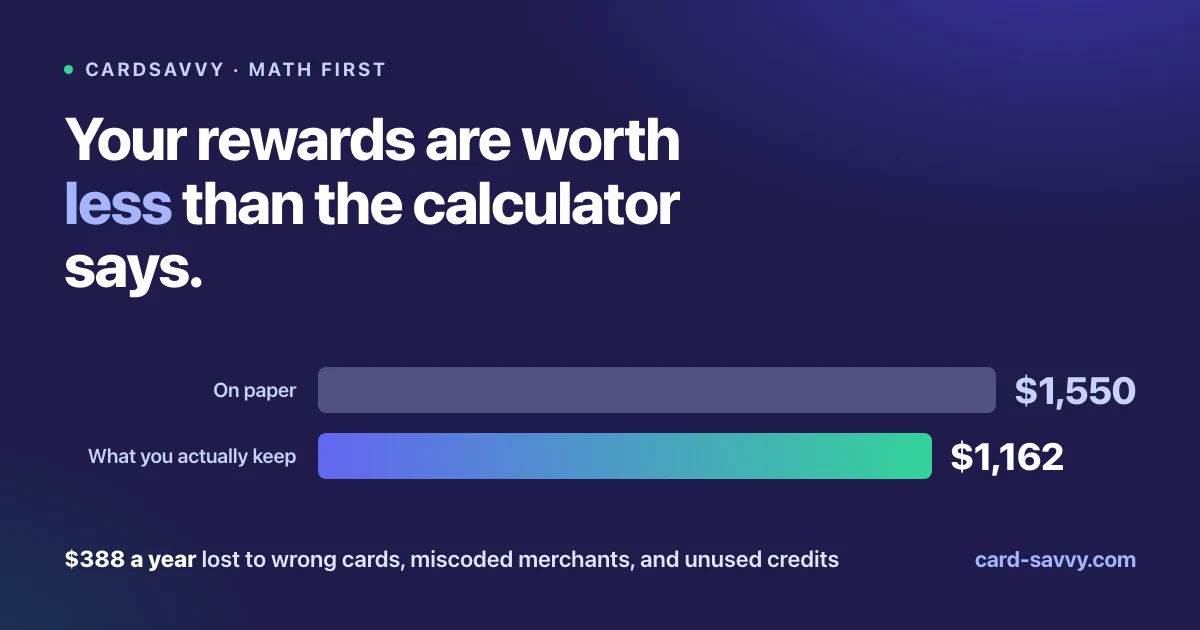
Why Your Credit Card Rewards Are Worth Less Than the Calculator Says
The optimization math is solved. Getting the money is not. Seven measurable gaps between the rewards a calculator promises and the value you actually keep, with the number attached to each.
Costco PayPal Debit Card Strategy: How to Get 7% Cash Back (2026)
Costco does not accept PayPal directly, but the PayPal Debit Card earns 5% back and stacks with Executive membership for 7% total. Here's the complete strategy.
Get smarter with your cards
Math-first card strategy posts, sent when we publish — not on a schedule. No spam. Unsubscribe anytime.
We respect your inbox.
Ready to optimize your wallet?
Get personalized card recommendations and spending strategies in under 2 minutes.
Free to use. No signup required.
Get My Strategy →Just need an answer for one purchase? Best Card →