How to Optimize Your Credit Card Rewards: A Real $34,800 Walkthrough
Quick answer: We ran an average US household's $34,800 of annual spending through CardSavvy Optimize. One flat 2% card earns $696 a year. Three cards, routed by category, earn $1,384 net of a $325 annual fee. The gap is $688 a year for the same spending.
Most rewards advice stops at "get a card with 4x dining." It rarely tells you what that's worth on your actual budget, or whether the annual fee eats it.
This is a full walkthrough of CardSavvy Optimize using numbers you can reproduce. Every figure below came out of the same solver the site runs, against the same 137-card catalog. Click the same buttons and you'll get the same answer.
Run your own spending through the optimizer →
What the optimizer is solving
You have some spending. You have some cards. Each card pays a different rate in each category, and some charge annual fees.
The question is which card to use for each category so the total is highest after fees. That's a small integer program, and CardSavvy solves it exactly rather than by rule of thumb. The output is an assignment: groceries to this card, gas to that one.
The reason this needs math is that the best card per category and the best wallet overall are different questions. A card that wins two categories by a few dollars might not cover its own annual fee.
Step 1: your spending
The first screen asks for annual spending by category. There are two modes.
Quick mode asks five questions: dining, grocery, gas, travel, and everything else. Detailed mode asks sixteen, splitting out fast food, Costco, Amazon, streaming, utilities, and the rest.
Quick mode is enough to rank cards correctly, because the ranking depends on the ratio between your categories rather than their exact values. Detailed mode is what you want once you care about the dollar figure, because it separates categories that earn very different rates. Amazon and general online shopping are the same bucket in Quick mode and pay differently on most cards.

The mode toggle and the one-click US average fill, both on the first screen.
If you don't know your numbers, there's a button that fills in US average spending. That's what this walkthrough uses:
| Category | Annual | Category | Annual |
|---|---|---|---|
| Grocery | $6,000 | Online Shopping | $3,000 |
| General | $6,000 | Amazon | $2,400 |
| Dining | $3,000 | Gas | $2,400 |
| Flights | $1,800 | Home Utilities | $1,800 |
| Costco | $1,800 | Hotels, Rideshare, Fast Food | $1,200 each |
| Internet, Cell Phone | $1,200 each | Streaming | $600 |
Total: $34,800. Those figures are calibrated against Bureau of Labor Statistics Consumer Expenditure Survey magnitudes, and they're deliberately conservative about what goes on a card. Mortgage and car payments aren't in there.
You can also import a Monarch Money CSV at /import and skip the guessing. That parses in your browser and never uploads your transactions.
Step 2: your cards
The wallet for this walkthrough is three cards:
| Card | Annual fee | What it's for |
|---|---|---|
| American Express Gold | $325 | 4x dining and groceries |
| Fidelity Rewards Visa | $0 | 2% flat catch-all |
| Costco Anywhere Visa | $0 | 4% gas, 2% at Costco |
Nothing exotic. One category card, one catch-all, one store card most Costco members already carry.
The point-value question
Here's where most rewards math goes wrong.
Amex Gold earns 4 points per dollar on dining. Whether that's a 2.4% return or an 8% return depends entirely on what you do with the points. Cash out and Membership Rewards are worth about 0.6 cents each. Transfer to an airline partner and 2 cents is achievable.
CardSavvy makes you pick. The Redemption Strategy control offers Cash Back, Travel Portal, and Transfer Partners, and it rewrites every card's point value accordingly. The catalog default used here values Membership Rewards at 2 cents, which assumes you transfer to partners and get real value out of it.
That assumption is doing a lot of work, and it's the single biggest lever on the final number. Hold everything else constant and change only the Membership Rewards valuation:
| MR valued at | Wallet net value |
|---|---|
| 2.0 cents | $1,384.20 |
| 1.5 cents | $1,141.20 |
| 1.0 cents | $910.20 |
| 0.6 cents | $748.20 |
At 0.6 cents the Gold card stops winning groceries entirely and the Fidelity Visa takes them. One assumption, a $636 spread, and a different recommendation. We wrote a whole post on how the answer moves when the assumptions move.
Credits: what would you actually use?
Amex Gold advertises $424 in annual statement credits against a $325 fee. On paper the card pays you to hold it.
In practice those credits are $120 in Uber Cash, $120 in dining credits at specific restaurants, $84 at Dunkin', and $100 at Resy restaurants, all doled out monthly or quarterly and forfeited if unused. A credit you were never going to spend is not worth its face value.
So the optimizer asks, per credit: would you use this anyway? Four buttons, Full, Partial, Maybe, and No, mapping to 100%, 50%, 25%, and 0%. There's a custom dollar input if you want to be precise.
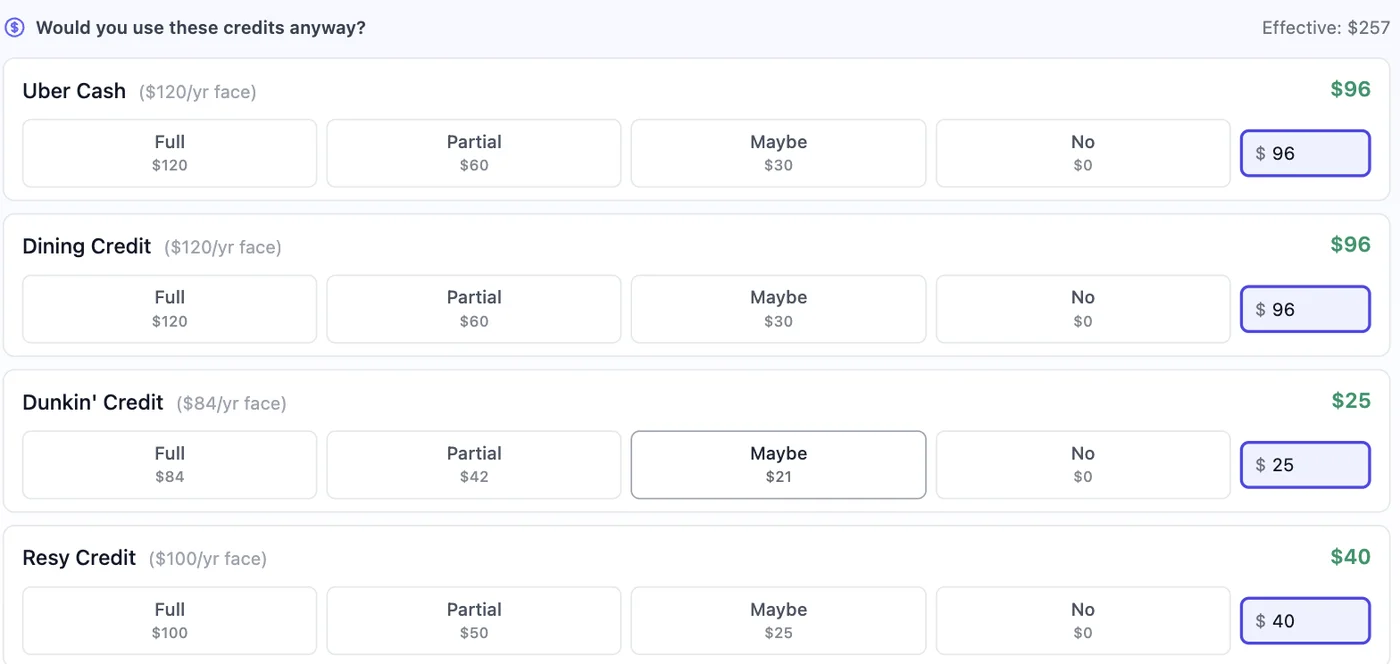
Each credit is set separately. The running total in the top right is what offsets the annual fee.
The catalog defaults assume 80% of the Uber and dining credits, 30% of Dunkin', and 40% of Resy. That comes to $257.20 realized against the $325 fee, so the effective cost of holding the card is $67.80.
Set every credit to Full and the card is free. Set them all to No and it costs the full $325. That's a $325 swing on one input, which is why the tool asks instead of guessing.
The results
With those inputs, here's what the solver returns.
The headline: $1,384.20 per year, net of fees.
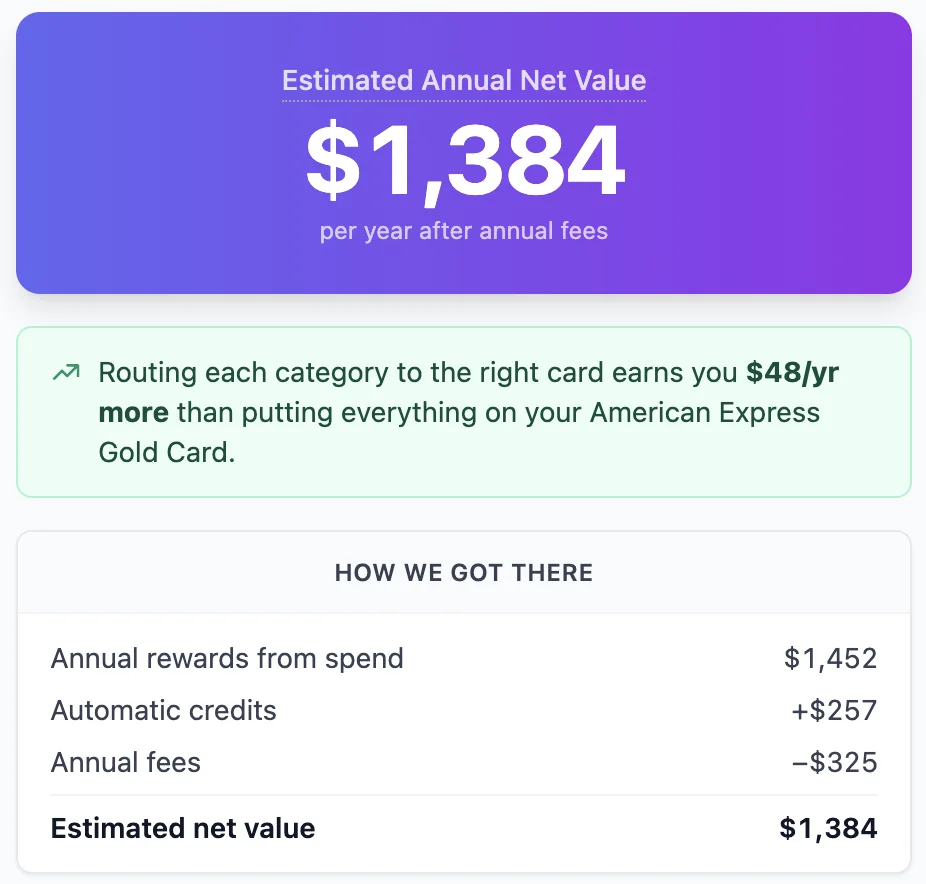
The results screen for this wallet. Captured July 30, 2026 on the US-average profile described above.
Underneath sits a comparison worth reading carefully:
Routing each category to the right card earns you $48/yr more than putting everything on your American Express Gold Card.
That number surprises people, so it's worth being precise about what it measures. CardSavvy compares your optimized wallet against your single best card, and here that's the Gold card, which on its own would earn $1,336. Splitting spending across all three only beats it by $48.
That's a different question from the one most rewards articles answer. Against a plain 2% cash back card, which is what most people carry, the same three-card wallet is worth $688 more. Against the best card already in your wallet, it's worth $48.
Both numbers are true and they answer different questions. If you're deciding whether to carry three cards instead of just the Gold, $48 is your number. If you're deciding whether to move off a single flat-rate card, $688 is.
How the number is built
The "How we got there" table reconciles every component:
| Line | Amount |
|---|---|
| Annual rewards from spend | $1,452.00 |
| Automatic credits | +$257.20 |
| Annual fees | −$325.00 |
| Estimated net value | $1,384.20 |
That table is enforced by the backend. If the components don't sum to the net within a cent, the response fails validation rather than rendering a number that doesn't add up.
Where each card earns
| Card | Rewards | Fee after credits | Net |
|---|---|---|---|
| Amex Gold | $1,200.00 | $67.80 | $1,132.20 |
| Costco Anywhere Visa | $132.00 | $0 | $132.00 |
| Fidelity Rewards Visa | $120.00 | $0 | $120.00 |
Amex Gold does the heavy lifting: $480 from groceries, $240 from dining, $96 from fast food. Groceries alone nearly cover the fee three times over.
The Costco Visa earns $96 on gas at 4% and $36 at Costco. Worth noting that its 4% gas rate is capped at $7,000 a year, which doesn't bind at $2,400 of gas spend. It would if you commuted more.
A word on the ties
If you look at the full allocation table, Amex Gold wins some categories it has no business winning, like Internet and Cell Phone.
Those categories are exact ties. Gold earns 1x on them, and at 2 cents per point that's a 2% return, which is precisely what the Fidelity Visa pays. The solver breaks the tie arbitrarily and the total is unaffected. Don't read the allocation table as advice on where to put your phone bill.
Where this number is soft
Three things would move it.
Your spending isn't average. The $34,800 profile is a midpoint. If you spend $12,000 on groceries instead of $6,000, the Gold card's advantage roughly doubles and the fee matters less.
Point valuations are assumptions. The 2 cents per Membership Rewards point assumes you transfer to partners and redeem well. Many people don't.
Credits require behavior. The $257.20 assumes you use most of the Uber and dining credits. If your life doesn't include monthly Uber Cash, that number is lower.
The optimizer has a stress test for exactly this. It re-runs the whole allocation at point values from 70% to 130% of your assumption and reports whether the winning setup holds. If your result only works at one specific valuation, it will tell you.
Quick Decision Guide
If you have one card and no idea if it's right: run Quick mode with US averages, add your card, and look at the routing gain. Under $100 means your card is fine for your spending.
If you're considering an annual fee card: set the credits honestly first. Most premium cards look good at 100% credit realization and bad at 25%.
If you already have three or more cards: the useful output is the per-card net value table. Any card with a negative net is costing you money.
Bottom Line
On average US spending, optimizing across three cards was worth $688 a year over a single flat 2% card. Most of that came from one card covering two large categories.
The number depends on assumptions you control, and the tool exposes all of them rather than burying them. Run your own numbers and check whether your result survives the stress test.
Frequently Asked Questions
How much can you earn by optimizing credit card rewards?
On an average US household budget of $34,800 per year, a three-card setup earned $1,384 net of annual fees, against $696 for a single flat 2% cash back card. The roughly $688 per year difference is what routing each spending category to its best card is worth. Households that spend more, or spend more heavily in bonus categories, will see a larger gap.
Do I need to enter my exact spending?
No. Quick mode asks five questions and there's a button that fills in US average spending. Rough numbers rank cards correctly because the ranking depends on the ratio between your categories. Detailed mode is worth it once you want the dollar figure to be accurate.
How many credit cards do you need?
Most of the value is in the first two. Here, adding a category card to a flat 2% card captured $640 of the $688 available. The third card added $48. See how many rewards cards you actually need for the full curve.
Does the optimizer account for annual fees and credits?
Yes. Fees are subtracted from rewards, and you set how much of each statement credit you would realistically use. On the Amex Gold that single input is worth more than $300 a year.
Is CardSavvy free?
Yes, and it takes no affiliate or advertising revenue today, so the ranking is whatever the math says. See our promise.
Related on Learn
Hand-picked based on topic and reader interest

How Many Rewards Credit Cards Do You Actually Need?
How many credit cards should you have for rewards? We added cards one at a time to an average US household budget and measured what each one earned. The second card was worth 13 times the third.

Three Ways a Rewards Optimizer Gives You the Wrong Answer (Ours Included)
Credit card rewards calculators disagree wildly. Here are the three assumptions that move the answer most, run on one wallet, plus a list of what CardSavvy's own model gets wrong and why.
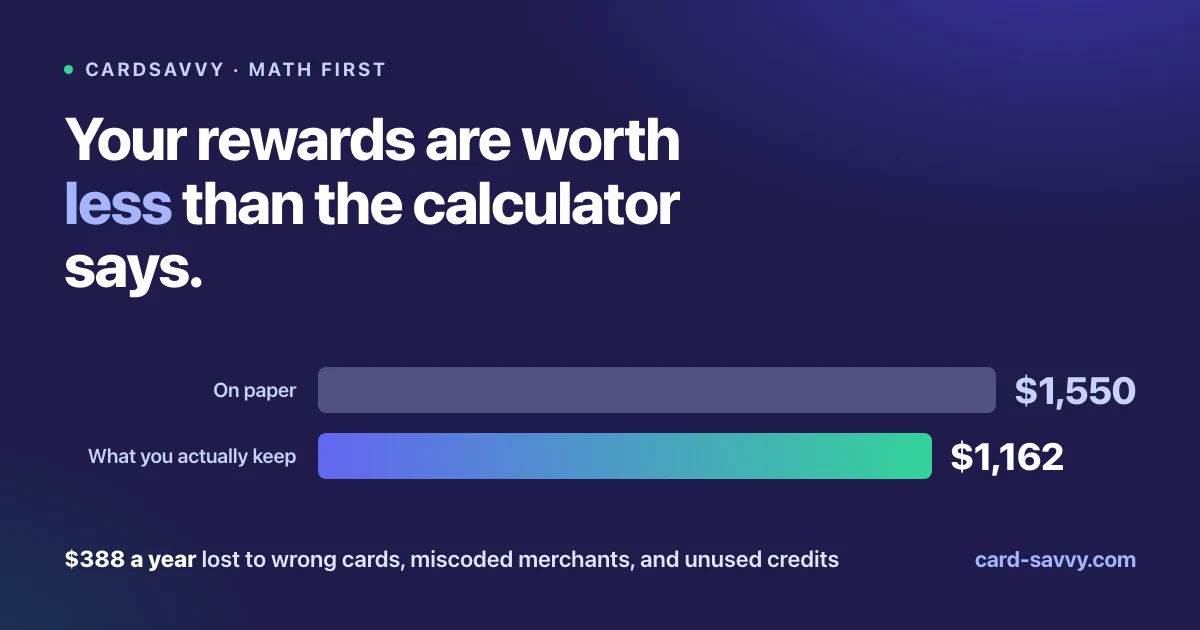
Why Your Credit Card Rewards Are Worth Less Than the Calculator Says
The optimization math is solved. Getting the money is not. Seven measurable gaps between the rewards a calculator promises and the value you actually keep, with the number attached to each.
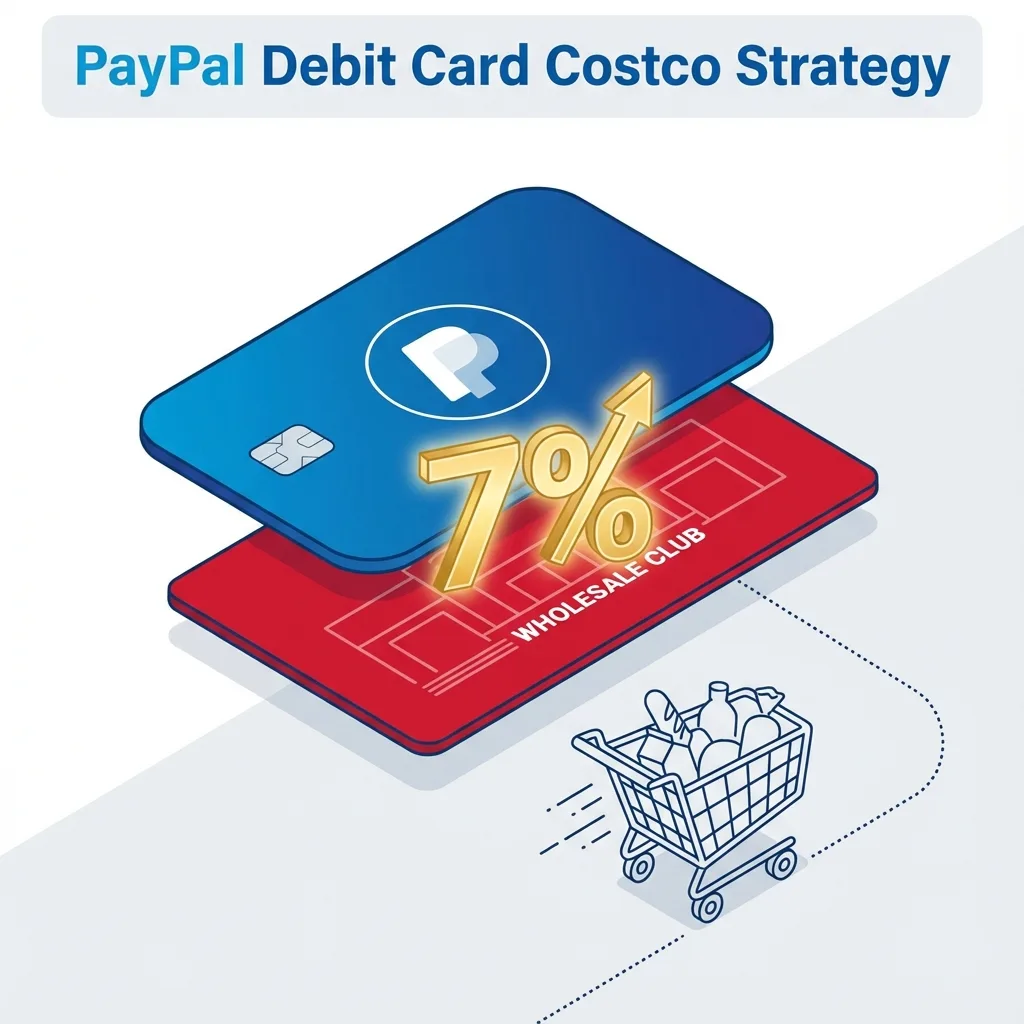
Costco PayPal Debit Card Strategy: How to Get 7% Cash Back (2026)
Costco does not accept PayPal directly, but the PayPal Debit Card earns 5% back and stacks with Executive membership for 7% total. Here's the complete strategy.
Get smarter with your cards
Math-first card strategy posts, sent when we publish — not on a schedule. No spam. Unsubscribe anytime.
We respect your inbox.
Ready to optimize your wallet?
Get personalized card recommendations and spending strategies in under 2 minutes.
Free to use. No signup required.
Get My Strategy →Just need an answer for one purchase? Best Card →