CSR vs. Prime Visa in 2026: The Quantitative Break-Even
Focus: Chase Travel Portal Bookings (Flights + Hotels)
If you book flights and hotels through the Chase Travel portal, the comparison between the Chase Sapphire Reserve (CSR) and the Chase Amazon Prime Visa in 2026 comes down to a single question:
How much extra value does the CSR’s higher earn rate generate, and is it enough to overcome the card's net annual cost?
Below is the clean, math-first break-even analysis for the new 2026 fee structure.
The Assumptions (Intentionally Narrow)
To isolate the variable that matters, we are only comparing:
- Portal bookings (Chase Travel flights + hotels).
- Rewards earned minus CSR annual fee plus CSR travel credit.
- Baseline redemption value (1.0¢ per point, ignoring "Points Boost" variance for the baseline).
Key Terms (2026 Data):
- CSR Annual Fee: $795
- CSR Annual Travel Credit: $300
- CSR Earn Rate (Chase Travel): 8x points
- Prime Visa Earn Rate (Chase Travel): 5% cash back (requires eligible Prime membership)
Valuation Baseline:
- CSR Baseline: 1.0¢ per point (conservative floor).
- Points Boost: Treated as upside rather than a guaranteed baseline, as availability varies dynamically.
Step 1: Convert to "Effective % Back"
First, normalize the rewards to a percentage return. If you redeem CSR points at a baseline of 1.0¢ per point:
- CSR (via Chase Travel): 8.0%
- Prime Visa (via Chase Travel): 5.0%
The Incremental Edge: The CSR generates an extra 3% return on portal spend compared to the Prime Visa.
Step 2: Determine CSR’s Net Annual Cost
We treat the travel credit as cash-equivalent (assuming you naturally spend >$300 on travel).
The CSR must generate $495 more in rewards than the Prime Visa annually to justify its slot in your wallet on a pure dollars basis.
Step 3: The Break-Even Calculation
Let be your annual spend on flights and hotels via the Chase Travel portal. The CSR wins when:
Solving for :
✅ The Baseline Break-Even: $16,500 If you redeem points at 1.0¢ each, you need to spend $16,500 per year in the Chase Travel portal for the CSR to mathematically outperform the Prime Visa.
A Reusable Formula (Plug in Your Valuation)
Since your personal valuation of Ultimate Rewards points () drives the math, here is the general formula to find your specific break-even spend ():
- = your value per point in dollars (e.g., 0.015 for 1.5¢).
- $495 = Net effective fee.
- and = The respective earn multipliers.
Sensitivity Analysis: The Impact of Valuation
Chase’s "Points Boost" can theoretically raise redemption values up to 2.0¢, though this is dynamic. Here is how higher valuations drastically lower the break-even bar:
| Effective Value per Point | CSR Effective Return (8x) | Incremental Edge vs. 5% | Break-Even Spend |
|---|---|---|---|
| 1.0¢ (Baseline) | 8.0% | 3.0% | $16,500 |
| 1.5¢ | 12.0% | 7.0% | ~$7,071 |
| 1.75¢ | 14.0% | 9.0% | $5,500 |
| 2.0¢ (Max Boost) | 16.0% | 11.0% | ~$4,500 |
The Punchline: If you reliably realize 1.75¢–2.0¢ per point via Points Boost or transfer partners, the break-even drops to a very accessible $4,500–$5,500. If you redeem at 1.0¢, the bar remains aggressively high.
Three Critical Caveats
- Prime Membership is Required: The Prime Visa's 5% earn rate is explicitly tied to an eligible Prime membership. Without it, the earn rate drops (typically to 3%), changing the math in CSR's favor.
- Portal Trade-offs: Booking via a portal often means sacrificing hotel elite benefits and points earning from the hotel chain itself. This "opportunity cost" is not captured here but is real for loyalists.
- Ancillary Benefits Ignored: This model ignores lounge access, DashPass, Lyft Pink, and insurance protections. If you value those perks at >$495, the break-even spend on travel is effectively $0.
The Card Savvy Takeaway
If you are optimizing strictly for "rewards earned vs. fees paid" on portal bookings:
- At 1.0¢ valuation: Stick with the Prime Visa unless you spend over $16,500 annually in the portal.
- At >1.5¢ valuation: The CSR becomes mathematically superior at just ~$7,000 of annual portal spend.
Related on Learn
Hand-picked based on topic and reader interest

Venture X vs. Sapphire Reserve: The 2026 Showdown
A clear, 2026-updated showdown between the simple Capital One Venture X and the perk-heavy Chase Sapphire Reserve.

The Best Credit Card Trifecta in 2026: The Math After Fees
We priced the Chase, Citi, Capital One, Wells Fargo and Amex combos on one $60,000 budget. At 1 cent per point, a free 2% card beats three of them. Here is when each one pays.

Chase Sapphire Preferred June 2026 Refresh: New 3x Categories, a Doubled Hotel Credit, and a Quieter Hyatt Devaluation
Chase refreshed the $95 Sapphire Preferred: 3x gas and EV, 3x Airbnb and Vrbo, a $100 hotel credit, and Global Entry. The cost: Hyatt transfers drop to 4:3. Run the math on your numbers.
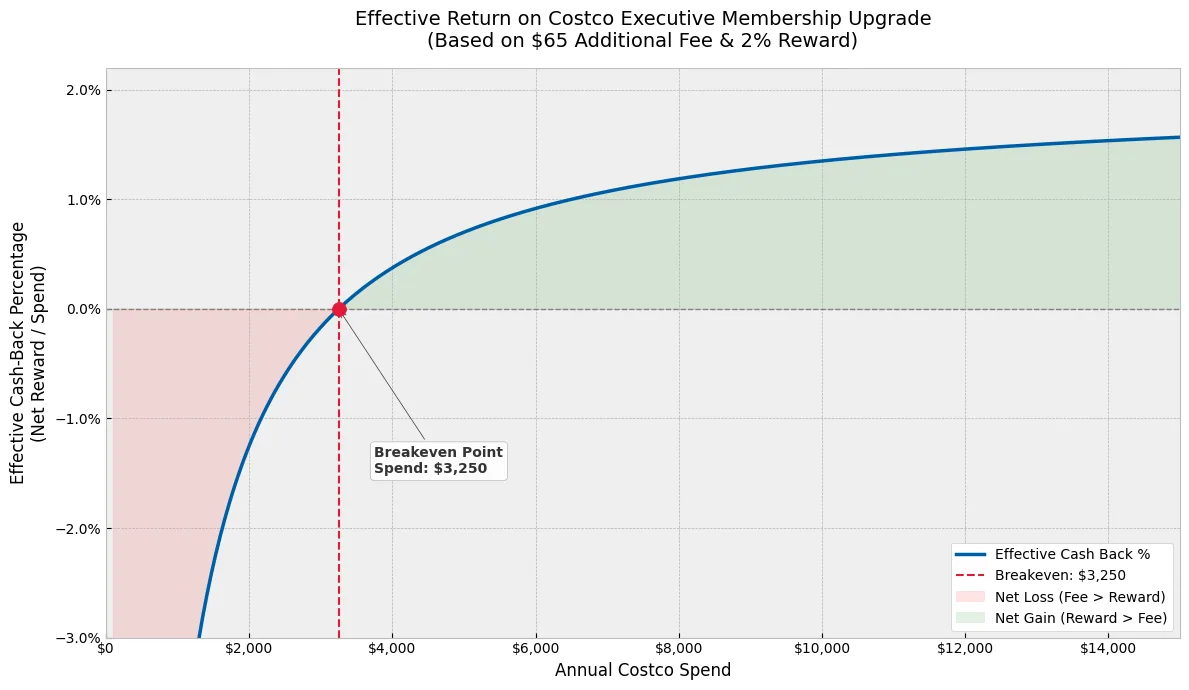
Are You *Really* Getting 2% Cash Back with Costco Executive? (The Math Says No)
The Costco Executive membership promises a 2% reward, but the $65 upgrade fee eats into your returns. We did the math to find your *true* effective cash-back rate.
Get smarter with your cards
Math-first card strategy posts, sent when we publish — not on a schedule. No spam. Unsubscribe anytime.
We respect your inbox.
Ready to optimize your wallet?
Get personalized card recommendations and spending strategies in under 2 minutes.
Free to use. No signup required.
Get My Strategy →Just need an answer for one purchase? Best Card →