How to Actually Use the CSR's $500 Edit Credit Without Overpaying (2026 Guide)
The Chase Sapphire Reserve's $500 annual Edit credit sounds like free luxury hotel money. It is not. It is a targeted rebate on specific portal bookings with rules that can quietly eat the value if you are not paying attention.

This guide breaks down how the credit actually works, the 8 biggest gotchas, and a math-first framework for deciding when The Edit beats booking direct. No inflated valuations, no assumptions about what "you could get."
See if the CSR is worth it for your spending →
What the $500 Edit Credit Actually Is
For the personal Chase Sapphire Reserve in 2026, Chase's current benefit page describes The Edit credit as:
- Up to $500 annually for prepaid The Edit bookings
- Maximum $250 per transaction (so you need at least two qualifying stays)
- 2-night minimum per stay
- Prepaid "Pay Now" reservation through Chase Travel only
- Credits typically post quickly but may take up to 4 weeks
A note on confusing Chase pages. Some older Chase educational articles still describe the benefit as $250 from January through June and another $250 from July through December. Chase's current CSR benefit page and card terms describe the 2026 version as a more flexible annual structure with a per-transaction cap. Both TPG and NerdWallet report that Chase made the credit more flexible starting in 2026. Treat the current benefit page as controlling.
For broader context on how this credit fits into the CSR's overall "coupon book" of credits, see our Premium Card Credits Scorecard.
8 Gotchas That Can Shrink Your $500 to $0
This is the section to bookmark. Each gotcha is sourced and real.
1. "The Edit access" is not the same as "The Edit credit"
The booking must be at a property labeled as The Edit, and it must be a qualifying prepaid booking of 2 or more nights. A pay-later rate may still give you the on-property perks (breakfast, upgrade, property credit), but you need the prepaid structure to trigger the statement credit. Read the listing carefully before assuming the $250 credit will apply.
2. You can absolutely overpay through Chase Travel
This is the biggest risk. NerdWallet compared 94 Edit properties and found that booking through The Edit was 7.8% more expensive on average, or about $83 more for an equivalent two-night stay. It was the same price or cheaper only 28% of the time.
That means on 72% of bookings studied, the portal charged more than booking direct. If you are paying $83 extra to get a $250 credit, your real value just dropped to $167.
3. The $100 property credit is per booking, not per day
Many Edit properties include a $100 on-property credit for dining, spa, or activities. But this is per booking, not per night. That means the value density is highest on short stays. On a 2-night stay, it is worth $50 per night. On a 5-night stay, it is worth $20 per night. Target short stays for the best credit-to-night ratio.
4. Breakfast and upgrades are often overstated
Daily breakfast for two sounds great. But the form varies wildly by property and may be capped at a specific dollar amount or limited to certain venues. Room upgrades, early check-in, and late checkout are all subject to availability. Both Chase and TPG emphasize this. Do not assign $40/day breakfast value if you are staying at a property where the continental buffet is the only option.
5. The credited portion does not earn Ultimate Rewards points
This is easy to miss. Chase's terms say purchases that qualify for the Edit statement credit will not earn points on the credited portion. So the "10x through Chase Travel" headline does not apply to the first $250. On a $500 two-night stay where $250 is credited, you earn 10x on only the remaining $250, not the full amount.
6. Portal bookings add friction if plans change
You are booking through a third-party channel. Cancellation and modification policies may differ from booking direct. TPG notes you should check cancellation rules carefully and watch for extra charges such as resort fees that may not be clearly surfaced in the portal. NerdWallet also flags that using a portal adds a middleman for any changes.
7. Hotel loyalty points and elite credit are not guaranteed
Chase has improved this significantly. Many Edit properties now show a "Hotel Loyalty Program Eligible" banner in search results, meaning you can earn hotel loyalty points and receive elite benefits even when booking through the portal. But it is still property-dependent. Check for the banner before assuming your Marriott Bonvoy or Hyatt status will be honored.
8. Paying entirely with points can kill the statement credit
Chase says you can pay with cash, points, or a combination. But the statement credit applies to qualifying card charges. Third-party reporting consistently confirms that an all-points booking will not trigger the credit because there is no charge to the CSR. If you want to use points, leave enough on the card to capture the $250 credit.
The Value Formula: When The Edit Beats Booking Direct
Here is the CardSavvy framework for evaluating any Edit booking. No guessing, no inflated estimates.
Net Edit Value =
| Component | How to value it |
|---|---|
| CSR statement credit used | Up to $250 (hard value) |
| Breakfast value | What you would actually spend on breakfast, not the menu price |
| Property credit value | Only count it if you would use dining, spa, or activities on-site |
| Upgrade / late checkout | $0 unless confirmed at booking (it is subject to availability) |
| Minus: Edit price premium vs direct | Compare same room, same dates, same cancellation terms |
Example: Best case
| Amount | |
|---|---|
| CSR credit | $250 |
| Breakfast (2 mornings, $25/person realistic value) | $100 |
| Property credit (used for dinner) | $100 |
| Edit premium over direct | -$30 |
| Net Edit value | $420 |
Example: Worst case
| Amount | |
|---|---|
| CSR credit | $250 |
| Breakfast (continental, worth $12/person) | $48 |
| Property credit (did not use) | $0 |
| Edit premium over direct | -$120 |
| Net Edit value | $178 |
The difference between $420 and $178 is entirely about how honestly you value the perks and how aggressively you rate-shop.
Best Use Cases for The Edit
The sweet spot: 2-night stays. This is where the math works best. You unlock the full $250 CSR credit, get the per-booking $100 property credit, and compress all benefits into the minimum stay window.
Independent and boutique luxury properties. NerdWallet found the strongest rate parity among properties not tied to major hotel chains. These are also the properties where you are least likely to have competing elite status that duplicates Edit perks.
Loyalty-eligible branded hotels. If the property shows the "Hotel Loyalty Program Eligible" banner, you get Edit perks on top of your loyalty earnings and elite benefits. This is one of the most underrated angles. A 2-night Hyatt stay where you earn World of Hyatt points, get a suite upgrade from Globalist status, and stack the Edit credit is genuinely strong value.
Stacking with other CSR hotel credits. Some 2026 Edit properties overlap with Chase's select hotel brands (IHG, Montage, Pendry, Omni, Virgin, Minor, Pan Pacific). TPG reports that overlapping stays may stack the Edit credit with the separate $250 Chase Travel hotel credit. If confirmed for your property, this is the highest-value play available.
Quick Decision Guide:
- You dine on-site and will use the property credit? Book through The Edit.
- Rate is within 5% of direct and property is loyalty-eligible? Book through The Edit.
- 2-night getaway at an independent luxury hotel? This is the ideal Edit booking.
- Long stay, status-heavy traveler, need flexibility? Book direct.
When to Skip The Edit and Book Direct
Be honest with yourself about these scenarios.
You already have top-tier hotel status. If you are Marriott Titanium or Hyatt Globalist, you already get breakfast, upgrades, and late checkout at most properties. The Edit perks become duplicative, and you are paying a portal premium for benefits you would get anyway.
The rate premium is above 10%. If Chase Travel is charging meaningfully more than the direct rate (and NerdWallet found this is the case 72% of the time), the $250 credit shrinks fast. A $150 premium on a 2-night stay means your real credit is only $100.
You need flexible cancellation. Prepaid rates are required to trigger the credit. If your travel plans are uncertain, a non-refundable portal booking is a risky bet.
You are staying 4+ nights. The property credit value density drops with longer stays, the rate premium compounds over more nights, and you may get better value from a direct loyalty rate with points earning.
Your Checklist Before You Click "Book"
Use this before every Edit booking.
- Compare the all-in price against booking direct (same room type, same dates, including taxes and fees)
- Confirm the property is labeled The Edit in Chase Travel (not just any Chase Travel hotel)
- Select a prepaid rate ("Pay Now") to trigger the statement credit
- Check for the loyalty-eligible banner if you want hotel points and elite benefits
- Plan to use the property credit on dining, spa, or activities (do not let it go to waste)
- Pay at least partially with your CSR (an all-points booking will not trigger the credit)
- Verify cancellation terms before confirming (portal policies may differ from direct)
See how the CSR stacks up against your other cards →
The Bottom Line
The CSR's Edit credit is best understood as a luxury-hotel rebate with strings attached, not a blanket "free $500." The strings are manageable, but only if you book deliberately.
The playbook is simple: book 2-night prepaid stays, compare the all-in price against direct, prioritize loyalty-eligible or independent luxury properties, and only count perks you will actually use.
Do that, and the Edit credit is genuinely valuable. Skip the rate-shopping, and that $500 can quietly shrink into a portal-priced illusion.
For more on how the CSR's full credit stack compares to other premium cards, see our 2026 Coupon-Book Scorecard and CSR vs Venture X comparison.
Cards Mentioned in This Article
Click any card above to see if it's worth adding to your wallet — personalized verdict in 30 seconds.
Related on Learn
Hand-picked based on topic and reader interest

Chase Sapphire Reserve StubHub Credit: $300 Guide (2026)
The Chase Sapphire Reserve's $300 StubHub credit is real, but resale markups and fees can quietly eat the value. Here's how to use it and what to actually count.

How to Use the CSR's $300 Dining Credit: Exclusive Tables Guide (2026)
The Chase Sapphire Reserve's $300 Exclusive Tables dining credit is narrow but real. Here's how to use it, the gotchas, and when it's actually worth it.
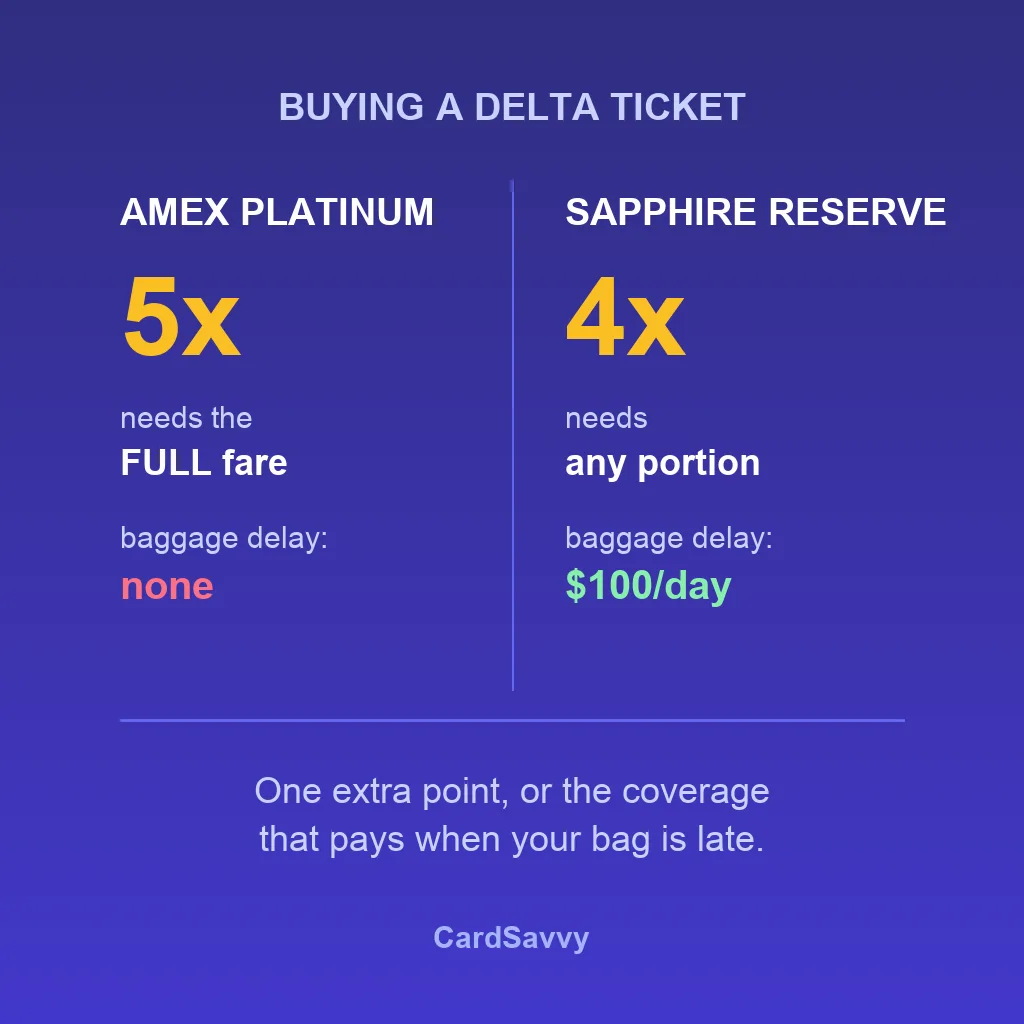
Which Card Should You Actually Buy Delta Tickets With?
Amex Platinum earns 5x on Delta airfare against the Sapphire Reserve's 4x. But Platinum requires the full fare charged to it and covers no baggage delay, which matters more than one extra point if you check bags.

Using the Sapphire Reserve Dining Credit in Seattle: $150 at Tomo
We used the Chase Sapphire Reserve's $150 dining credit at Tomo in White Center. What it covered, what it did not, and why the eligible restaurant list now reaches further than we said it did.
Get smarter with your cards
Math-first card strategy posts, sent when we publish — not on a schedule. No spam. Unsubscribe anytime.
We respect your inbox.
Ready to optimize your wallet?
Get personalized card recommendations and spending strategies in under 2 minutes.
Free to use. No signup required.
Get My Strategy →Just need an answer for one purchase? Best Card →