Are You Ready for Credit Card Rewards? A Decision Framework Before You Optimize
Credit card rewards can put $500 or more back in your pocket every year. They can also put you $3,500 in debt with a 490 credit score. The difference isn't luck or willpower. It's whether you were ready to play the game in the first place.
A recent episode of the Vox podcast Explain It to Me drove this point home with a story that should sound familiar to anyone who got their first credit card at 18: small charges snowball, minimum payments barely cover interest, and suddenly a $1,500 limit becomes a years-long financial anchor. The podcast also made a compelling case that rewards optimization is genuinely valuable, but only once the fundamentals are in place.
This post is the framework for deciding which side of that line you're on. No signup required. Just math.
Already know you're ready? Skip to the optimizer →
Quick Decision Guide
| Your situation | Ready for rewards? | Next step |
|---|---|---|
| Carrying credit card debt | No. Pay it off first. | See "The Debt Rule" below |
| Credit score below 670 | Not yet. Build credit first. | Best first credit card guide |
| Pay in full, score 670+ | Yes. You're leaving money on the table. | Run the optimizer |
| Pay in full, score 720+ | Absolutely. Premium cards are in play. | Run the optimizer |
If you land in the top two rows, keep reading. The sections below explain why, and more importantly, what to do instead.
The Debt Rule: Why Rewards Math Breaks When You Carry a Balance
Sara Rathner, a credit card analyst at NerdWallet, put it bluntly on the Vox podcast: "If you have credit card debt, don't play the credit card points game." The math backs her up completely.
Here's what happens when you earn rewards while carrying a balance:
| Scenario | Rewards earned | Interest paid | Net result |
|---|---|---|---|
| $1,000/month spend, 2% back, paid in full | $240/year | $0 | +$240 |
| $1,000/month spend, 2% back, $3,000 balance at 25% APR | $240/year | $750/year | -$510 |
| $1,000/month spend, 5% category card, $3,000 balance at 29% APR | $600/year | $870/year | -$270 |
Even a "great" 5% category card loses to a 29% APR. You cannot out-earn interest with rewards. It is not close.
Angel Sevilla, a guest on the same podcast, shared his own version of this story. He got a $1,500 credit limit at 18, charged small things, made minimum payments, and watched the balance grow. His credit score eventually dropped to 490, which meant he couldn't even get approved for an apartment. Years of rebuilding followed.
His story is not unusual. The Federal Reserve reported that roughly half of credit card holders carry a balance at least some of the time.
The pivot: If you carry a balance, your number-one "optimization" is paying it off. Every dollar of interest you eliminate is a guaranteed return that no rewards card can match. (For a deeper look at how proposed rate caps could change this equation, see our analysis of the 10% APR cap proposal.)
Once your balance is $0 and you can commit to paying in full every month, come back. The optimizer will be here.
Who Actually Pays for Rewards (And Why It Matters)
Credit card rewards don't appear out of thin air. Understanding where the money comes from helps explain why the system works the way it does and why the "readiness" question matters so much.
The short version: rewards are primarily funded by interchange fees, the 1.5-3% cut that merchants pay to the card network on every transaction. Those fees are baked into retail prices, which means everyone pays them whether they use a credit card or not. The rest comes from interest charged to cardholders who carry balances and from annual fees paid by premium cardholders.
Sean Vanatta, a financial historian at the University of Glasgow and author of Plastic Capitalism, traced this system's evolution on the Vox podcast. Credit cards started as department store charge plates in the 1950s, morphed into bank-issued revolving credit in the 1960s, and exploded after a 1978 Supreme Court ruling allowed banks to charge interest rates based on the laws of their home state (not the borrower's). That's why so many card issuers are headquartered in South Dakota and Delaware, states with no usury caps.
The uncomfortable truth is that rewards effectively transfer wealth from people who carry balances and pay interest to people who pay in full and collect points. If you're in the first group, you're subsidizing someone else's free flights.
This is exactly why we believe optimization tools should be accessible and transparent, not gatekept behind paywalls or buried in affiliate-driven rankings. The math should be available to everyone. (For more on this, read The CardSavvy Philosophy.)
The Readiness Checklist: 5 Questions
Before you start comparing cards or running optimizations, answer these five questions honestly.
1. Do you pay your full balance every month?
This is the only non-negotiable. If the answer is no, everything else is irrelevant. Go back to the Debt Rule section above.
2. Is your credit score above 670?
Most rewards cards require at least 670 to approve. Premium cards like the Chase Sapphire Reserve or Amex Gold typically want 720 or higher. If you're below 670, focus on building credit first with a starter card. You can get there in 6-12 months of responsible use.
3. Do you have at least $500/month in card-eligible spending?
If you spend less than $500/month on cards, a simple flat-rate 2% cash back card captures most of the available value. The difference between a 2% card and an "optimized" multi-card setup on $400/month is roughly $5-10/month. Not nothing, but not worth the complexity.
4. Can you remember which card to use for which category?
Be honest. If managing two cards sounds like a chore, a single flat-rate card is the right answer. There's no shame in simplicity. When we added cards one at a time to an average budget in how many rewards cards you need, the second card added $640 a year and the third added $48.
5. Are you willing to review your wallet once a year?
Card terms change. Annual fees increase. Bonus categories rotate. A wallet that was optimal in 2025 might not be in 2026. Budget 10 minutes once a year to re-run the optimizer. That's it.
If you answered yes to all five: you're ready. Run the optimizer now →
If you answered no to any of the first two: focus there first. The rest can wait.
Three Levels of Rewards Optimization

Not everyone needs (or wants) a five-card strategy. Here's how to match your optimization effort to your lifestyle.
Level 1: The One-Card Setup (5 minutes)
Get a flat-rate card and use it for everything. No category tracking, no card switching, no mental overhead.
The best options right now: the Fidelity Rewards Visa at 2% on all purchases, or the Robinhood Gold Card at 3% (with a Robinhood Gold membership). For a full comparison, see our best unlimited spend cards guide.
This is the right level if your monthly spend is under $1,000 or if you want zero friction. A 2% flat card on $1,500/month earns $360/year. That's real money for zero effort.
Level 2: The Two-Card Setup (15 minutes)
Add one category card for your biggest spending bucket. For most people, that's dining or groceries. A flat 2% card plus a 4x dining card captures roughly 80% of the value of a fully optimized wallet.
This is the sweet spot for most people. It takes 15 minutes to set up and requires remembering exactly one rule: "Use this card for food, use the other card for everything else."
For the full breakdown, see which card combinations clear their fees and the 80/20 rule of credit card rewards.
Level 3: The Optimized Wallet (30 minutes)
This is where CardSavvy's optimizer shines. Enter your monthly spending across categories, and the algorithm finds the mathematically best combination of cards for your profile, accounting for rewards rates, annual fees, sign-up bonuses, and credit redemption values.
The optimizer uses linear programming (the same math used in logistics and supply chain optimization) to find the provably best allocation. No guesswork, no affiliate bias. For a deeper look at how point valuations work, see our guide to valuing credit card points.
Find your optimal wallet now →
What About Annual Fees?
Annual fees are where most rewards mistakes happen. A card can offer incredible rewards rates and still be a bad deal if the fee exceeds the value you extract.
Sara Rathner's advice from the podcast is solid: evaluate each card when the annual fee posts. Ask three questions. Did I use the benefits? Would I sign up again at this price? Is there a no-fee downgrade option?
At CardSavvy, we model this as a simple equation: Net Value = Total Rewards Earned minus Annual Fee. Only count credits you would actually use without changing your behavior. A $300 hotel credit has $0 value if you don't stay in hotels.
This is the "premium card trap" we wrote about in The Coupon Book Problem. If you have to change your behavior to justify a card, the card isn't justified. The fee should pay for itself based on spending you were already going to do.
The Bottom Line
Credit card rewards are a genuine mathematical advantage, but only if the prerequisites are in place. Pay in full every month, have a credit score that qualifies you for decent cards, and spend enough to make the optimization meaningful.
If you're not there yet, that's fine. Build credit, pay down debt, and come back when the fundamentals are solid. The optimizer doesn't expire.
If you are ready, stop leaving money on the table. The difference between a random card and the right card can be hundreds of dollars a year, and it takes less than five minutes to find out.
Related on Learn
Hand-picked based on topic and reader interest

Credit Card Rewards A to Z: 26 Rules and the Math Behind Them
Twenty-six rules for credit card rewards, one per letter, each with the math attached. Annual fees, net value, merchant coding, devaluation, and the rule that comes before A.

The Best Credit Card Trifecta in 2026: The Math After Fees
We priced the Chase, Citi, Capital One, Wells Fargo and Amex combos on one $60,000 budget. At 1 cent per point, a free 2% card beats three of them. Here is when each one pays.
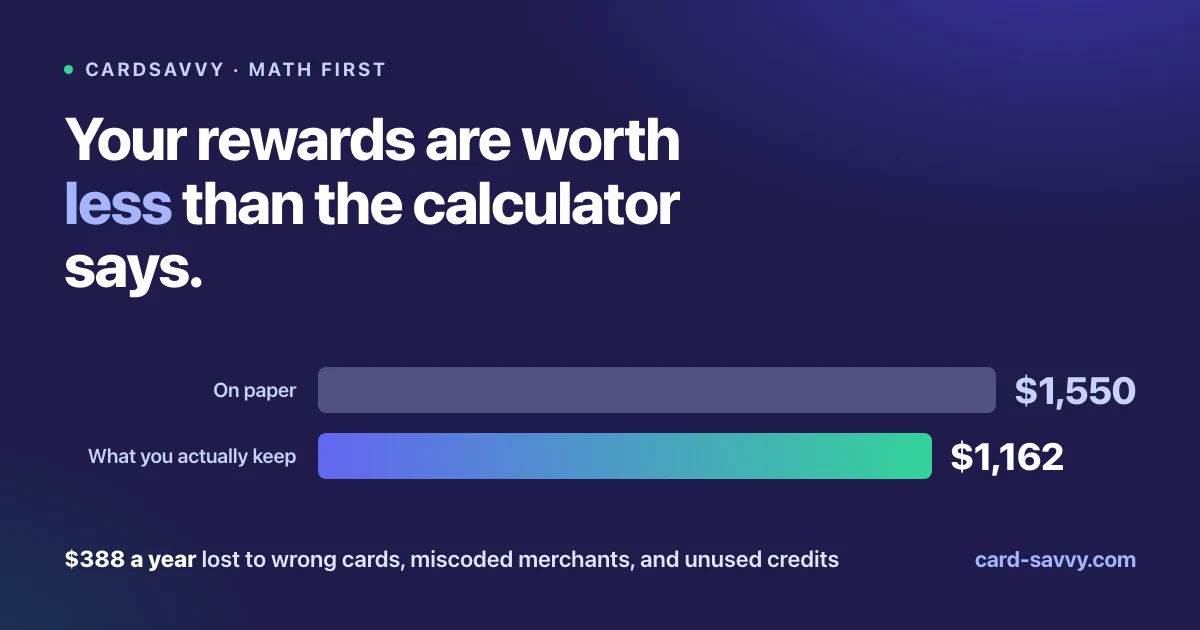
Why Your Credit Card Rewards Are Worth Less Than the Calculator Says
The optimization math is solved. Getting the money is not. Seven measurable gaps between the rewards a calculator promises and the value you actually keep, with the number attached to each.

Three Ways a Rewards Optimizer Gives You the Wrong Answer (Ours Included)
Credit card rewards calculators disagree wildly. Here are the three assumptions that move the answer most, run on one wallet, plus a list of what CardSavvy's own model gets wrong and why.
Get smarter with your cards
Math-first card strategy posts, sent when we publish — not on a schedule. No spam. Unsubscribe anytime.
We respect your inbox.
Ready to optimize your wallet?
Get personalized card recommendations and spending strategies in under 2 minutes.
Free to use. No signup required.
Get My Strategy →Just need an answer for one purchase? Best Card →