AAA Credit Cards Review (2026): The 5% Is Real, but Mind the Caps
AAA sells two credit cards now, and the headline rates look almost too good for $0 annual fee cards: 5% on groceries on the AAA Daily Advantage Visa Signature, and 5% on gas and EV charging on the AAA Travel Advantage Visa Signature. Both are issued by Comenity Capital Bank (Bread Financial), both skip foreign transaction fees, and neither requires a AAA membership.
The rates are real. The catch is the caps, and the caps work differently than most reviews assume. The Daily Advantage doesn't cap your spending. It caps your cash back, at $500 per calendar year, shared across three categories. That distinction changes the math, so we'll show it.
Our verdict up front: both cards are worth adding as category specialists. The Daily Advantage is one of the strongest no-fee grocery cards available in 2026. The Travel Advantage is one of the strongest no-fee gas and EV cards, especially if you don't buy gas at Costco. Neither should be the card you put everything on.
See where these cards fit in your wallet →
The two cards at a glance
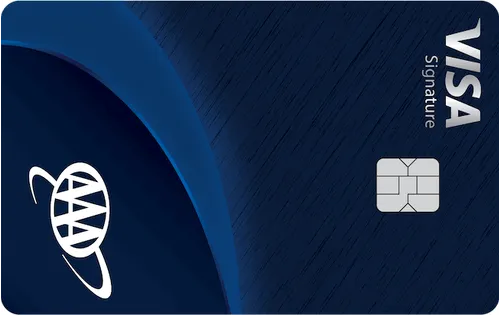
AAA Daily Advantage Visa Signature
| Category | Rate |
|---|---|
| Grocery stores | 5% |
| Gas/EV charging, wholesale clubs, streaming, pharmacy, AAA purchases | 3% |
| Everything else | 1% |
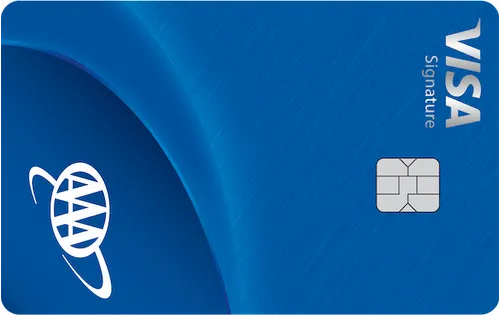
AAA Travel Advantage Visa Signature
| Category | Rate |
|---|---|
| Gas and EV charging | 5% |
| Travel, restaurants, grocery stores, AAA purchases | 3% |
| Everything else | 1% |
Shared facts: $0 annual fee, no foreign transaction fees, Visa Signature network, and a $100 statement credit after $1,000 in purchases in the first 90 days. Purchase APR runs 17.49% to 31.49% variable, which is normal for this class of card and irrelevant if you pay in full. Cash back redeems as a statement credit or direct deposit starting at $5.
One genuinely unusual perk: cash back redeemed at a participating AAA club location or call center is worth 5% more. $100 in rewards becomes $105. If you already pay for AAA membership or travel through a AAA office, that's a small but free boost.
The caps are the whole story
Daily Advantage: a $500 cash-back cap, not a spend cap
The terms are specific: a maximum of $500 in cash back earned per calendar year at grocery stores, wholesale clubs, and gas stations combined. After that, those categories earn 1% for the rest of the year.
Because the cap counts dollars earned rather than dollars spent, the spending threshold depends on your category mix:
| Your spend | Cash back | Cap status |
|---|---|---|
| $8,000 grocery | $400 | Under cap |
| $10,000 grocery | $500 | Cap reached exactly |
| $12,000 grocery | $520 | $500 + 1% on the overflow |
| $8,000 grocery + $4,000 wholesale + $2,000 gas | ~$512 | Cap hit early; overflow earns 1% |
Grocery-only spenders get the cleanest deal: $10,000 per year at a full 5%. That covers a typical household's supermarket budget with room to spare. But if you also route wholesale club and gas spending to this card, you'll burn through the $500 sooner, and every dollar of those categories after that earns 1%.
The practical advice: treat the Daily Advantage as a grocery card first. If your combined grocery, wholesale, and gas spending is large, put gas on a different card and let the cap cover groceries.
Travel Advantage: $350 cash back equals exactly $7,000 of gas
The Travel Advantage cap is simpler because only one category earns 5%. The cap is $350 in cash back per calendar year on gas and EV charging, and at a uniform 5% that converts to exactly $7,000 in spend. After that, gas drops to 1%.
$7,000 a year is a high bar. At $3.80 a gallon, that's roughly 1,840 gallons. Most one-car households never get close; two-car commuter households and rideshare drivers will. The 3% categories (travel, restaurants, grocery) have no stated annual cap in the current terms.
How they stack up against the field
The grocery card market has a clear benchmark: the Amex Blue Cash Preferred earns 6% at U.S. supermarkets on up to $6,000 per year, with a $95 annual fee after the first year. Run the grocery-only numbers and the no-fee AAA card wins at every realistic spend level:
| Annual grocery spend | AAA Daily (5%) | Blue Cash Preferred (6%, after $95 fee) |
|---|---|---|
| $3,000 | $150 | $85 |
| $6,000 | $300 | $265 |
| $10,000 | $500 | $305 |
Blue Cash Preferred still makes sense if you value its 6% streaming, 3% transit, and Amex offers as a package, and its first-year fee waiver makes year one a wash. But on grocery math alone, the Daily Advantage is ahead. Against the no-fee Blue Cash Everyday (3% on up to $6,000) and Capital One Savor (unlimited 3%), the Daily Advantage wins on rate up to its cap, while Savor remains the better single-card pick because its 3% dining, entertainment, and streaming are uncapped.
On the gas side, the natural comparison is the Costco Anywhere Visa: 5% at Costco gas, 4% at other gas and EV charging, on the first $7,000 of fuel purchases per year. The Travel Advantage matches the $7,000 ceiling and beats it on rate everywhere outside Costco: 5% versus 4%. If most of your fuel comes from Costco pumps, keep the Costco Visa. If it doesn't, the Travel Advantage is the better gas card, and it adds 3% on restaurants, travel, and groceries that the Costco card can't match outside its own niche.
The Wells Fargo Autograph is the broader rival: unlimited 3X on restaurants, travel, gas, transit, streaming, and phone plans with no annual fee. The Travel Advantage beats it on gas up to the cap (5% versus 3%); Autograph wins on breadth and simplicity.
What neither AAA card does is replace a catch-all. The 1% base rate is weak, so pair either card with a 2% flat-rate card for everything outside the bonus categories.
Compare these cards against your actual spending →
What about Costco?
This deserves its own section because the categories trip people up. Costco warehouse purchases code as a wholesale club, not a grocery store, regardless of how many groceries are in your cart.
So at a Costco register, the Daily Advantage earns 3% (its wholesale club rate), not 5%. That still makes it one of the better cards to use at Costco, since both AAA cards are Visas and Costco takes Visa. The Travel Advantage earns just 1% inside the warehouse, but should earn 5% at Costco's gas pumps, where transactions code as fuel.
The fine print that matters
Merchant coding controls everything. Bonus rates apply when the merchant's category code matches an eligible category. Comenity and AAA don't assign those codes and won't fix miscoded purchases. A superette that codes as a convenience store earns 1%, not 5%.
PayPal and Venmo kill the bonus. The terms state that purchases made through third-party payment accounts, including PayPal and Venmo, earn no bonus cash back. If you pay for groceries through a PayPal checkout button, expect 1%.
"AAA purchases" is narrower than it sounds. The 3% applies when a participating AAA club is the merchant of record. Third-party insurance products, extended warranties, and some travel services sold through AAA are excluded.
Rewards expire and can be forfeited. Cash back expires five years after it posts. Comenity can forfeit rewards if your account goes 60 days delinquent or is closed; voluntary closures generally give you 30 days to redeem first.
Terms can change. Comenity reserves the right to modify or end the rewards program. Co-branded cards re-price more often than bank flagship cards, so the rates above are accurate as of June 2026 and worth re-checking before you apply.
Who should get which card
Get the Daily Advantage if groceries are your biggest bonus-eligible expense. Up to $10,000 a year at 5% with no fee is rare, and 3% on streaming and pharmacy is useful filler. (How does it score for your wallet? →)
Get the Travel Advantage if you spend heavily on gas or EV charging away from Costco, or you want one no-fee card that covers fuel, restaurants, and travel at decent rates. Up to $7,000 of fuel at 5% beats nearly every no-fee competitor.
Get neither if you want one card for everything. A flat 2% card beats both outside their bonus categories, and points cards beat them for premium travel value.
Getting both is a legitimate strategy: Daily for groceries, Travel for gas, and the shared issuer means one login. Just remember each card's caps run separately, and only the Daily card's cap is shared across categories.
Bottom line
These are competitive, fairly designed cards with one detail that most marketing glosses over: the caps. The Daily Advantage's $500 cash-back cap makes it an excellent grocery specialist and a mediocre everything-card. The Travel Advantage's $350 gas cap is generous enough that most drivers will never see it.
We've added both cards to the CardSavvy optimizer, including the shared-cap math, so you can see capped totals instead of headline-rate fantasies. That's the math-first standard we hold every card to: model the fine print, then recommend.
Related on Learn
Hand-picked based on topic and reader interest

Walmart OnePay CashRewards Card Review 2026: Is 5% Back Actually Worth It?
The Walmart OnePay card earns up to 5% back at Walmart for Walmart+ members. We run the breakeven math on the $98 membership, the 1.5% non-Walmart rate, and how it pairs with a 2% catch-all.

Apple Card Review 2026: When 3/2/1% Cash Back Beats 2% Flat
Apple Card earns 3% at Apple and select merchants, 2% on Apple Pay, and 1% everywhere else. We run the math on when that beats a flat 2% card, who should keep it, and what the Chase transition changes.

World of Hyatt Credit Card Review 2026: Is the $95 Fee Worth It?
The World of Hyatt card's $95 fee pays for itself with the annual Category 1-4 free night. We run the math on the 9x earn rate, $15k bonus night, and elite fast-track.
Coinbase One Card Review: 4% Bitcoin Back Is Real, but Most People Won't Earn It
The Coinbase One Card offers up to 4% bitcoin back on purchases. We break down the asset tiers, monthly caps, and membership costs to show who actually benefits.
Get smarter with your cards
Math-first card strategy posts, sent when we publish — not on a schedule. No spam. Unsubscribe anytime.
We respect your inbox.
Ready to optimize your wallet?
Get personalized card recommendations and spending strategies in under 2 minutes.
Free to use. No signup required.
Get My Strategy →Just need an answer for one purchase? Best Card →