Best First Business Credit Card for Startups 2026: Ink Unlimited vs Blue Business Cash
You're starting a business. Maybe it's freelancing, an Etsy shop, a consulting practice, or a SaaS side project. The first piece of financial hygiene everyone tells you about is the same: get a business credit card to separate your expenses.
They're right. Mixing personal and business spending on one card is an accounting headache that gets worse every month. But you don't need an LLC, a business plan, or even a registered business name to get approved. A sole proprietorship (which you already are if you earn non-W2 income) qualifies.
The real question is which card. After running the math, two $0 annual fee cards stand above the rest for new entrepreneurs: the Chase Ink Business Unlimited and the Amex Blue Business Cash. Here's how to pick between them.
Find your optimal business card setup →
Quick Answer
Choose the Chase Ink Business Unlimited if you plan to eventually pair it with a Chase Sapphire card. You'll earn 1.5x Ultimate Rewards points on everything, and those points become worth 25-100% more when pooled with the Sapphire Preferred or Sapphire Reserve.
Choose the Amex Blue Business Cash if you want pure simplicity. You'll earn a flat 2% cash back as automatic statement credits with no transfer partners to think about.
Head-to-Head Comparison
| Feature | Chase Ink Business Unlimited | Amex Blue Business Cash |
|---|---|---|
| Annual Fee | $0 | $0 |
| Reward Rate | 1.5x UR points on everything | 2% cash back on everything |
| Spending Cap | Unlimited | 2% on first $50K/yr, then 1% |
| Welcome Bonus | $750 after $6K in 3 months | Varies (typically $250-$500) |
| Intro APR | 0% for 12 months | 0% for 12 months |
| Foreign Transaction Fee | 3% | None |
| Points Flexibility | Transfer to airlines/hotels via Sapphire | Cash back only (statement credits) |
| Network | Visa | American Express |
| Employee Cards | Free | Free |
The Key Math: When 1.5x UR Beats 2% Cash Back
On the surface, 2% beats 1.5%. But Ultimate Rewards aren't cash back. They're transferable points, and their value depends on how you redeem them.
The break-even calculation is straightforward. Divide the Blue Business Cash earn rate by the Ink Unlimited earn rate: 2% / 1.5 = 1.33 cents per point. If you can get more than 1.33 cents per Ultimate Rewards point, the Ink Unlimited wins.
Can you hit 1.33 cpp? Easily. Here's the range:
- Cash back floor: 1.0 cpp (redeem UR as statement credits with Ink alone)
- Sapphire Preferred: 1.25 cpp via Chase Travel portal
- Sapphire Reserve: 1.50 cpp via Chase Travel portal
- Transfer partners: 1.5-2.0+ cpp on airline awards (Hyatt, United, Southwest)
If you pair the Ink Unlimited with any Sapphire card, you clear the 1.33 cpp threshold without trying. If you transfer to Hyatt or airlines for premium redemptions, you can double it. For a deeper look at how to value transferable points honestly, see our guide to valuing credit card points.
The catch: If you never get a Sapphire card and redeem UR as cash at 1.0 cpp, the Ink Unlimited effectively earns 1.5% cash back. That's worse than the Blue Business Cash's 2%. So the Ink only wins if you commit to the Chase ecosystem.
Deep Dive: Chase Ink Business Unlimited
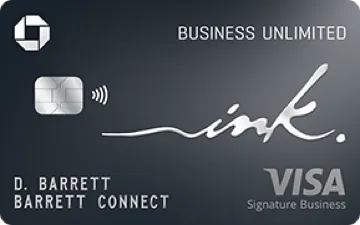
The Ink Business Unlimited is a straightforward flat-rate card that becomes powerful in context. On its own, 1.5x UR points is decent. Paired with the broader Chase ecosystem, it's one of the best business cards available.
Why it works for startups:
The $750 welcome bonus after $6,000 in 3 months is generous for a no-fee card. If you're launching a business, you're probably spending on web hosting, software subscriptions, inventory, and advertising anyway. Hitting $6K in three months is realistic for most startups.
The 0% intro APR for 12 months is equally valuable. New businesses often front-load expenses (equipment, initial inventory, marketing) before revenue comes in. Twelve months of interest-free financing on those startup costs can save hundreds of dollars.
The UR ecosystem advantage:
Chase Ultimate Rewards points pool across cards. If you later add a Chase Sapphire Preferred ($95/yr) or Chase Sapphire Reserve ($550/yr), every point earned on the Ink Unlimited becomes worth more. This is the single biggest reason to choose the Ink over the Blue Business Cash.
For example, $3,000/month in business spending earns 54,000 UR points per year. With a Sapphire Reserve, those points are worth $810 in the travel portal (1.5 cpp) or potentially $1,080+ through transfer partners (2.0 cpp). The same spending on the Blue Business Cash would return $720 in statement credits.
One thing to know: Chase's 5/24 rule applies to business card applications. You need to be under 5 new card accounts in the past 24 months to get approved. However, the Ink Unlimited itself typically doesn't count toward 5/24 once approved, since Chase doesn't report business cards to personal credit bureaus.
Deep Dive: Amex Blue Business Cash
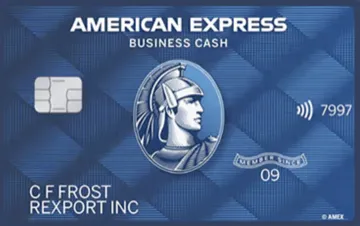
The Blue Business Cash is the "set it and forget it" option. There's no points program to learn, no transfer partners to research, and no secondary card needed to unlock full value. You earn 2% cash back and it shows up as a statement credit automatically.
Why it works for startups:
Simplicity matters when you're focused on building a business. The 2% rate is competitive with any flat-rate card (personal or business), and it comes with no annual fee. You don't need to think about point valuations or redemption strategies.
The 0% intro APR for 12 months mirrors the Ink Unlimited's offer, giving you the same startup financing flexibility.
The $50K cap:
The Blue Business Cash earns 2% on the first $50,000 in purchases per calendar year, then drops to 1%. For most new businesses, $50K in annual spending isn't an issue. But if your business scales quickly (especially with advertising or inventory costs), you'll hit that cap around $4,167/month in spending. Plan accordingly.
For context, at $50,000/year the card earns exactly $1,000 in cash back. Every dollar beyond $50K earns only 1%, which is below most competitors.
Expanded Buying Power:
Amex offers a feature called Expanded Buying Power on this card. It lets you spend beyond your credit limit on select purchases, based on your payment history and spending patterns. This can be useful for startups with irregular cash flow or occasional large purchases.
Acceptance consideration:
American Express is accepted at fewer merchants than Visa, particularly at smaller businesses and some international vendors. If your startup costs include a lot of small-vendor purchases, this is worth considering. For online software, SaaS subscriptions, and major vendors, Amex acceptance is typically not an issue. Amex also charges no foreign transaction fees, which is a plus if you work with international suppliers.
When to Step Up: Premium Card Break-Even Math
Both starter cards are great for the first 6-12 months. But once your spending patterns stabilize, a premium business card can significantly increase your earnings. Here's when the upgrade makes sense.
Chase Ink Business Preferred ($95/yr)
The Ink Preferred earns 3x UR points on the first $150,000 per year in combined spending on shipping, advertising (including social media and search engine ads), internet, cable, and phone services. Everything else earns 1x.
Break-even vs. Ink Unlimited: The Ink Preferred earns 3x in bonus categories where the Ink Unlimited earns 1.5x. The incremental value is 1.5x points per dollar in those categories. At a conservative 1.0 cpp, you need:
$95 / (1.5 points x $0.01) = $6,333/yr in 3X categories
At 1.5 cpp (Sapphire Reserve portal value):
$95 / (1.5 points x $0.015) = $4,222/yr in 3X categories
If you spend more than $350-$530/month on advertising, shipping, internet, or phone, the Ink Preferred pays for itself. For more on how cards in the $95 tier compare, see our full breakdown.
Amex Business Gold ($375/yr)
The Amex Business Gold earns 4x Membership Rewards points on the top 2 categories where your business spends the most each billing cycle (from a list that includes airfare, advertising, gas, dining, shipping, and technology). It earns 1x on everything else.
The card also comes with up to $240/year in FedEx and Grubhub credits plus a $155 Walmart+ credit. If you use all three (and many business owners genuinely use FedEx and Walmart+), the effective annual fee drops to roughly zero, making the 4x earnings nearly free.
Break-even vs. Blue Business Cash: If you value Membership Rewards at 1.0 cpp and use all credits, the card essentially pays for itself with credits alone. Without the credits, you'd need roughly $9,375/yr in 4X categories for the incremental 2x points (over the Blue Business Cash's 2%) to cover the $375 fee.
The Business Gold is particularly strong for businesses with heavy advertising (Facebook/Google Ads) and SaaS/cloud spending, since both categories qualify for 4x.
Upgrade Summary
| Card | Annual Fee | Break-Even Spend (in bonus categories) | Best For |
|---|---|---|---|
| Chase Ink Preferred | $95 | $4,200-$6,300/yr | Shipping + advertising heavy |
| Amex Business Gold | $375 ($0 net with credits) | $0-$9,375/yr | SaaS + advertising heavy |
Our advice: Stick with the $0 annual fee card for your first 6-12 months. Let your spending patterns stabilize. Then check back, run the numbers, and upgrade only if the math clearly works.
You Don't Need an LLC
This is the biggest misconception that stops new entrepreneurs from getting a business card. You do not need an LLC, a corporation, an EIN, or any formal business registration.
If you earn any income outside of a W-2 job, you already have a business. The IRS considers you a sole proprietor by default. That includes freelancing, selling products online, consulting, tutoring, rideshare driving, or any other self-employment income.
What to put on the application:
- Business name: Your legal name (e.g., "Jane Smith")
- Business type: Sole Proprietorship
- Tax ID: Your Social Security Number
- Years in business: How long you've been earning this income (even 0 years is fine for some issuers)
- Annual business revenue: Your best estimate of gross income from business activities
- Business category: Whatever best describes your work (consulting, retail, technology, etc.)
Be honest but don't undersell yourself. Credit card companies want to lend to businesses. Annual revenue of $5,000-$10,000 from a side business is perfectly fine for approval.
How Business Cards Affect Your Credit
Applying for a business credit card creates a hard inquiry on your personal credit report. This is true for both Chase and Amex. You'll also need to provide a personal guarantee, meaning you're personally liable for the balance.
After approval, the news gets better. Chase and Amex typically do not report business card balances or utilization to personal credit bureaus. Only defaults or severely delinquent accounts show up. This means high utilization on your business card won't hurt your personal credit score.
This also has a strategic benefit: business cards generally don't count toward Chase's 5/24 rule. So getting the Ink Unlimited now won't limit your ability to apply for personal cards later.
The exception to be aware of: some issuers (Capital One, Discover) do report business card activity to personal bureaus. Chase and Amex do not, which is another reason these two cards are the top picks.
The Bottom Line
For your first business credit card, the decision comes down to ecosystem commitment vs. simplicity.
Pick the Chase Ink Business Unlimited if: You're open to the Chase ecosystem, might add a Sapphire card down the road, and want the flexibility of transferable points. The higher welcome bonus ($750 vs. typical $250-$500) sweetens the deal.
Pick the Amex Blue Business Cash if: You want guaranteed 2% back with zero complexity, no spending caps for the first $50K, and no foreign transaction fees. It's the "just works" option.
Either way, you're making a smart move. Separating business expenses from personal spending simplifies your taxes, builds business credit history, and earns you rewards on money you're already spending.
For a broader look at all business card options including category-specific picks and premium choices, check out our complete guide to the best business credit cards in 2026.
Related on Learn
Hand-picked based on topic and reader interest

Best Business Credit Cards 2026: Cash Back and Rewards for Small Businesses
Complete guide to the best business credit cards in 2026. Compare cash back cards, rewards programs, intro APR offers, and find the right card for your SMB spending profile.

Best Business Credit Card for Cloud Computing and SaaS Costs (2026)
Running GCP, AWS, or Azure? Chase Ink Cash's 5% internet category doesn't cover cloud hosting. Here's the math on which business card actually wins for solo entrepreneurs with cloud and SaaS spending.

Best Business Credit Cards for Pre-Revenue Startups (2026)
You have an LLC, a domain, and a pile of SaaS bills, but no revenue yet. Here is how to handle the Amex $1,000 minimum revenue field honestly and which card to actually start with.

Best Credit Cards for Paying Insurance Premiums 2026
Can you pay insurance with a credit card? Yes, but fees can eat your rewards. Learn which cards maximize value, which insurers accept cards, and when it's worth paying by credit card.
Get smarter with your cards
Math-first card strategy posts, sent when we publish — not on a schedule. No spam. Unsubscribe anytime.
We respect your inbox.
Ready to optimize your wallet?
Get personalized card recommendations and spending strategies in under 2 minutes.
Free to use. No signup required.
Get My Strategy →Just need an answer for one purchase? Best Card →