Best Business Credit Cards for Pre-Revenue Startups (2026)
You vibe-coded a niche website over a weekend, registered a domain, formed an LLC, and now your "business" has $700 a year in SaaS bills before earning a dollar. Hosting, email, GitHub, two AI coding tools, a design subscription, analytics. The expenses are real. The revenue is not.
Then you sit down to apply for a business credit card and hit a wall: the application wants an annual business revenue figure, and the field will not accept zero. American Express specifically requires four digits, which means at least $1,000 in revenue. Per a One Mile at a Time report, the field rejects anything lower.
This guide covers the right move when you have real business expenses but no revenue yet, including how to handle that revenue field honestly and which card to use in the meantime.
See which business card fits your spending →
The Short Answer
If your business has no revenue and no concrete plan to monetize this year: Skip the traditional business credit card for now. Use a cash-underwritten card like Mercury IO or a plain business debit card. You will keep your books clean without misrepresenting your revenue.
If your business has real revenue, or a realistic plan to earn at least $1,000 in gross business revenue this year: The Amex Blue Business Cash (2%, no annual fee) or the Chase Ink Business Unlimited (1.5x UR points, no annual fee) are the standard first cards. Our first business card guide breaks down the choice in detail.
The Amex $1,000 Problem
A few years ago, Amex business applications accepted any revenue number, including zero. That changed. The current online form requires a four-digit figure, which functionally means $1,000 minimum.
The intent is to filter out applicants who do not have a real business. That is fine in principle. The practical problem is that "real business" does not always mean "revenue-generating business" in 2026. A solo founder building a SaaS prototype, a blogger who has not enabled ads yet, an iOS developer waiting on App Store approval. All real businesses, all with real expenses, all with zero current revenue.
A common workaround on credit card forums is to enter $1,000 because the form will not accept less. That is bad advice when it is not true. Falsifying an application is fraud, and Amex can claw back rewards, close accounts, and refer cases to financial crime authorities if they audit and find misstatements.
Whether $1,000 is a defensible good-faith estimate of your business's revenue this year depends on the situation. Sometimes it is. Often, for a brand new project, it is not.
What counts as good faith
Gross business revenue means money the business actually earns before expenses. Not personal salary. Not money you transferred into a business account from your savings. Not hypothetical future revenue from a project you might launch someday.
Here is how different scenarios stack up:
| Scenario | Is $1,000 a defensible estimate? |
|---|---|
| No revenue, no monetization plan for this year | No |
| Ads running, affiliate links live, or paid subscribers, on track for $1,000+ | Yes |
| App launching this year with paid tiers priced to clear $1,000 | Probably yes |
| "I might monetize someday if things change" | No |
| Signed contracts or invoices for at least $1,000 | Yes |
| The form would not accept $0, so you entered $1,000 anyway | No |
If you are in a "no" row, the right move is to wait until you are in a "yes" row before applying for an Amex business card.
For True Pre-Revenue Businesses: Mercury IO
The cleanest option for a startup with zero current revenue is Mercury IO, Mercury's cash-underwritten business credit card.
Why it fits a pre-revenue startup:
- Cash-underwritten. Your credit limit is based on the cash balance held at Mercury, not on your business revenue. There is no revenue field to fudge.
- No personal guarantee. Most traditional business cards put your personal credit on the hook if the business defaults. Mercury IO does not.
- 1.5% unlimited cash back on all spend, with no rotating categories and no annual fee.
- No interest charges. Mercury auto-pays the balance daily, or monthly once you cross $15,000 in account balances, so you cannot carry a balance.
The tradeoffs are real. Mercury IO transactions can decline if they exceed your linked cash balance. The card does not build personal credit (the flip side of "no personal guarantee"). And you have to bank with Mercury, which is a digital-only startup bank, not a household name.
For a pre-revenue founder whose only goal is clean separation of business expenses plus a small cash-back kicker, those tradeoffs are usually worth it.
Compare Mercury IO against traditional business cards for your spend →
Other pre-revenue options
If Mercury is not a fit, the next-best options are:
- A plain business debit card from your business checking account. Zero rewards, zero application friction.
- A corporate card like Ramp or Brex. These also rely on business cash or funding rather than revenue, but they are generally aimed at venture-backed startups with bank balances in the tens of thousands. Solo founders with a $2,000 operating account often will not qualify.
Once You Have Revenue: The First Traditional Card
Once your business actually earns money, or you have a realistic plan to earn at least $1,000 this year, the calculus changes. Now you can apply for an Amex business card honestly.
The two standard picks for a first card, both with no annual fee:
Amex Blue Business Cash
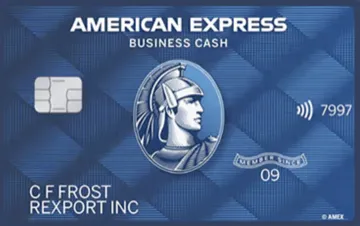
- Rewards: 2% cash back on the first $50,000 in purchases per year, then 1%.
- Annual fee: $0
- Welcome bonus: Typically $250 to $500 after a few thousand in spend (offer varies).
- Best for: Founders who want pure simplicity. Statement credits, no transfer partners, no categories to track.
For a SaaS-heavy business spending $500 to $3,000 a year, the 2% rate covers nearly all spending under the $50K cap.
Chase Ink Business Unlimited
- Rewards: 1.5x Ultimate Rewards points on everything.
- Annual fee: $0
- Welcome bonus: $750 after $6,000 in spend in 3 months.
- Best for: Founders who already have or plan to add a Chase Sapphire Preferred or Reserve. The points become worth 1.5 to 2+ cents each when transferred to airline and hotel partners.
The 1.5x rate looks worse than 2% cash back, but only if you redeem at 1 cent per point. Most reasonable Chase Ultimate Rewards redemptions clear 1.33 cents per point, which is the break-even with a 2% card. Our first business card guide has the full math.
For a deeper look at category-specific cards once your SaaS and cloud spend grows, see our cloud and SaaS business card guide.
What Not to Do
A few habits that look harmless and are not:
Do not invent revenue to pass the form. A misstated revenue figure can be treated as application fraud. The downside is asymmetric: you save five minutes, you risk a clawback and an account closure. Wait until you have a number you can defend.
Do not mix personal and business expenses to "save the application." If your business is not ready for a card yet, keep personal expenses on a personal card and use a business debit card for business spending. Untangling commingled accounts during a tax audit is the worst version of this problem.
Do not pay an annual fee for aspirational rewards. Premium cards like the Amex Business Gold ($375 a year) only pay off once your business spending is high enough to clear the fee in category multipliers. At $700 a year in SaaS spend, you would be paying $375 to earn maybe $56 in extra rewards. The math gets there eventually. Wait for it.
Do not carry a balance because the business is "investing in growth." Business credit card APRs are typically 18% to 28%. There is no investment math that justifies paying that rate on operating expenses, unless you have a specific time-bounded reason like a 0% intro APR period for a one-time inventory purchase.
Quick Decision Guide
$0 revenue, no concrete monetization plan this year: Use Mercury IO or a business debit card. Do not apply for an Amex business card yet.
$1,000+ in real or good-faith expected business revenue this year: The Amex Blue Business Cash is the safest first card. 2% on everything under the $50K cap, no annual fee.
You want transferable points and you will get a Sapphire card: The Chase Ink Business Unlimited fits better. 1.5x UR points scale up when paired with the Chase travel ecosystem.
You are not sure how to estimate revenue: Use what you can defend in writing. Signed contracts, live affiliate accounts, paid subscribers, ad earnings, app store sales. Skip projected income from projects that are not built or launched.
You are spending heavily on ads or cloud infrastructure: Read our cloud and SaaS business card guide. Once spend volume justifies the complexity, category cards beat flat-rate ones.
The Bottom Line
For a true pre-revenue startup, the best first business card is usually not a credit card at all. It is a cash-underwritten card like Mercury IO, or a plain business debit card. That separates your books and earns a small cash-back kicker without forcing you to stretch the truth on an application.
Once your business earns or realistically expects $1,000+ in gross revenue this year, the Amex Blue Business Cash and Chase Ink Business Unlimited are the standard first cards. Both have no annual fee, both reward general spend at a reasonable rate, and both keep your business spending separate from personal.
The right card for a pre-revenue founder is the one that matches the business you actually have, not the business you hope to have next year.
Run your optimization → to see which card fits your current spending profile.
Related on Learn
Hand-picked based on topic and reader interest

Best Credit Cards for AI, SaaS, Cloud, and Software Subscriptions (2026)
ChatGPT, Claude, AWS, Adobe, and the rest do not all earn rewards the same way. Here is the best card by spend type, with the caps, credits, and merchant-coding traps that decide your real return.

Best Business Credit Card for Cloud Computing and SaaS Costs (2026)
Running GCP, AWS, or Azure? Chase Ink Cash's 5% internet category doesn't cover cloud hosting. Here's the math on which business card actually wins for solo entrepreneurs with cloud and SaaS spending.

Best Business Credit Cards 2026: Cash Back and Rewards for Small Businesses
Complete guide to the best business credit cards in 2026. Compare cash back cards, rewards programs, intro APR offers, and find the right card for your SMB spending profile.

Credit Cards for ChatGPT and Claude Spending: The $300 Amex Credit (2026)
Amex's $300 AI credit covers ChatGPT Business only. There is no Amex Claude credit. Here is what Amex and Anthropic actually shipped, what Claude spend earns, and whether AI bills belong on a personal or business card.
Get smarter with your cards
Math-first card strategy posts, sent when we publish — not on a schedule. No spam. Unsubscribe anytime.
We respect your inbox.
Ready to optimize your wallet?
Get personalized card recommendations and spending strategies in under 2 minutes.
Free to use. No signup required.
Get My Strategy →Just need an answer for one purchase? Best Card →