Best Credit Cards for Coffee Shops and Cafés in 2026: The MCC Decides
Visa's Merchant Data Standards Manual runs to several hundred pages, and one line in it settles most of the argument about coffee cards. Under MCC 5814, Fast Food Restaurants, in the column listing what belongs there, sits the entry "Coffee Shops."
That matters because credit card rewards follow the merchant's category code, not the drink in your hand. A correctly registered café is a restaurant as far as your card is concerned, and every major dining bonus covers 5814. The interesting question is what happens when a café is registered as something else.
See which card in your wallet wins a café purchase →
Quick answer
| Card | Coffee earn | Annual fee | Why it makes the list |
|---|---|---|---|
| Capital One Savor | 3% | $0 | The only major issuer that counts bakeries as dining, and no foreign transaction fee |
| BofA Customized Cash | 6% year one, then 3% | $0 | Highest rate available, capped at $2,500/quarter |
| U.S. Bank Altitude Go | 4x | $0 | $2,000 per quarter is more coffee than anyone drinks |
| Amex Gold | 4x | $325 | Only if you already carry it for other reasons |
This is deliberately a short table. If you want the full ranking of restaurant cards, that lives in our best dining cards guide, and the answers there mostly apply here. What follows is the part that is specific to coffee, where the standard dining advice stops holding.
Where coffee actually codes
There is no dedicated coffee shop merchant category code. People take that to mean coffee coding is a coin flip. It is not.
Visa's April 2026 merchant standards describe 5814 as covering merchants that "sell prepared food and beverages for consumption either on the premises or packaged for carry-out," where "orders are typically made and paid for at a counter, kiosk or drive-through window." The inclusion list names quick service restaurants, sandwich shops, ice cream shops, coffee shops, yogurt shops, and pretzel stands.
So the standard is clear. Coffee shops belong in 5814, and 5814 is inside every dining bonus worth having. When a café fails to earn your dining rate, that is a misregistration or a structural exception, not ambiguity in the rules.
The complication is that you have no way to check. Visa took down its public merchant category lookup tool, and Amex, Mastercard, and Discover never had one. There is no way for a cardholder to find out how a café is coded before paying. That single fact is why this problem persists, and it is why the advice at the end of this article is to run a test purchase rather than to trust a list.
The three ways coffee loses its dining bonus
The bakery café. Bakeries are MCC 5462, which Visa describes as merchants that "sell (and may make) bakery goods," listing bagel shops, cake shops, cookie stores, doughnut shops, pastry shops, and pie shops. Coffee shops are not in that list. But a café that sells enough pastry can reasonably register as a bakery, and once it does, Chase and Citi both exclude it from dining by name. Bank of America does something different and files bakeries under grocery.
The counter inside another business. Visa's rules require a separate merchant code only when a business inside another business has a distinct area, its own customer-facing branding, and its own point of sale. Their own worked example is a coffee shop inside a supermarket. If the counter rings up on the store's registers, it is grocery spend. If it has its own terminal and signage, it can be its own merchant.
The hotel lobby café. Same mechanism, worse outcome. A café that bills through the hotel earns your hotel rate, which on most cards is fine, and on a dedicated dining card is not. Citi handles this explicitly, excluding restaurants located inside another business including hotels, stores, stadiums, grocery stores, and warehouse clubs.
None of these is about coffee. They are about how the merchant registered the business.
Issuers disagree, in writing
The useful thing about this category is that most issuers publish their definitions, and the definitions genuinely differ.
| Issuer | Cafés | Bakeries | Inside another business |
|---|---|---|---|
| Citi (Strata Premier) | Named as included | Named as excluded | Named as excluded |
| Capital One (Savor) | Named as included | Named as included | Not addressed |
| Chase | Covered via MCC, not named | Excluded by name | Excluded unless restaurant-coded |
| Bank of America | 5812, 5813 and 5814 only | Filed under grocery | Not addressed |
Citi's Strata Premier terms are the most precise, and worth quoting because they show how much thought goes into these carve-outs:
Restaurants: Includes purchases at cafes, bars, lounges, fast-food restaurants, restaurant delivery services, and take out restaurants. Excludes purchases at bakeries, caterers, and restaurants located inside another business (such as hotels, stores, stadiums, grocery stores, or warehouse clubs).
Capital One's definition for the Savor is one sentence and goes the other way on the single point that matters most for coffee drinkers: "Purchases at restaurants, cafes, bars, lounges, fast-food chains and bakeries."
Why Capital One Savor is the coffee pick
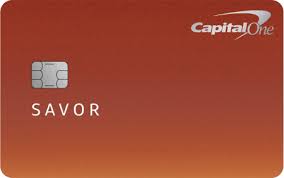
Three percent is not the highest number in this article. The Savor wins on coffee anyway, for two reasons that have nothing to do with the multiplier.
It is the only major issuer whose dining definition names bakeries. If your regular spot is a bakery café, or if you cannot tell which of your regular spots are registered that way, the Savor is the only card here that removes the question entirely. Chase and Citi will both drop you to 1% at the same merchant.
It also charges no foreign transaction fee, which matters more than it sounds like it should once you start ordering beans from Nordic or Japanese roasters.
The card has no annual fee, and the 3% is uncapped. For coffee, an uncapped 3% you can rely on beats a 5% you have to think about.
The lever that beats every multiplier
Capital One Cafés give 50% off handcrafted beverages, every day, to anyone paying with a Capital One or Discover credit or debit card. There are more than 60 locations, they serve Verve coffee, and Capital One publishes no expiration date and no per-visit limit.
Run the numbers against the thing this article is nominally about. At the 2026 national average latte price of $5.54, the difference between a 3% card and a 5% card is 11 cents. The Capital One Café discount is $2.77.
One visit is worth about twenty-five drinks' worth of multiplier optimization.
That is the whole CardSavvy argument in one comparison. Optimize the offer before you optimize the rate. The rate is what card marketing talks about because it is what card marketing can control.
Starbucks after the March 2026 change
Starbucks rewrote its Rewards terms effective March 10, 2026, and the change invalidates most of what is written about paying at Starbucks.
The old system paid differently depending on how you paid, with preloaded Starbucks Card purchases earning double. That distinction no longer exists, and earn is now set by your tier alone:
| Tier | Stars per $1 | How you reach it |
|---|---|---|
| Green | 1 | Default |
| Gold | 1.2 | 500 Stars in 12 months |
| Reserve | 1.7 | 2,500 Stars in the 12 months after reaching Gold |
You earn the same rate paying with a linked credit card, a mobile wallet, a Starbucks Card, or by scanning your barcode and paying separately. Guest checkout earns nothing, and buying or loading a Starbucks Card earns no per-dollar Stars at all.
Reloading still wins, but for a different reason than it used to. Digital reloads of $30 earn 10 bonus Stars and reloads of $50 earn 25, as standing program terms rather than a promotion, with no additional Stars above $50.
What are those worth? A 200-Star redemption covers a handcrafted drink up to $10. Redeemed against a $5.54 latte, a Star is worth about 2.8 cents, so the 25 bonus Stars on a $50 reload come to roughly 69 cents, or about 1.4% on top of whatever your card earns. Redeem against a more expensive drink and it is worth more.
That 1.4% is roughly half of the entire card-choice question, earned by pressing a different button in an app. It is also the ceiling: reload bonuses do not scale past $50.
One caveat worth stating because nobody can resolve it: whether a Starbucks Card reload transmits a different merchant code than an in-store purchase is undocumented. Visa's stored value code, 6540, is reserved for merchants "whose primary business is the sale of and/or any subsequent reloads of stored value cards," which Starbucks is not. Beyond that, there is no authoritative answer, only forum reports, some of which note that the category shown on your statement and the category your card actually pays on are not always the same thing.
Buying beans online is a different problem
If you are the kind of coffee drinker who reads this far, you may spend more on beans than on drinks. Joe's Q2 2026 survey puts the national average retail bag at $23.65 across nearly 15,000 products. Two bags a month is $570 a year, and it does not earn what you think it does.
For what those beans cost once they are in your kitchen, our sister site BeanBench has the per-cup math and why bag prices jumped. Retail coffee is up about 52% since early 2024 while cafe prices barely moved, which quietly changed the case for brewing at home.
Shop Pay does not make a purchase "Shopify." Shop Pay is an accelerated checkout inside Shopify Payments, and Shopify's own documentation says those transactions are "processed at your Shopify Payments rates," under the merchant's own account. The merchant is still the merchant. The statement descriptor is the shop's name, which Shopify requires to be the shop name, legal entity name, or store URL.
What the checkout does not tell you is how the roaster's online store is classified. That is set on the merchant's payments account, and it can differ from the café's in-person code.
The Amex Blue Cash Everyday shows how badly this can break. It pays 3% on U.S. online retail purchases up to $6,000 a year. Amex defines eligible online retail as a website or app purchase "from a U.S. retail merchant that sells physical goods or merchandise directly to consumers," and then excludes "purchases made at restaurants, supermarkets, gasoline stations, or automotive dealers."
So a roaster classified as an online retailer earns 3%. A roaster whose ecommerce runs under the café's restaurant code earns 1%, despite shipping a physical bag of beans to your door. Two roasters with identical Shopify storefronts can pay you different rates, and neither one tells you which is which.
Digital wallets can cost you the bonus. Capital One discloses on its Savor product page that "purchases made through third-party payment accounts, mobile or wireless card readers, mobile or digital wallets or similar technology may not receive a higher percentage reward, depending on how the technology is set up to process the purchase."
Foreign roasters, and the fee rule people get wrong. A foreign transaction fee is triggered by a currency conversion or by the transaction being processed through a foreign bank. Either one is enough. As Amex puts it, "you don't have to be in another country, or even pay in a foreign currency, to end up owing foreign transaction fees."
The practical consequence: a price in dollars is no guarantee you avoid the fee, because the determinant is where the transaction is acquired rather than where the roaster keeps its mailing address. A 3% fee wipes out any plausible rewards rate. Use a card with no foreign transaction fee for overseas orders and stop optimizing there.
How much is any of this worth?
Here is the number that should govern how much effort you spend on this.
Five café drinks a week at $5.54 is $1,440 a year. Moving from a flat 2% card to a 4x dining card earns you about $29 more per year. That is 11 cents a drink.
Now compare it to the other lever. If a quarter of your regular spots fail to code as restaurants, you lose about $11 a year on that same habit, and if none of them code correctly you lose $43. The merchant code is worth more than the card choice, which is the opposite of what every article on this topic implies by spending all its words on multipliers.
If the question underneath this one is whether a daily coffee habit is hurting your retirement, our sister site Summitward runs the compounding math on it, including the option that argument usually skips.
Both numbers are small. That is the honest finding. A $29 annual gain is worth capturing on a card you already carry and cannot justify opening anything, least of all a $325 card. Amex Gold earns 4x at restaurants worldwide on up to $50,000 a year and carries a $7 monthly Dunkin' credit that Amex lists as ending December 31, 2026. Use it at cafés if you have it. Do not acquire it because you like coffee.
What to do
Put café spend on whichever card in your wallet has the highest dining rate, and stop there if the answer is obvious.
If you are choosing a new no-fee card and coffee is a real category for you, the Capital One Savor removes the bakery problem that the other issuers leave in place. If you want the highest rate and can live with a quarterly cap, the BofA Customized Cash pays 6% in year one with Dining selected.
Then run one small test purchase at each of your regular spots and read the posted category on your statement. That is the only way to learn how a café codes, it takes one cycle, and it will tell you more than any list can.
Methodology
Card terms verified against issuer primary sources on September 9, 2026: Capital One's Savor product page, Bank of America's cash rewards category and BofA Rewards pages, U.S. Bank's Altitude Go page and program rules, American Express's Gold Card and rewards-info pages, Citi's Strata Premier terms PDF, and Chase's rewards category FAQ.
Merchant category definitions come from the Visa Merchant Data Standards Manual, April 2026 edition. Starbucks figures come from the Starbucks Rewards Terms of Use effective March 10, 2026.
Café drink prices come from Joe's "State of Coffee" Q2 2026 report, a survey of observed menu prices rather than transactions, covering 7,479 lattes. These are private point-of-sale figures. The Bureau of Labor Statistics publishes no index for coffee bought away from home, so no official figure exists for this one.
Points are valued at 1 cent throughout. Transfer partner upside is real and is deliberately not credited here, because coffee spend is too small to change a transfer decision.
Bank of America's 6% first-year rate is promotional with no published end date. Citi Custom Cash appeared in earlier versions of our category guides and is absent here because Citi closed it to new applicants on May 28, 2026.
Cards Mentioned in This Article
Click any card above to see if it's worth adding to your wallet — personalized verdict in 30 seconds.
Related on Learn
Hand-picked based on topic and reader interest
Best Credit Cards for Dining 2026: Cash Back vs Points Compared
What's the best credit card for restaurants in 2026? We compare 4x points cards vs 5% cash back options, plus which cards count takeout and delivery as dining.
Best Business Credit Cards 2026: Cash Back and Rewards for Small Businesses
Complete guide to the best business credit cards in 2026. Compare cash back cards, rewards programs, intro APR offers, and find the right card for your SMB spending profile.
Best Credit Cards for Gas and EV Charging 2026: Up to 5% Back
What's the best credit card for gas in 2026? We compare cards earning up to 5% at gas stations and EV charging, including which cards actually code EV correctly.
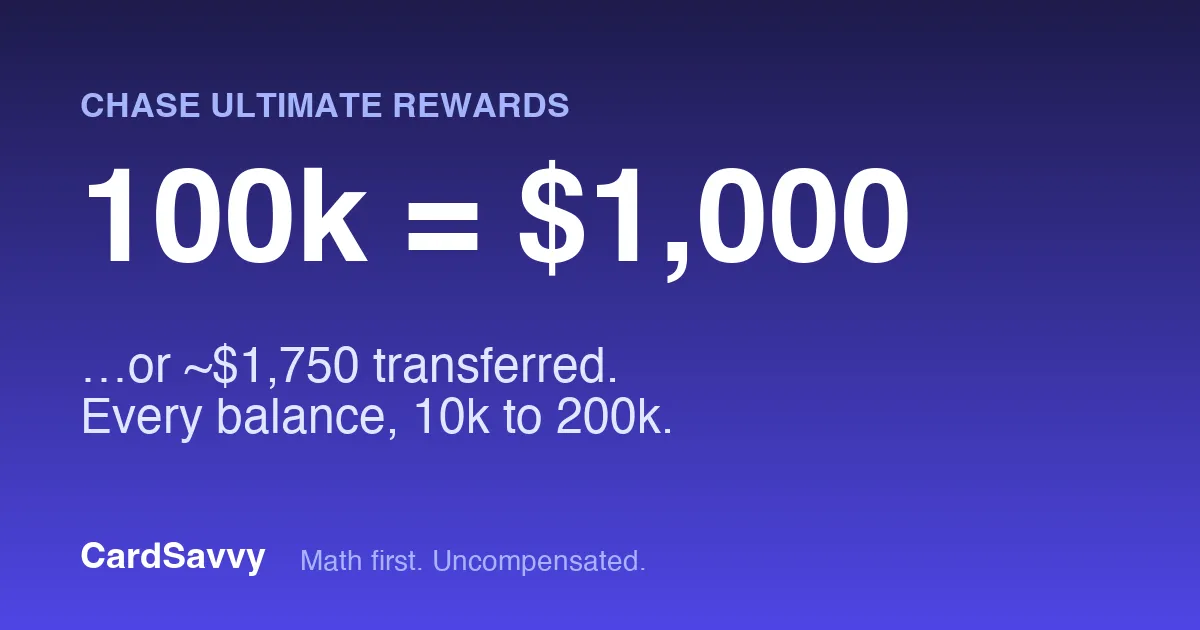
How Much Are Chase Points Worth? 10,000 to 200,000 Points in Dollars (2026)
100,000 Chase Ultimate Rewards points are worth $1,000 as cash, about $1,500 on a Points Boost booking, and about $1,750 transferred to a good airline or hotel award. Here is the dollar value of every common balance, and which card you need for each.
Get smarter with your cards
Math-first card strategy posts, sent when we publish — not on a schedule. No spam. Unsubscribe anytime.
We respect your inbox.
Ready to optimize your wallet?
Get personalized card recommendations and spending strategies in under 2 minutes.
Free to use. No signup required.
Get My Strategy →Just need an answer for one purchase? Best Card →